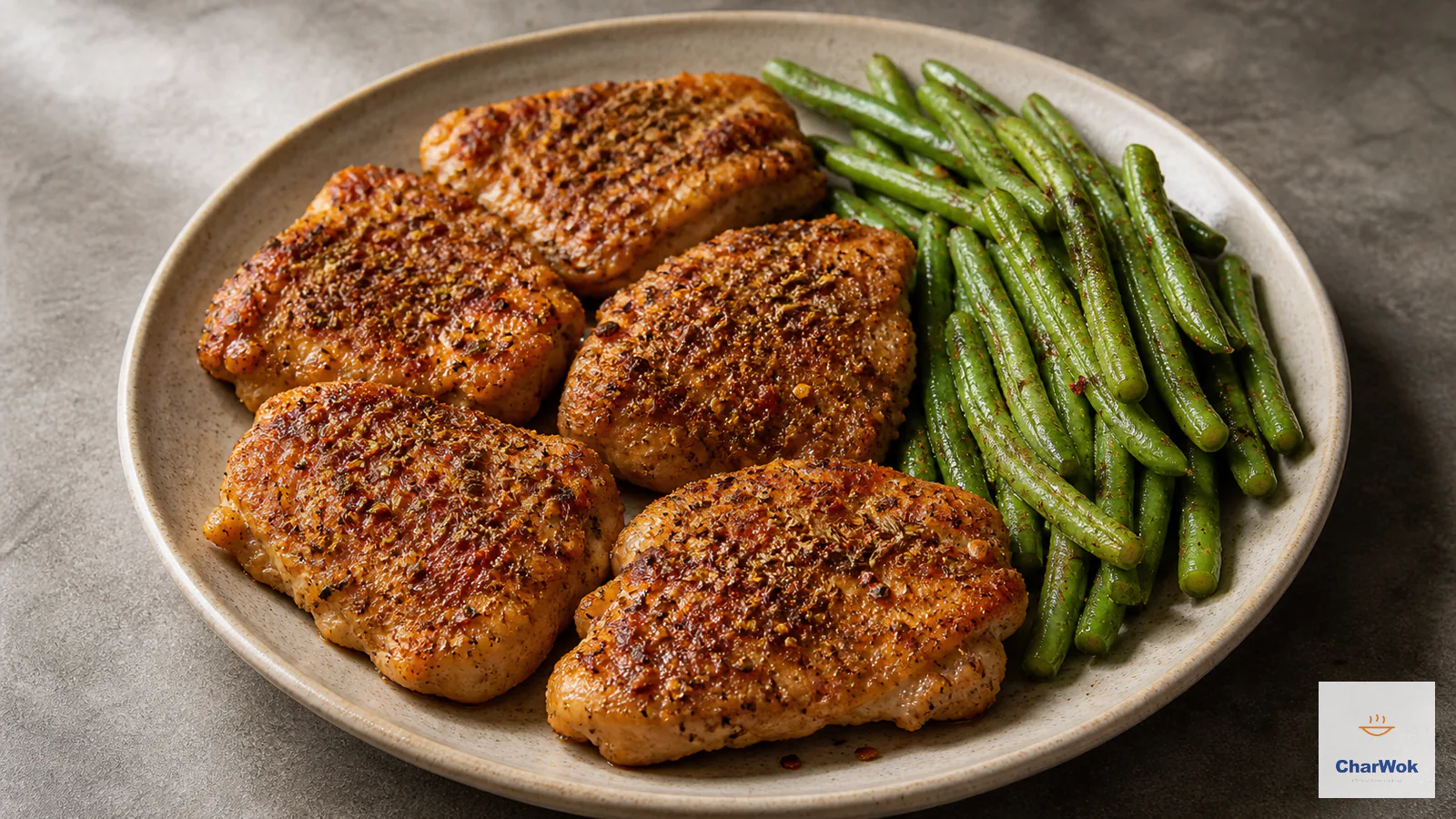
Cumin and chili, toasted dark, will make a kitchen smell like a night market grill in Xinjiang. That smoky, slightly sweaty aroma is the whole reason this dish exists, and the reason it migrated off lamb skewers and onto just about every protein in northern Chinese cooking. Here it lands on boneless chicken thighs, where the fat renders into the spice crust and you get crisp, mahogany edges without a drop of batter or a wok full of oil.
The flavor starts with cumin lamb skewers (yang rou chuan'r) from northwestern China. Chicken thighs offer enough fat to carry the spices while remaining practical for a skillet dinner. The important distinction is between spices that merely coat the meat and spices that bloom in hot fat until fragrant, without scorching.
Pan-fry the spice-crusted thighs skin-side down in a dry heavy pan, six pieces in a single layer, about 4 minutes on the first side and 2 on the second, then sizzle blanched green beans in the rendered fat. Cumin is the soul; chili is adjustable. Pull the chicken at 74°C / 165°F internal and do not crowd the pan.
Where this flavor comes from
Cumin is not native to the soy-and-ginger Chinese pantry of the eastern seaboard. It came west to east along the old trade routes and settled into the food of Xinjiang, Gansu, and Shaanxi, where it pairs with lamb, flatbreads, and hand-pulled noodles. You see it in the spiced beef flatbreads of the northwest and in the cumin lamb stir-fries that show up on northern family tables. The same seasoning, applied to chicken, is a home-cook shortcut, not a regional classic, and I think that is a feature rather than a flaw. It means there is no single authentic version to chase, only the question of how to make the spice taste like a grill instead of a spice jar.
If you want the full family in one meal, this chicken sits comfortably next to a bowl of cumin lamb hand-torn noodles or a plate of classic Xi'an dishes, and it borrows the same logic I use for cumin lamb stir-fry: bloom the dry spices in the heat of the pan so the volatile oils release before they have a chance to scorch.
Ingredients
Ingredients at a glance
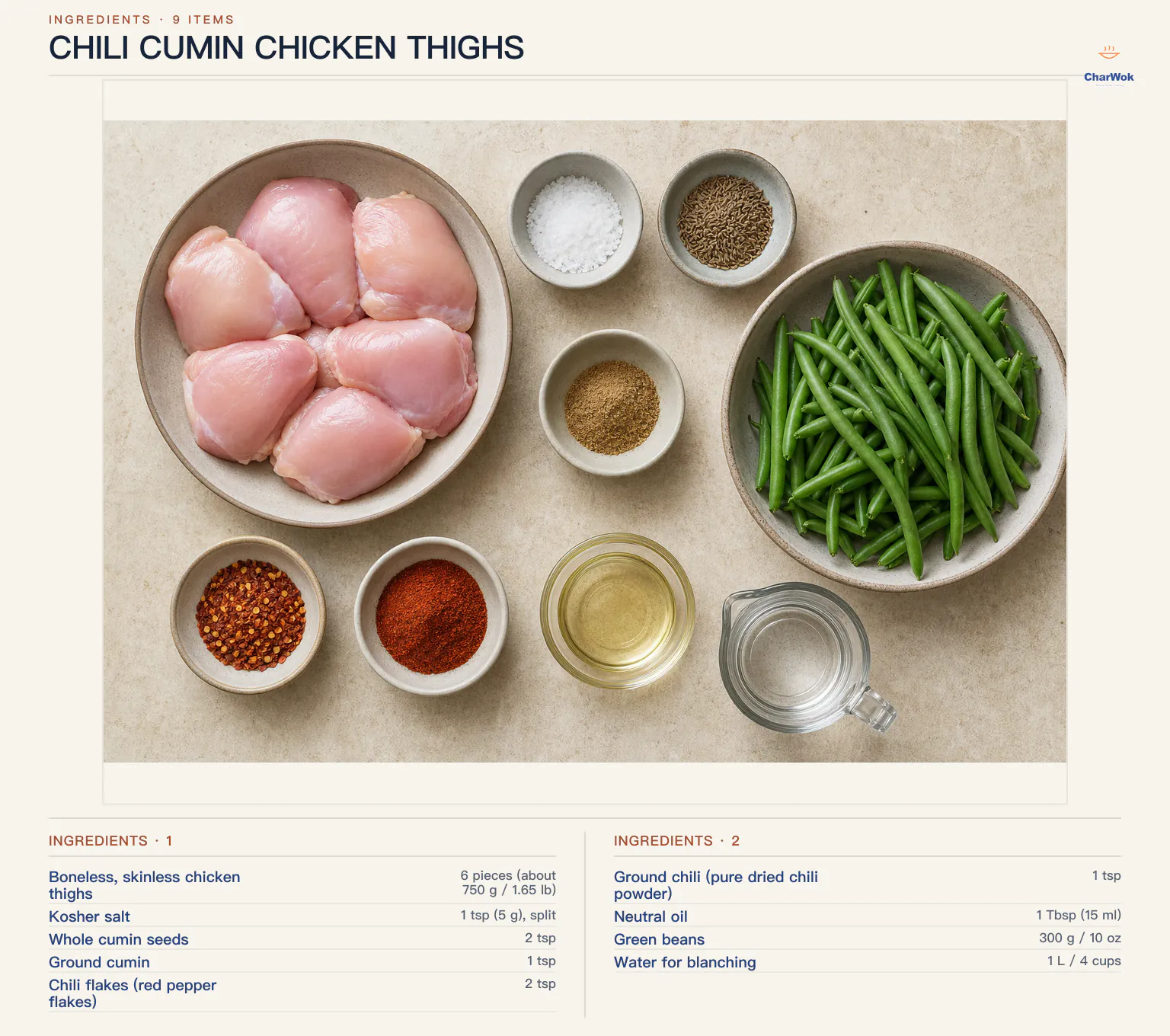
| Ingredient | Amount | Notes / substitute |
|---|---|---|
| Boneless, skinless chicken thighs | 6 pieces (about 750 g / 1.65 lb) | Thighs, not breast. The fat is what carries the spice and keeps the meat juicy. |
| Kosher salt | 1 tsp (5 g), split | ½ tsp for the marinade, ½ tsp for blanching the beans. |
| Whole cumin seeds | 2 tsp | Do not substitute all-powder. The whole seeds give the crunch and the visual. |
| Ground cumin | 1 tsp | Toasted fresh is dramatically better than a stale jar. |
| Chili flakes (red pepper flakes) | 2 tsp | Cut to 1 tsp for mild, push to 1 Tbsp if you want a real burn. |
| Ground chili (pure dried chili powder) | 1 tsp | Use plain ground chilies, not a chili-blend seasoning that already contains salt and cumin. |
| Neutral oil | 1 Tbsp (15 ml) | Canola, grapeseed, or peanut. Just enough to bind the spice to the meat. |
| Green beans | 300 g / 10 oz | Broccoli florets, asparagus, or snow peas also work; see notes below. |
| Water for blanching | 1 L / 4 cups | Bring to a full boil before the beans go in. |
Two ingredient choices matter most. Chicken thighs stay juicier in this dry sear; if you substitute breast, slice it into cutlets no thicker than 1 cm and still verify that every piece reaches 74°C / 165°F. Keep the whole cumin seeds and ground cumin separate: the seeds toast in the rendered fat for crunch, while the powder distributes an earthy base across the meat. The same seed-forward approach also works in Sichuan spicy peanuts and dry-fried green beans.
The method, with the why
This is a one-pan dish built around three ideas: a short marinade that is really a seasoning paste, a dry sear that renders the fat and toasts the spice, and a brief finish where the vegetable drinks up the spiced oil. Each step has one make-or-break detail.
- Season for 15 minutes under refrigeration. Toss the thighs with the salt, both cumin forms, both chili forms, and the oil. Cover and refrigerate while you prepare the beans. Keep the raw-chicken bowl and utensils away from cooked food, and wash hands and the work surface before handling the vegetables or serving plate.
- Blanch the beans until just underdone. Boil 1 L of water with ½ tsp salt, drop in the trimmed beans, and cook 2 to 3 minutes until they bend but still snap. Drain immediately. The point of the blanch is to soften the raw edge and set the green color; the beans will finish cooking later in the chicken fat. If you over-blanch now, they collapse into mush in the pan. Asparagus and snow peas skip this step entirely because they cook through in the sear.
- Sear in a dry, heavy pan, one layer only. Heat a cast-iron or heavy-bottomed skillet over medium for a good two minutes before the chicken goes in. Lay the thighs flat with space between them. Do not add oil; the spice paste already has a tablespoon, and the thighs will render their own fat within a minute. Crowding the pan drops the temperature and you end up steaming the crust off instead of frying it onto the meat. Cook in two batches if your skillet is small.
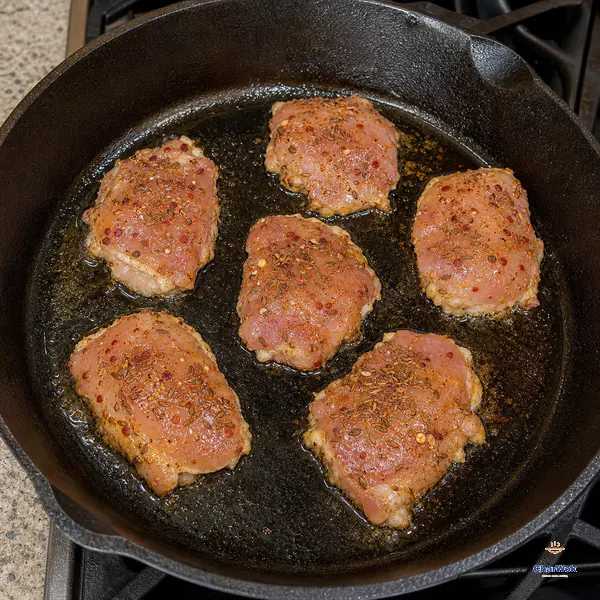
Preheat the heavy pan, then lay all six thighs flat in one uncrowded layer without adding oil; the marinade and rendered chicken fat are enough to fry on a crust instead of steaming the meat.
- Flip once, then begin checking. Leave the chicken alone for about 4 minutes, until the first side is golden and the cumin smells toasted. Flip and cook about 2 minutes more as a first check. Insert a clean instant-read thermometer into the thickest part of every thigh; each one must reach 74°C / 165°F.
- Finish the beans, then pass the temperature gate. Tilt the pan so the spiced oil runs to the empty side, add the drained beans, and sizzle for 2 to 3 minutes. If the beans are ready before the chicken, move them to a clean plate. Any thigh below 74°C / 165°F stays in the pan: lower the heat, cover, cook 2 to 3 minutes, clean the thermometer probe, and check every piece again. Serve only after every thigh passes the temperature check.
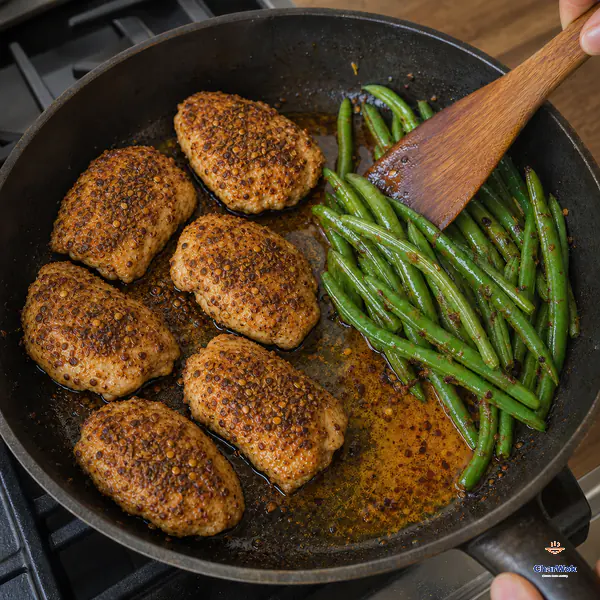
Sizzle the beans in the spiced fat, moving them to a clean plate if they finish first; check the thickest part of every thigh and serve only when each reaches 74°C / 165°F.
When it goes wrong, and how to fix it
The spice tastes raw and dusty. This means the cumin never got hot enough to toast. Two fixes: pre-toast the whole cumin seeds in the dry pan for 20 seconds before the chicken goes in, or hold the pan at a true medium so the seeds in contact with the metal actually darken. A pale pan temperature is the most common culprit.
The chicken is grey, not golden. The pan was either cold at the start or overcrowded. Preheat for two full minutes and cook in batches. Grey meat also means you flipped too early; let the first side develop real color before you turn it.
The chicken is dry. Thin breast cutlets and smaller thighs finish before thick pieces, so checking only the largest piece can leave the others cooking too long. Measure every piece and remove each one as soon as it reaches 74°C / 165°F; springiness, color, and elapsed time are texture clues, not safety tests.
The chili burned and turned bitter. Ground chili scorches faster than flakes. If your pan runs hot, drop the ground chili to ½ tsp and rely on the flakes for the bulk of the heat. Burnt chili cannot be rescued; start the spice paste over.
Variations and what to serve it with
On a plain weeknight, this chicken belongs over steamed jasmine rice with nothing else, and that is a complete meal. The spiced oil pools into the rice and you will not need a sauce. For something heartier, spoon the sliced chicken over egg fried rice, the way readers sometimes use leftover takeout proteins.
If you are feeding a crowd, slice the thighs into strips and pile them into freshly steamed bao buns with a smear of chili oil, or wrap them in the soft pancakes I use for Peking duck. The cumin crust reads almost like a filling rather than a topping, which is a trick that also works for mala chicken and Hunan chicken when you have leftovers.
For a different protein, the entire spice ratio drops straight onto lamb shoulder for a faster, skillet version of the skewers, or onto firm tofu pressed and torn into chunks. Tofu wants a slightly hotter pan and an extra teaspoon of oil because it has no fat of its own. Vegetable-wise, broccoli florets are the obvious swap for green beans, and cubed eggplant works if you salt and drain it first so it does not soak up every drop of oil.
Storage and reheating
Transfer leftovers to shallow covered containers and refrigerate within 2 hours, or within 1 hour when the room is hotter than 32°C / 90°F. Use within 3 to 4 days. Reheat chicken and beans to 74°C / 165°F throughout; a covered skillet with a spoonful of water helps prevent drying, but “steaming” or a fixed number of minutes is not the endpoint. For make-ahead prep, keep seasoned raw chicken covered on the lowest refrigerator shelf, separate from ready-to-eat food, and cook it within 1 day. See the USDA guidance for safe chicken handling and cooling and reheating leftovers.
Frequently asked questions
Can I use chicken breast instead? Yes. Slice it into cutlets no thicker than 1 cm and remove each piece as soon as its thickest part reaches 74°C / 165°F. Opacity alone is not a reliable safety test.
Do I need a wok? No. A flat, heavy-bottomed skillet actually works better here because you want a wide searing surface, not the deep walls of a wok. A cast-iron pan is ideal.
How spicy is this? With the recipe as written, it lands at a solid medium that most adults handle fine. Drop the flakes to 1 tsp and the ground chili to ½ tsp for a gentle version, or double both if you want it to bite back.
Can I skip the blanching step? Only if you swap to a quick-cooking vegetable like snow peas or asparagus. Raw green beans need that head start or they scorch before they soften in the pan.
Why both whole cumin seeds and ground cumin? The whole seeds give crunch and a hit of flavor when you bite into one, while the ground cumin spreads a baseline earthiness across the whole crust. Drop the whole seeds and the dish tastes one-dimensional.
How do I know every chicken thigh is safely cooked? Check the thickest part of every thigh with a clean instant-read thermometer. Each piece must reach 74°C / 165°F; if one is under, cover and continue cooking it for 2 to 3 minutes, clean the probe, and check again.