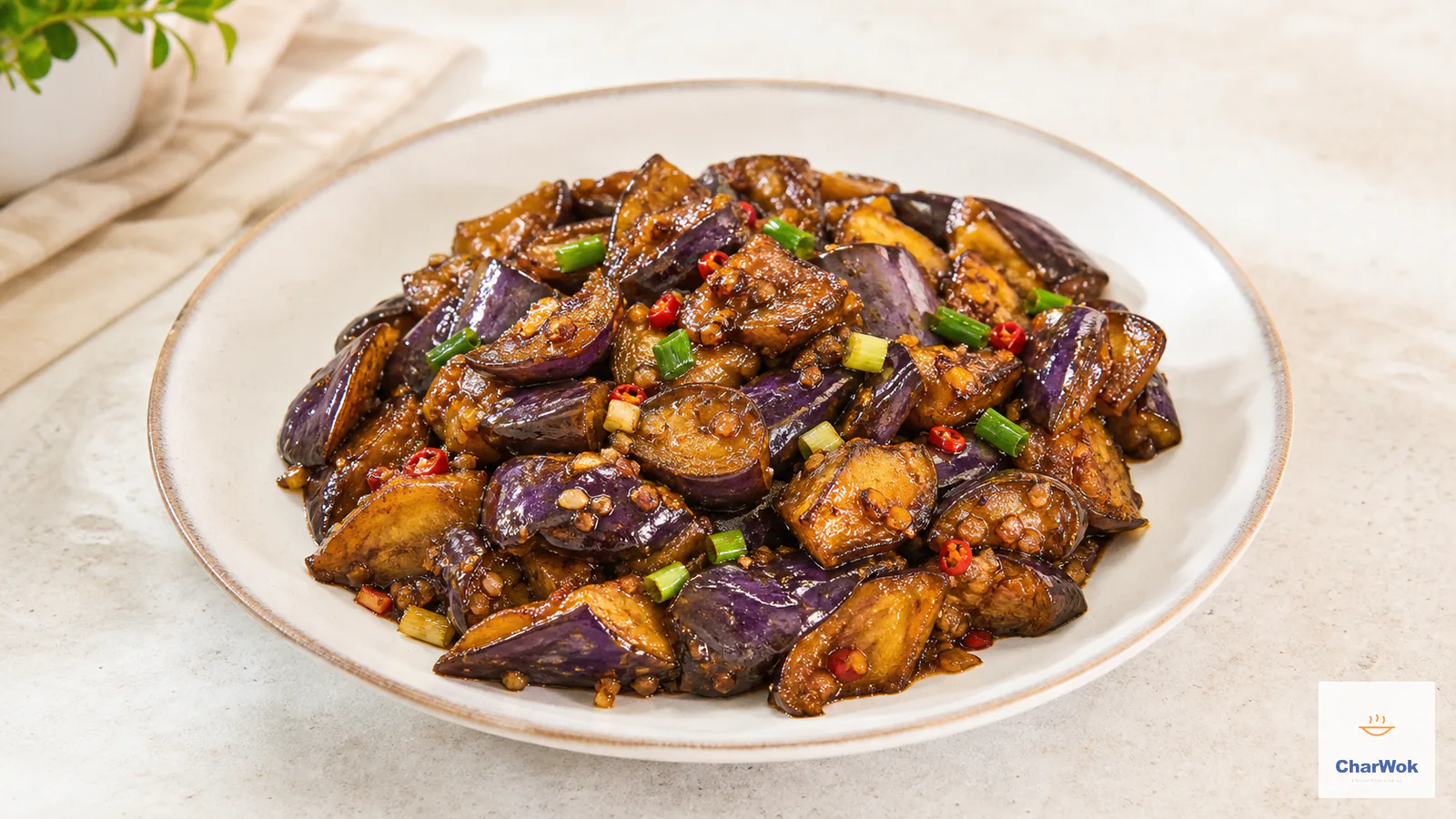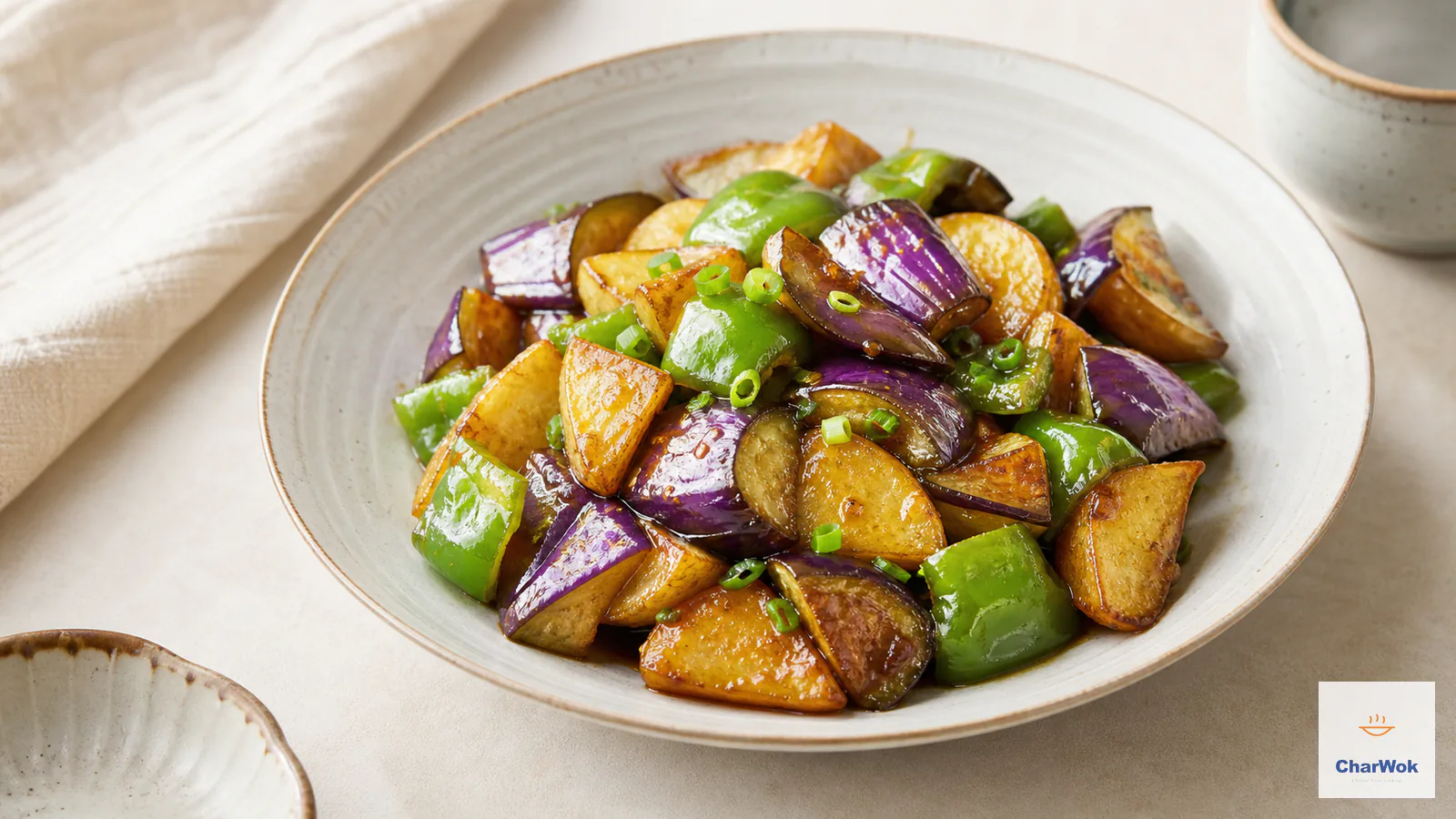
There is a particular disappointment in home eggplant cookery: the dish arrives at the table glossy and promising, then you bite in and the eggplant has gone brown, spongy, and greasy, sitting in a pool of oil it should never have drunk. Di San Xian, the northeastern Chinese stir-fry of eggplant, potato, and pepper, exists to prove that eggplant does not have to end up that way. Done right, each piece has a thin crust that gives to a creamy interior, and the three vegetables arrive at the table unified under a dark, glossy sauce that clings rather than pools.
My first few attempts failed in the way most first attempts do. I fried the eggplant naked, and it soaked up the entire pan of oil like a sponge. The potato, cut small, fell apart before the eggplant was done. The sauce, poured in hot, seized into translucent lumps the instant it hit the wok. None of those failures are random. Each maps to a single decision in the method, and once you know the reasoning behind the salt-and-cornstarch coat, the fry order, and the off-heat sauce pour, the dish becomes reliable. This recipe is built around those three decisions.
Three vegetables, one sauce, shallow-fried and finished hot. The whole dish hinges on two minutes: coat the eggplant in salt then cornstarch so it stops drinking oil, and pour the sauce off the heat so the cornstarch thickens into a glaze instead of lumps. About 22 minutes start to finish, serves two generously over rice.
Where the dish comes from
Di San Xian (地三鲜) translates literally as "three fresh flavors of the earth," and it is one of the best-known dishes of northeastern Chinese cooking, or Dongbei cuisine. That region, with its long winters and short growing season, built a food tradition around root vegetables, preserved greens, and hearty sauces borrowed from Shandong (Lu) cuisine, the oldest of China's eight major regional styles. What sounds like a plain vegetable medley is, in context, a clever answer to a problem: how do you make cold-storage eggplant and potato taste vibrant? You fry them hard, then bind them in a savory-sweet sauce.
The dish is fully plant-based by default, which makes it a natural for anyone looking for vegan Chinese cooking that does not feel like a compromise. It also sits comfortably next to bolder, meatier dishes, which is how it is usually served in a Dongbei home, as one of several sharing plates rather than a main. I often cook it alongside something like Mapo Tofu or a red-braised pork belly to balance a meal between bright vegetables and rich protein.
The three vegetables, and why each one matters
Eggplant
Use the long, slim Asian eggplant if you can find it. It has fewer seeds, thinner skin, and a sweeter, less bitter flesh than the large globe eggplant, and its narrow shape is ideal for the roll-cut you want here. Globe eggplant works, but pick a firm, glossy one with no dark seeds showing when you cut it open, since mature seeds are the main source of bitterness. If you are curious about how Asian and globe eggplant behave differently across dishes, my steamed eggplant recipe breaks that down.
Potato
Reach for a starchy potato: russet, Idaho, or a floury baking potato. The high starch content is the whole point. It browns into a crisp edge in the oil and then softens into a fluffy center that drinks in the sauce. Waxy potatoes hold their shape but never get that contrast of crust and fluff, so they are the wrong tool here. You are aiming for the same starchy, browning personality that makes five spice potatoes or a crispy potato pancake work.
Pepper
A green or red bell pepper is the standard, and any color works. In northeastern China you will also see large, fleshy mild green chiles used, which add a grassier, slightly hotter edge. The pepper's job is freshness and a little bitterness to offset the sweet, dark sauce. It cooks fastest of the three, so it goes in last among the frying steps. If you enjoy blistered peppers on their own, this is the same principle as tiger skin pepper, just taken a shade lighter.
Ingredients
Ingredients at a glance
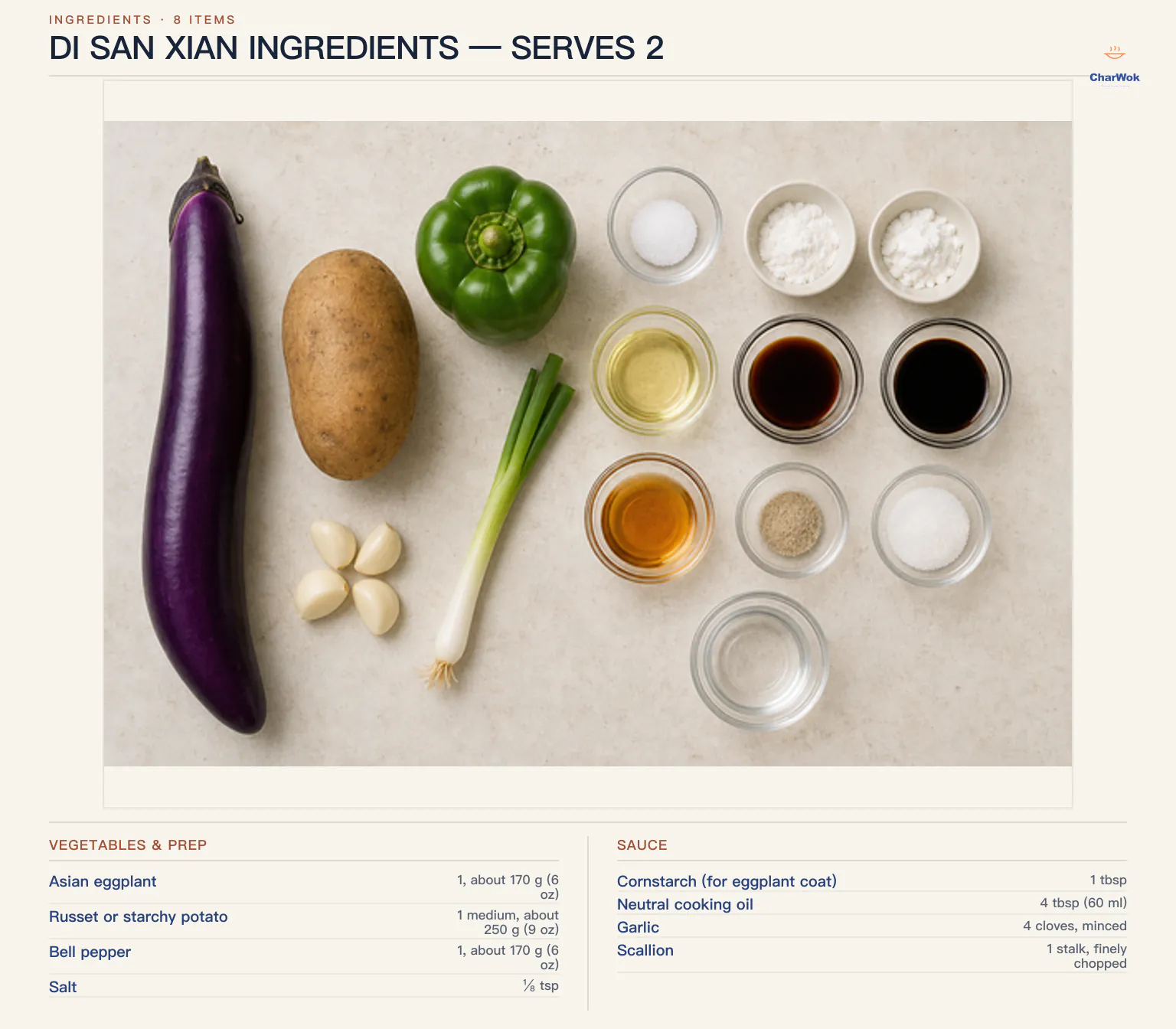
Serves two as a main over rice, or four as part of a multi-dish meal. The sauce quantities are tuned for a glossy coating, not a gravy; if you want more liquid to soak into rice, scale the water up by a tablespoon.
| Ingredient | Amount | Notes / substitute |
|---|---|---|
| Asian eggplant | 1, about 170 g (6 oz) | Globe eggplant works; pick firm, seed-free |
| Russet or starchy potato | 1 medium, about 250 g (9 oz) | Yukon Gold ok; avoid waxy red potatoes |
| Bell pepper | 1, about 170 g (6 oz) | Any color, or large mild green chile |
| Salt | ⅛ tsp | For drawing moisture from the eggplant |
| Cornstarch (for eggplant coat) | 1 tbsp | Potato starch works similarly |
| Neutral cooking oil | 4 tbsp (60 ml) | Canola, grapeseed, or peanut |
| Garlic | 4 cloves, minced | About 2 tsp minced |
| Scallion | 1 stalk, finely chopped | Green and white parts |
A note on the soy sauces, because they are not interchangeable here. Light soy sauce provides salt and the fermented, savory backbone. Dark soy sauce contributes the mahogany color and a faint caramel sweetness that defines the look of the dish. If you only have light soy sauce, the flavor will be fine but the dish will read pale and sharper; add a pinch more sugar to round it off. The Shaoxing wine can be swapped for dry sherry, but skip the wine entirely rather than substituting something sweet or salty.
Method
- Cut everything to a similar size using a roll-cut. Roll-cut the eggplant by slicing at a 45-degree angle, rotating the eggplant a quarter turn, then slicing again on the diagonal. This creates irregular facets with more surface area than straight cuts, which means more crust and more sauce-holding edges. Repeat the same cut on the peeled potato and the seeded pepper so all three cook in roughly the same time. Uneven sizing is the most common reason one vegetable overcooks while another stays raw.
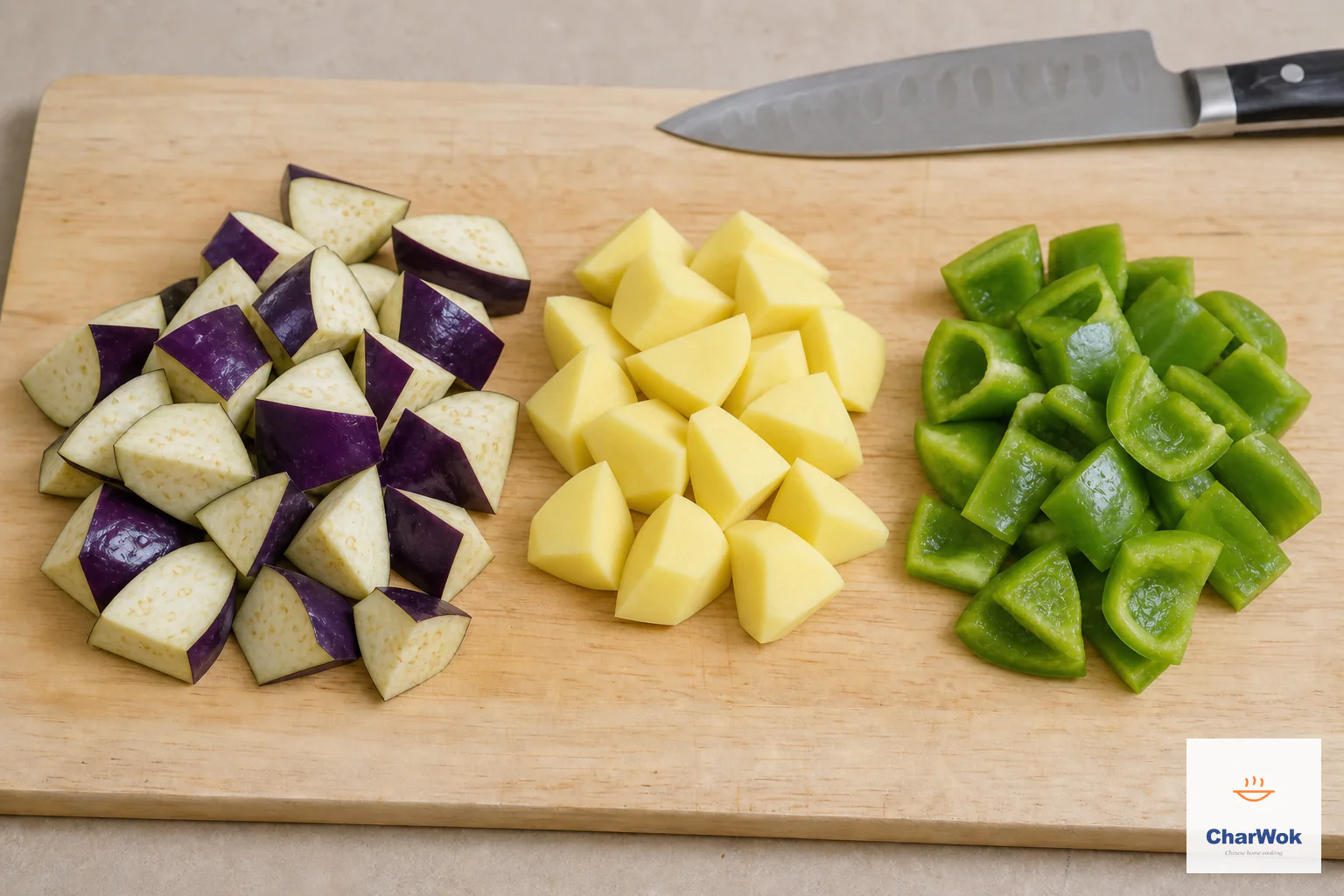
Roll-cut the eggplant, then cut the potato and pepper into similarly sized pieces so all three vegetables cook and coat evenly.
- Salt the eggplant, wait five minutes, then coat in cornstarch. Spread the eggplant pieces out, sprinkle the salt over them, and let them sit until beads of moisture appear on the surface. Then add the cornstarch and toss with your hands until every piece is evenly dusted. This is the make-or-break step. Eggplant flesh is a sponge of air pockets; salting collapses those cells and draws out water, and the cornstarch forms a barrier that crisps in the oil instead of letting it soak in. Skip this and you will pour cup after cup of oil into the pan.
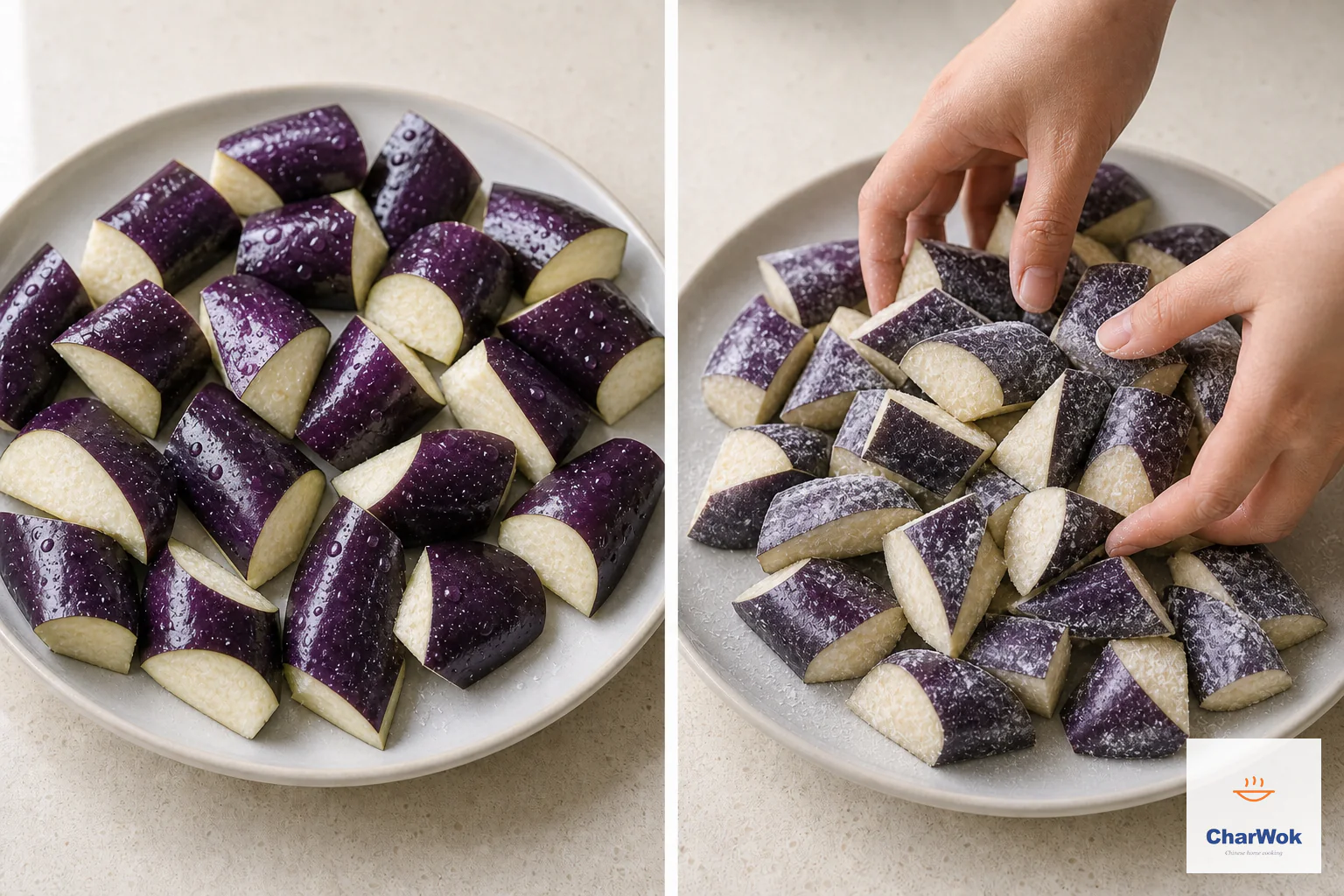
Salt the eggplant for 5 minutes, blot the released moisture, then apply a thin cornstarch coat rather than a heavy batter.
- Mix the sauce and set it beside the stove. Stir the soy sauces, wine, cornstarch, white pepper, sugar, and water together in a small bowl. Cornstarch sinks fast, so plan to stir it again right before you use it; a settled layer is what causes lumps later.
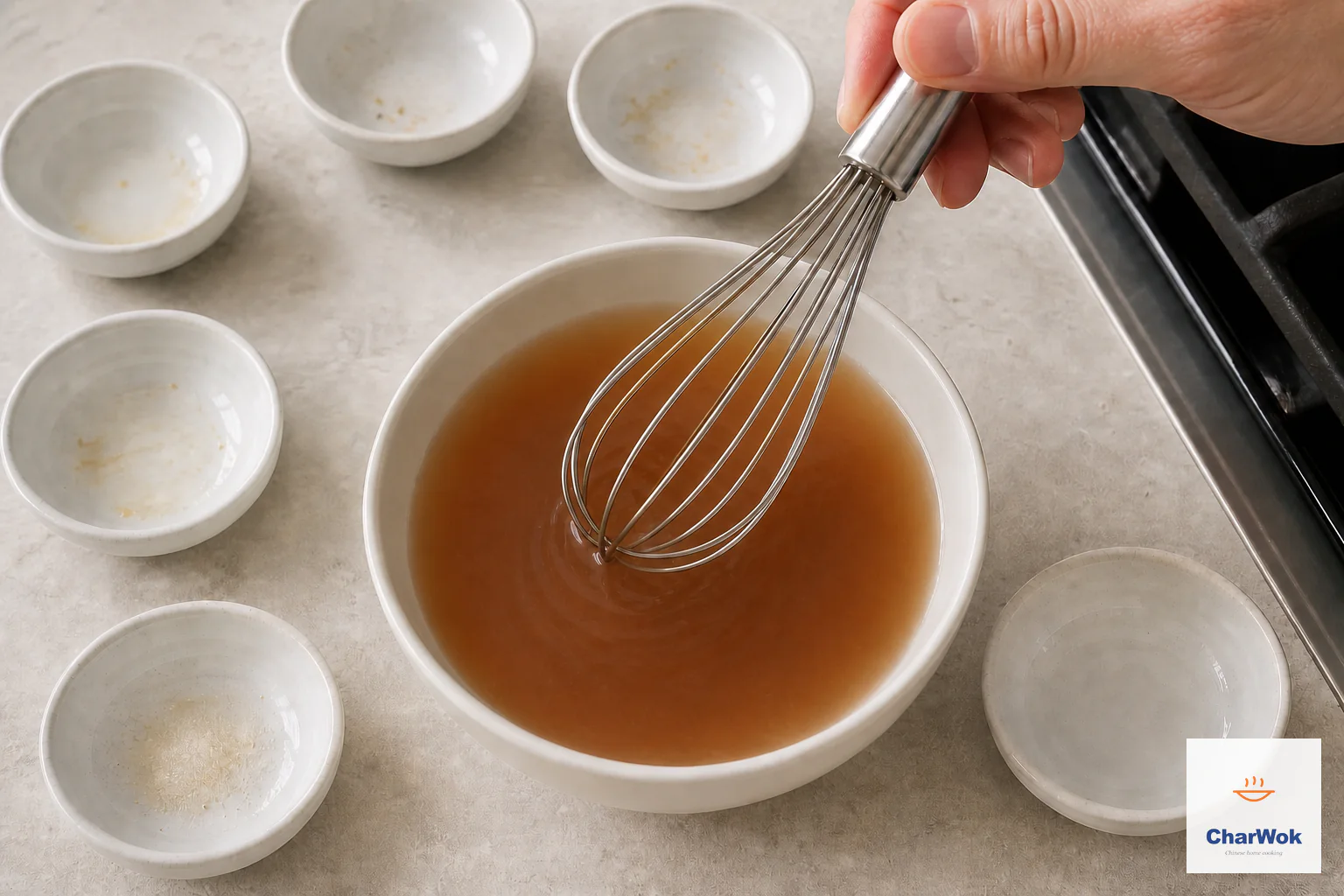
Whisk the seven sauce ingredients until smooth and watery, then stir again immediately before pouring because the cornstarch settles.
- Fry the potato first, over medium heat. Heat the oil in a wok or wide skillet over medium. Add the potato and turn the pieces every minute or two so they brown on more than one face. You want a pale golden crust and a knife-tender center, about 6 to 8 minutes. Lift them out to a rack or paper-towel-lined plate. The goal is gelatinized starch at the surface that will hold the sauce; if the potato is still hard in the middle, it will never soften in the final toss.
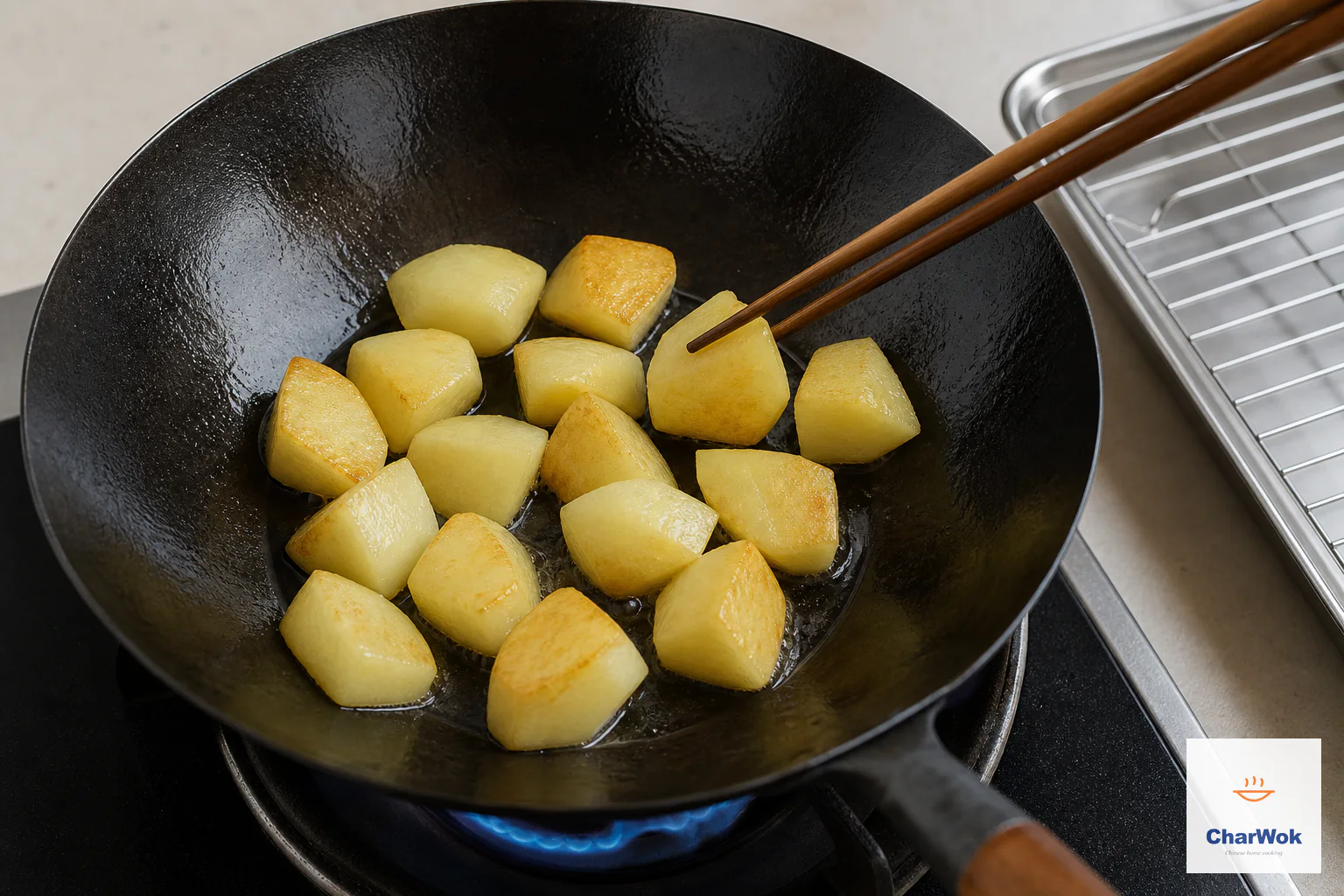
Fry the potato over medium heat for 6 to 8 minutes, stopping at pale gold when a chopstick slides through without resistance.
- Fry the pepper next, just until the skin blisters. Drop the pepper into the same oil and fry one to two minutes, until the skin puckers and chars in spots. Remove it immediately. Pepper collapses into mush if you push past a blister, so err on the short side.
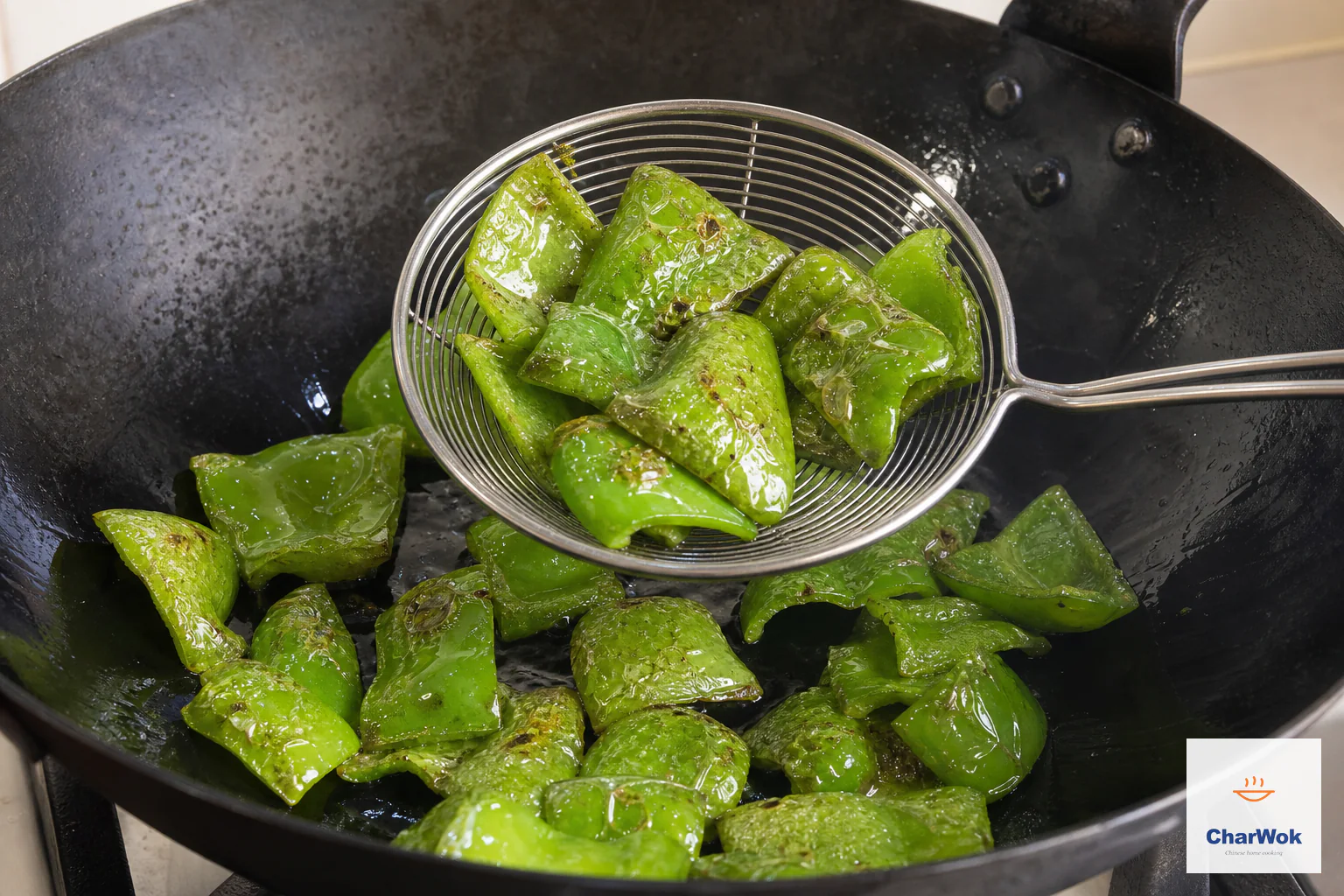
Fry the pepper for only 1 to 2 minutes: look for a few blisters while the pieces stay bright, firm and not collapsed.
- Crank the heat and fry the eggplant last. Raise the heat to high, add the eggplant, and fry until the cornstarch coating turns golden and the pieces feel light rather than heavy with oil, about 3 minutes. High heat sets the starch crust quickly before the interior can absorb fat. Transfer out and drain.
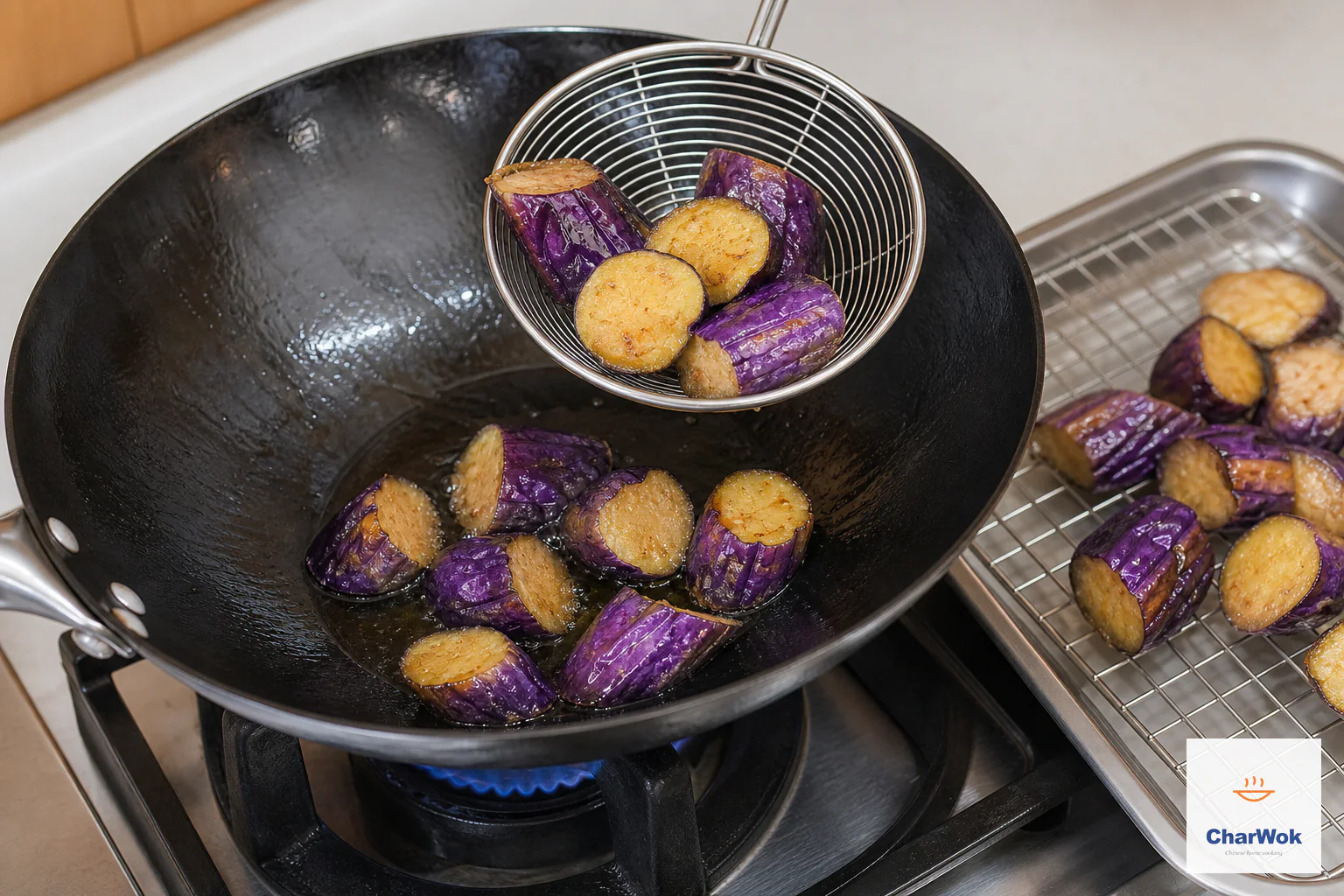
Fry the coated eggplant over high heat for about 3 minutes, just until a thin golden crust forms, then drain promptly.
- Deglaze the pan with aromatics, off the heat for the sauce. Pour off all but a thin film of oil. Return the pan to low heat, add the garlic and scallion, and let them sizzle gently until fragrant, about 20 seconds. Now the trick: take the pan off the flame, give the sauce one final stir, pour it in, and immediately swirl with a spatula. The cornstarch thickens the moment it hits the hot metal, and pulling the pan off the heat slows that reaction so the sauce stays smooth and glossy. Move fast.
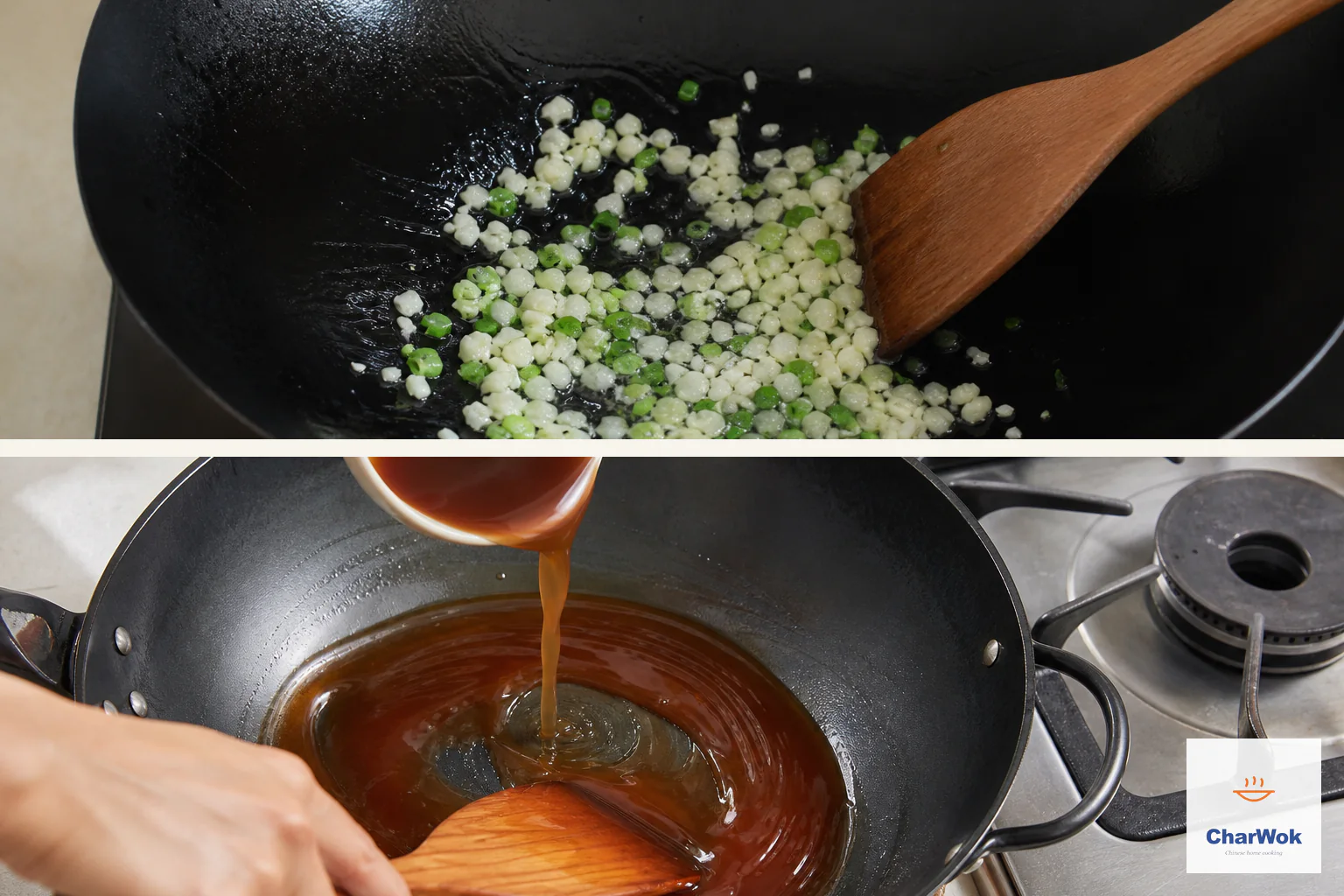
Bloom garlic and scallion over low heat for about 20 seconds. Move the wok completely off the flame before pouring and stirring the sauce so it thickens smoothly without scorching.
- Return the vegetables and toss to coat. Tip the potato, pepper, and eggplant back in and toss over low heat for 20 to 30 seconds, just until every piece is wrapped in the sauce. Prolonged cooking here makes the crusts soggy, so stop the moment the glaze is evenly distributed. Serve at once over steamed jasmine rice.
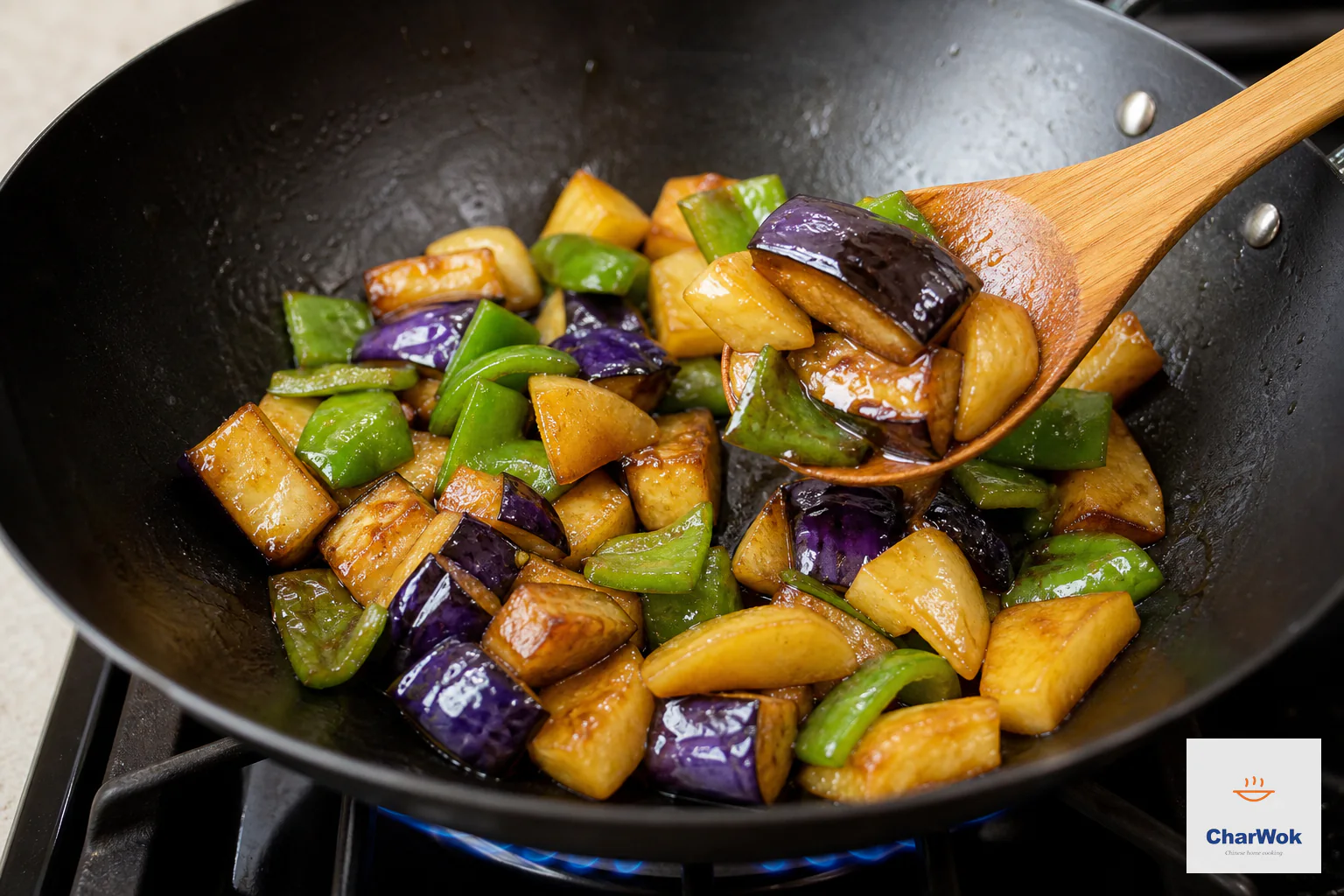
Return all three vegetables and toss over low heat for 20 to 30 seconds; stop as soon as every piece is lightly coated and no sauce puddle remains.
When it goes wrong, and how to fix it
Most failures fall into one of four buckets, and each has a clear cause.
The eggplant came out greasy and brown
The cornstarch coat failed or the oil was not hot enough. The coating needs to hit hot oil immediately to set, so the pan should be shimmering but not smoking when the eggplant goes in. If you see the cornstarch sloughing off, you skipped or shortened the salting step, and the wet flesh had nothing for the starch to bind to. Next time, salt for the full five minutes and dust more heavily.
The sauce turned lumpy
The cornstarch had settled, or the sauce hit a screaming hot pan. Cornstarch gels at around 60 to 70 degrees C, and a too-hot surface seizes it into clumps before it can disperse. The fix is preventive: stir the bowl, pull the wok off the heat, pour, and swirl. If it has already lumped, add a tablespoon of warm water and whisk vigorously off the heat; you can usually rescue it.
The potato is hard in the middle
It was either too large or fried too briefly at too high a heat, so the outside browned before the inside cooked. Cut the next batch smaller, drop the oil temperature a notch, and test a piece by pressing it with a spatula; it should yield with slight resistance, not snap.
The vegetables went soft by the time they hit the table
You let them sit in the sauce too long at the end. The glaze is a finish, not a braise. Twenty to thirty seconds of tossing is all the crust can take before it dissolves. Plate the dish the instant it is coated.
Variations and pairings
The classic is unbeatable, but the framework is flexible. For a hotter version, add a chopped red chile with the garlic, or finish with a spoonful of chili oil stirred in off the heat. For a sweeter, more glaze-forward dish that leans toward the eggplant with plum sauce family, add an extra ½ teaspoon of sugar and a teaspoon of black rice vinegar to the sauce. You can also fold in a handful of wood ear mushroom or rehydrated shiitake for texture, which nudges the dish toward a heartier one-plate meal.
To build a full Dongbei-style spread, pair it with a crunchy cold vegetable like hot-and-sour napa cabbage, a clean green such as broccoli with garlic sauce, and a protein. The eggplant-and-garlic flavor family is wide; if you enjoy this dish, the same sauce logic powers eggplant with garlic sauce (Yu Xiang Qiezi), which is worth learning next.
Storage and reheating
Di San Xian is a dish that loses something every minute it sits, because the crust softens against the sauce. I cook it to order when I can. Leftovers keep in the fridge for two days and reheat best in a dry skillet over medium-high heat, tossing just until warmed through; the microwave turns the eggplant rubbery. Do not freeze it, as the potato breaks down into a grainy texture on thawing.
Frequently asked questions
A few questions that come up often when cooking this dish at home.
Can I bake or air-fry the vegetables instead of shallow-frying? Yes. Toss each vegetable in a little oil and roast at 220 degrees C (425 F), adding the potato first, the eggplant after 10 minutes, and the pepper for the last 5 minutes. You lose some crunch but cut the oil sharply.
Do I have to peel the potato? I peel it for the cleanest crust, but unpeeled works if you scrub it well and like the earthier flavor; just cut a touch smaller so it cooks through.
Is there a gluten-free version? Use tamari instead of the soy sauces, replace the Shaoxing wine with a gluten-free dry sherry or omit it, and confirm your cornstarch is pure. The thickening and glazing behave identically.
Why roll-cut instead of straight cubes? The angled facets create more surface area per piece, which means more crispy crust and more places for the sauce to cling. Straight cubes work but produce a blunter texture.