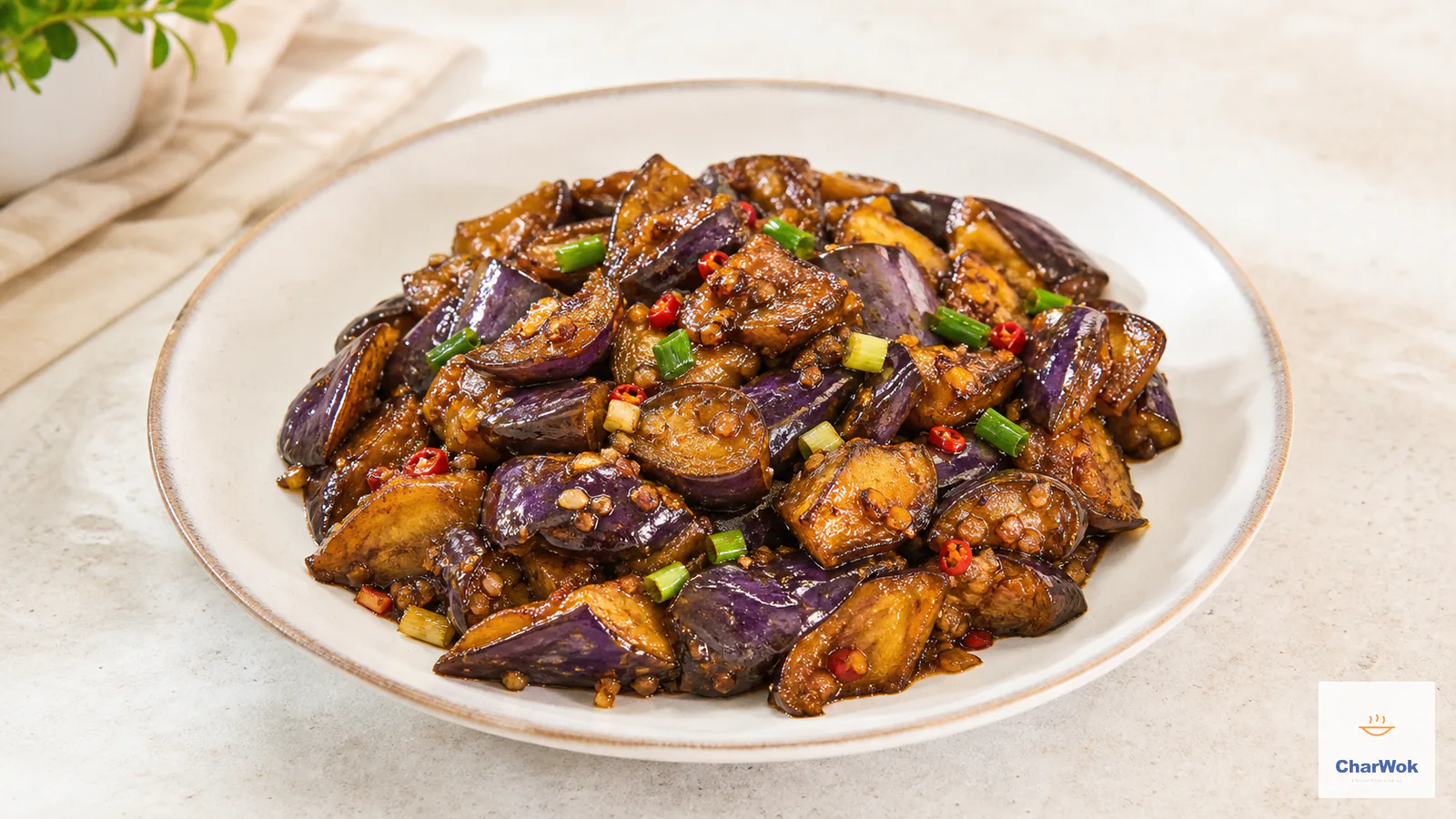
Eggplant is the vegetable that taught me humility. I spent years producing rubbery, oil-slicked wedges that nobody wanted seconds of, and I assumed the dish simply required a deep fryer I did not own. Then I learned the one move that fixes everything: soften the eggplant before the wok ever gets hot. Once the flesh is already tender, the stir-fry only needs about a tablespoon of oil to glaze, char, and carry flavor. That is the entire trick behind stir-fried eggplant with plum sauce, a Cantonese-leaning home dish where creamy, collapsed eggplant meets a sweet-sour plum glaze and a heavy hand of garlic.
Soften the eggplant first (3 to 4 minutes steamed, or a quick run in the microwave), then just a tablespoon of oil and about 90 seconds over high heat give you silky, glossy eggplant in a clingy sweet-sour plum glaze. The whole thing comes together in about 10 minutes.
Why eggplant eats up so much oil (and how to stop it)
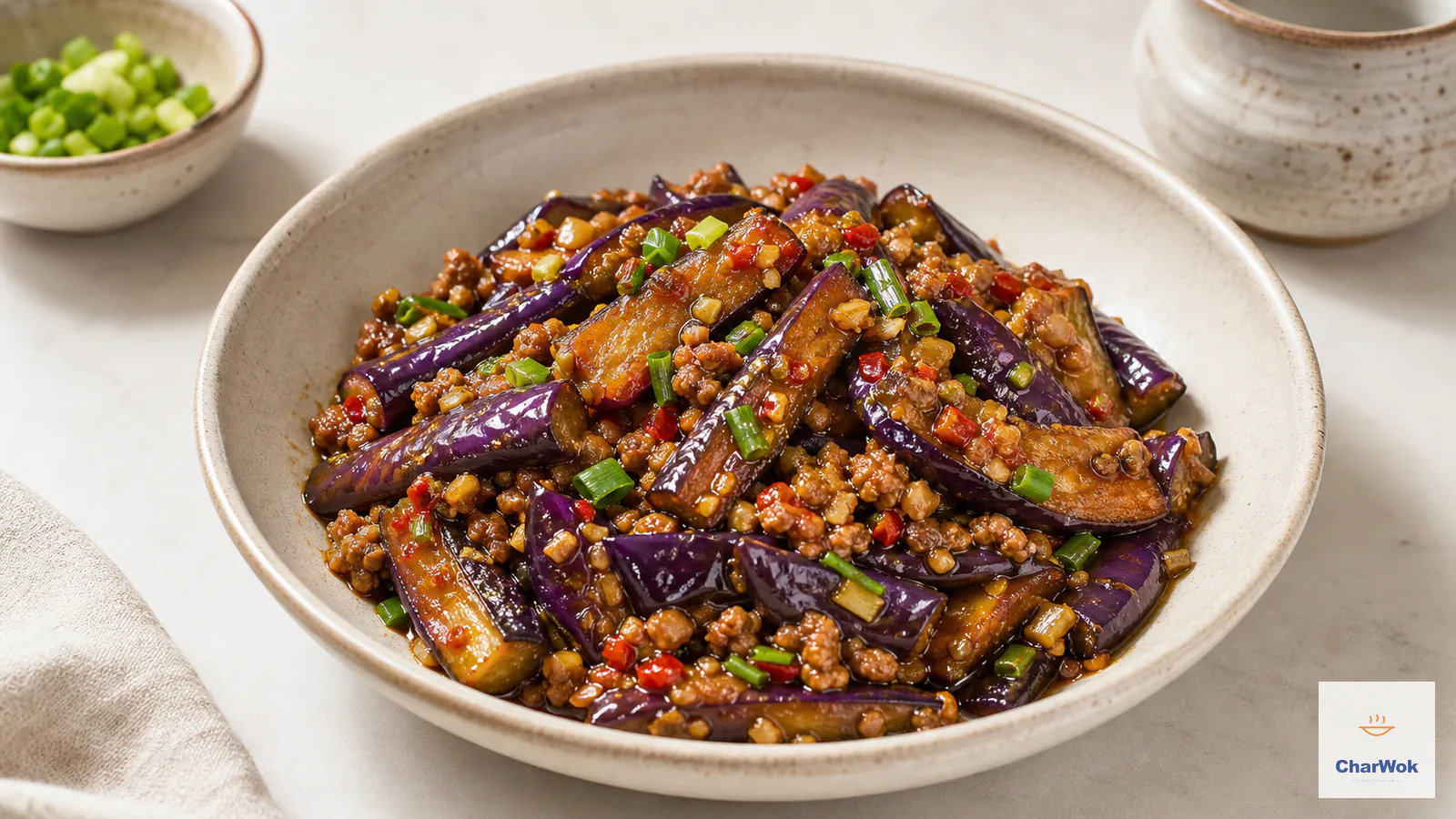
Raw eggplant is a sponge. Its cell walls are full of air pockets, and when you drop it into a hot pan with oil, those pockets collapse and drink up every drop you gave them, then ask for more. That is why restaurant eggplant dishes like eggplant with garlic sauce or the northeastern classic Di San Xian traditionally get a pass through the deep-fryer: the oil seals the outside fast and the inside steams in its own moisture, so the pieces come out creamy instead of greasy. The home cook's problem is that this costs a liter of oil and fills the kitchen with spatter.
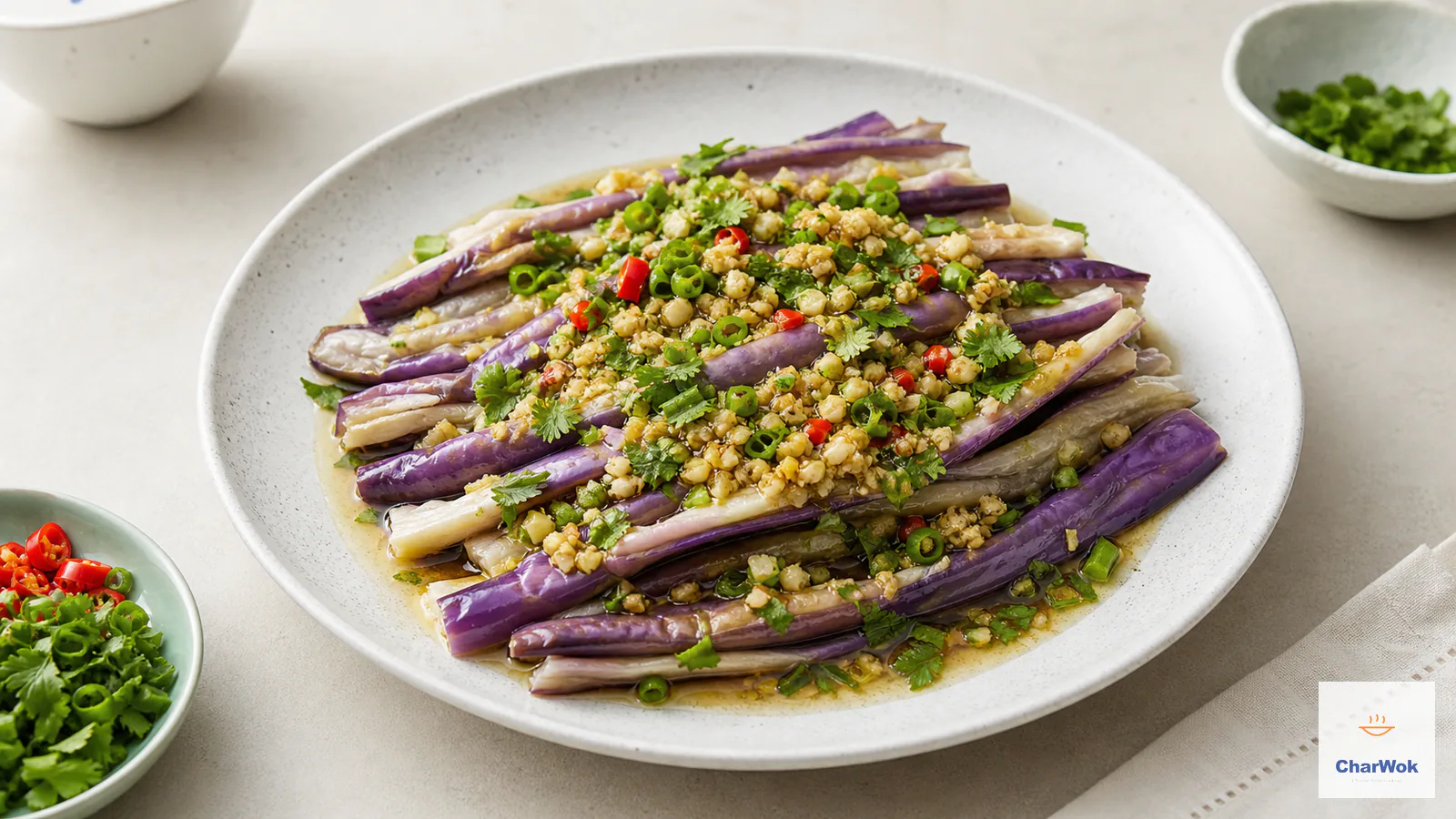
The workaround is to collapse those air pockets with water instead of oil. Steam or microwave the cut eggplant until it is just yielding, and its structure changes. It will no longer soak up oil; it will only take on what it needs to brown. You lose nothing in texture, and you gain a pan that is manageable. I now use this pre-cook step for nearly every eggplant stir-fry, including the chili-oil dressed steamed eggplant salad that lives in my summer rotation.
A quick word on plum sauce
Chinese plum sauce (sometimes labeled su mei jiang, 苏梅酱) is a thick, jammy condiment made from salted plums, vinegar, sugar, ginger and chili. It reads sweet on the spoon, but the acidity does the heavy lifting in a hot pan. You will most often see it in a dish next to crispy spring rolls, where it works as a dip. Here, thinned with soy and rice wine, it becomes a glaze that balances eggplant's mild, buttery flavor. If you keep a well-stocked Chinese pantry you may already have it; it is one of the condiments worth keeping on hand for exactly this kind of fast weeknight vegetable.
Brand matters a little. The Lee Kum Kee jar most American supermarkets carry is fine and reliable. If you find a thinner sauce, you will need to add less water in the glaze. If yours is very sweet, balance it with an extra few drops of black rice vinegar at the end.
Ingredients
Ingredients at a glance
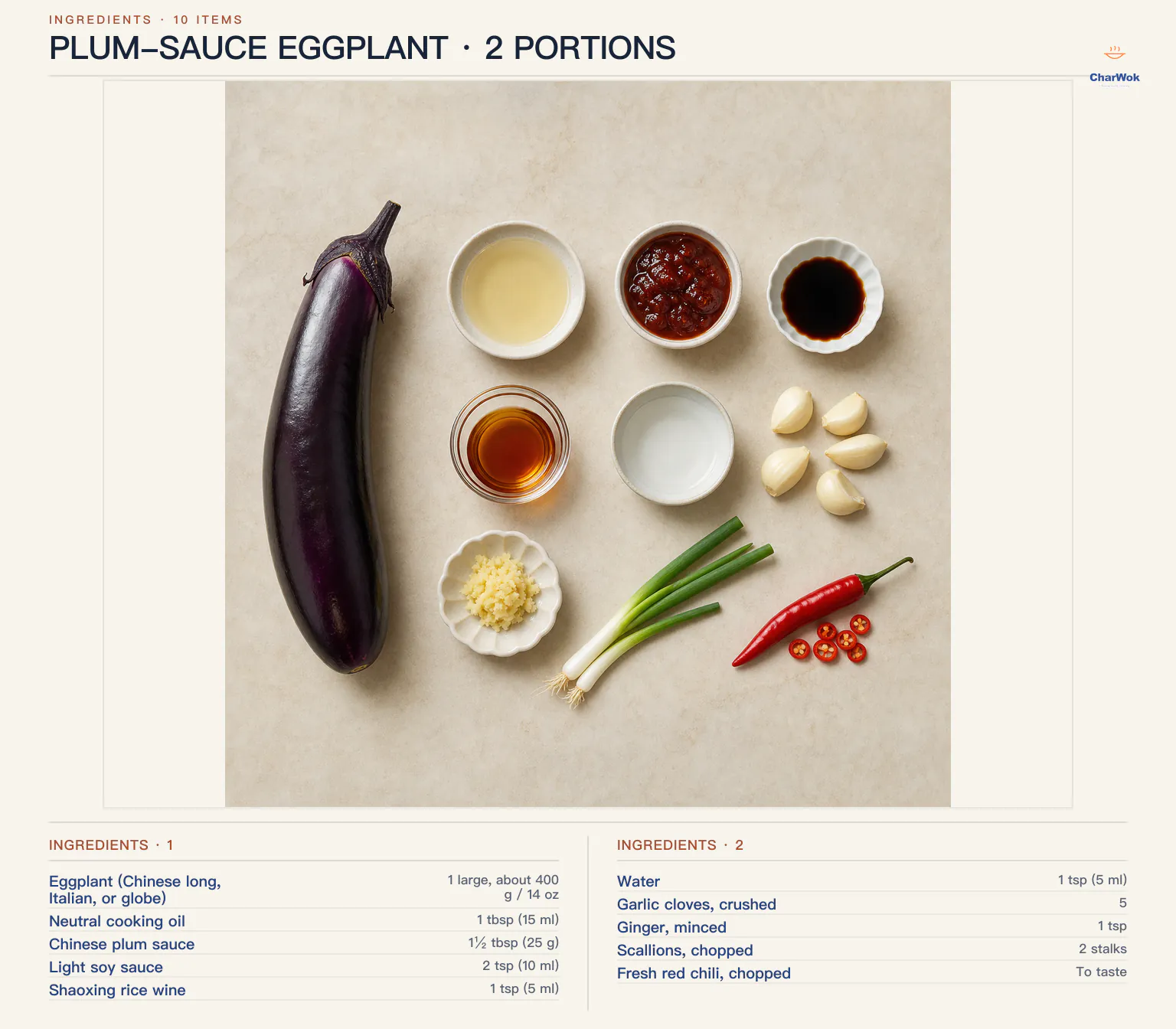
| Ingredient | Amount | Notes / substitute |
|---|---|---|
| Eggplant (Chinese long, Italian, or globe) | 1 large, about 400 g / 14 oz | Chinese (long, slim) eggplants are less bitter and need no salting. Globe (fat, round) works if you peel or salt it 15 min first. |
| Neutral cooking oil | 1 tbsp (15 ml) | Canola, peanut, or grapeseed. Not olive oil, which smokes at stir-fry heat. |
| Chinese plum sauce | 1½ tbsp (25 g) | If unavailable, mix 1 tbsp apricot preserves + ½ tsp Chinese mustard + a few drops vinegar as a rough stand-in. |
| Light soy sauce | 2 tsp (10 ml) | Light, not dark. See light vs. dark soy for why. |
| Shaoxing rice wine | 1 tsp (5 ml) | Dry sherry substitutes cleanly. Skip the salt-labeled "cooking wine." |
| Water | 1 tsp (5 ml) | Just to loosen the glaze. Add more by the half-teaspoon if your plum sauce is thick. |
| Garlic cloves, crushed | 5 | Crushed, not minced. Crushed gives you aromatic oil without burning to bitterness in seconds. |
| Ginger, minced | 1 tsp | |
| Scallions, chopped | 2 stalks | Split white and green parts; whites go into the pan, greens finish the dish. |
| Fresh red chili, chopped | To taste | Optional but I always add it. Bird's-eye or Fresno both work. |
How to make it
Serves 2 as a side. Total time about 10 minutes, including the pre-cook. Serve over freshly steamed jasmine rice.
- Cut the eggplant into irregular chunks, about bite-size. Keep the skin on; it holds the pieces together once the flesh softens. If you are using a fat globe eggplant and want to be safe, toss the chunks with ½ tsp salt and let them sit 15 minutes, then blot dry. This pulls out bitter juice and is a belt-and-braces move I personally skip with smaller eggplants.
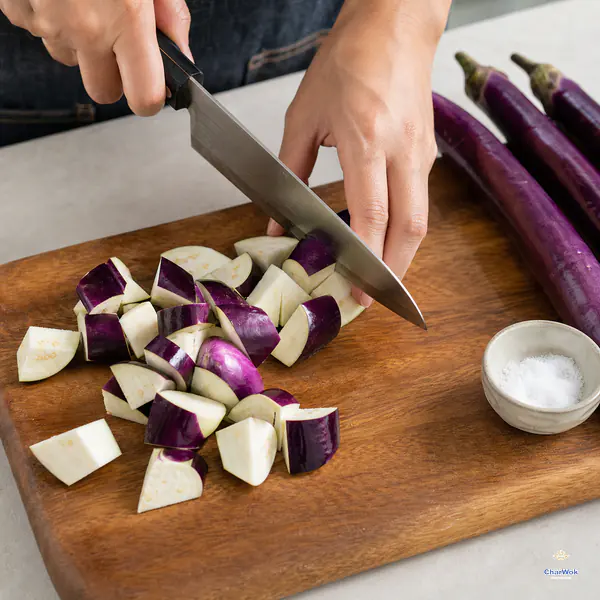
Cut the eggplant into evenly sized irregular chunks and keep the skin on so each piece holds together after softening.
- Pre-cook the eggplant (choose one method). Steam: bring water to a full boil in your steamer, add the chunks, cover, and steam 3 to 4 minutes, just until a knife slides in with slight resistance. Tip out any pooled water. Microwave: lay out one portion of the chunks on a plate with space between them, and give them 2 minutes at full power. Because they need breathing room to soften evenly rather than stewing in their own steam, work in two rounds rather than piling the whole batch on at once. The microwave version is less watery, which is why I prefer it. Either way, do not walk away. Overcooked eggplant collapses into stringy mush, and there is no fixing it. (The 2-minute time assumes an 800-watt oven; a higher-wattage model will be faster, a lower one slower.)
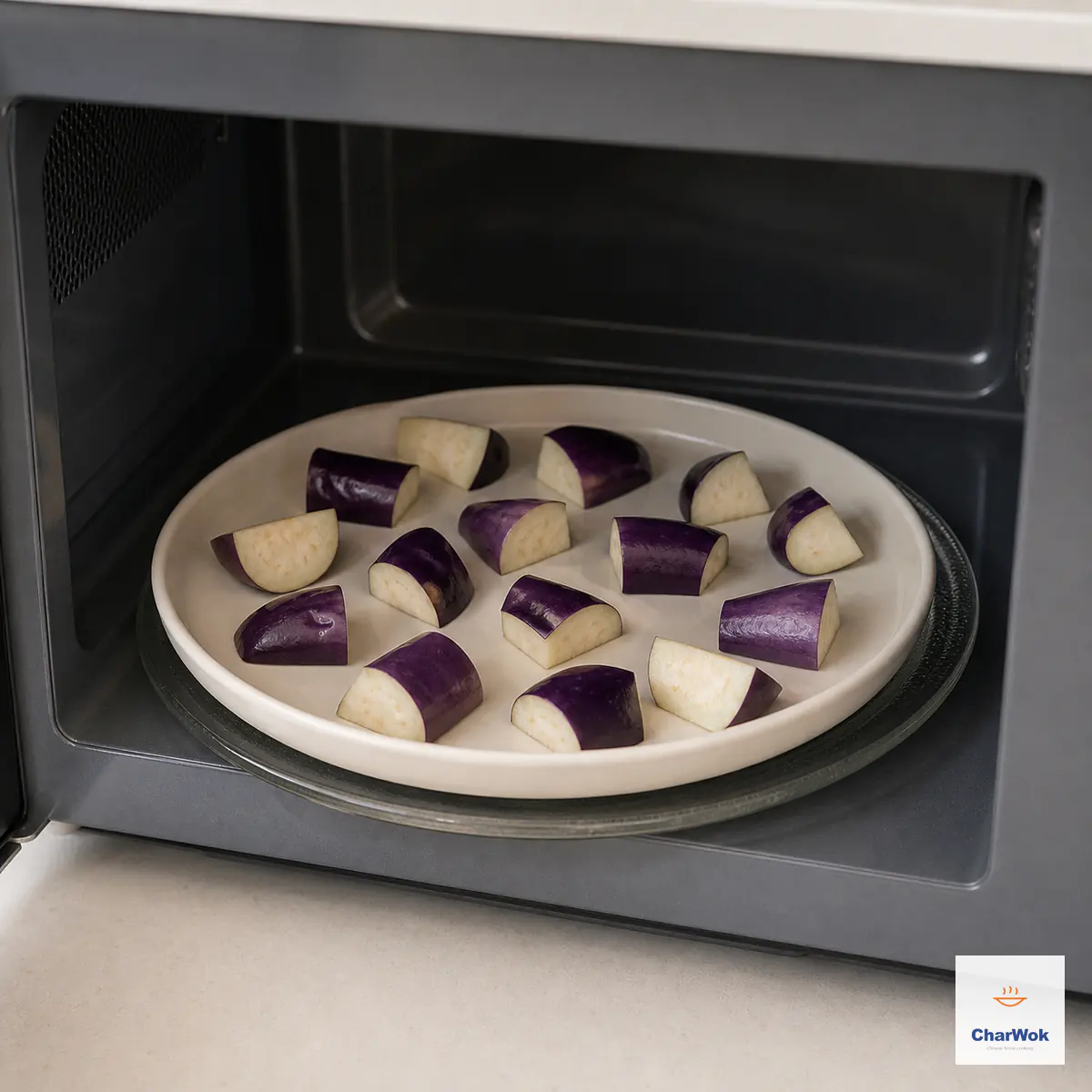
Microwave one uncrowded layer at a time so the chunks soften evenly without collapsing or steaming in pooled water
- Mix the glaze. In a small bowl, combine the plum sauce, light soy, rice wine, and that teaspoon of water. Plum sauce is stubbornly thick, so whisk patiently until the liquids surrender and you have a smooth, pourable glaze. Leave it within reach of the wok. (If you want to deepen the flavor, add ¼ tsp toasted sesame oil at the end, never in the hot wok, where heat kills its aroma.)
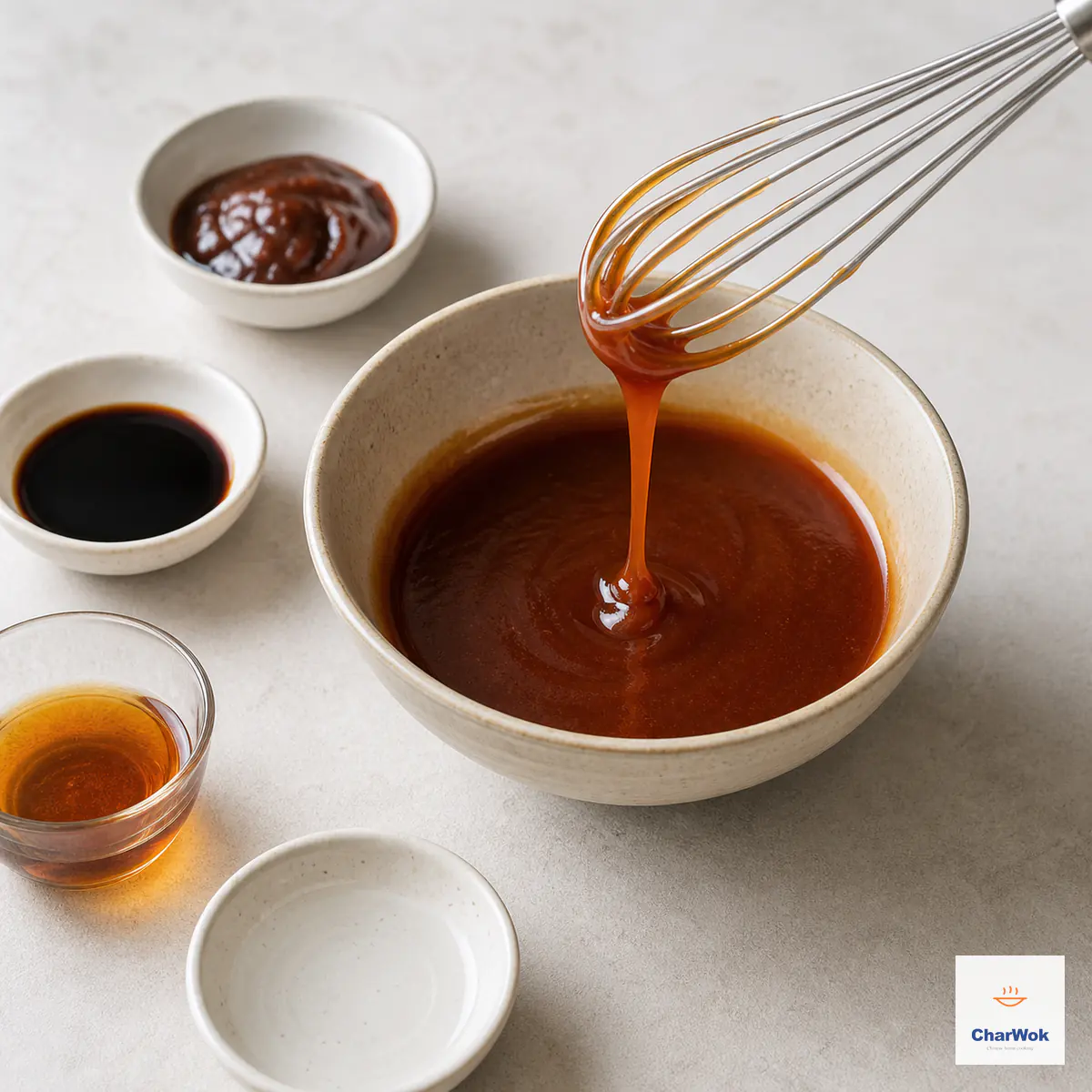
Whisk the plum sauce, light soy, Shaoxing wine, and water until the glaze is completely smooth and pourable
- Sear the aromatics, then the eggplant. Get your wok (or a wide skillet) ripping hot, just shy of smoking. Pour in the oil and swirl it around, then drop in the ginger and crushed garlic. The goal here is to release their aromatics into the fat, not to brown them, so as soon as the first wave of garlic fragrance hits, push in the eggplant and the white scallion pieces. Toss so the flesh sears in spots, about 1 minute. That patchy browning is where the deep, roasted notes come from, part from the eggplant itself and part from the sticky plum residue already on the spatula caramelizing against the hot metal.
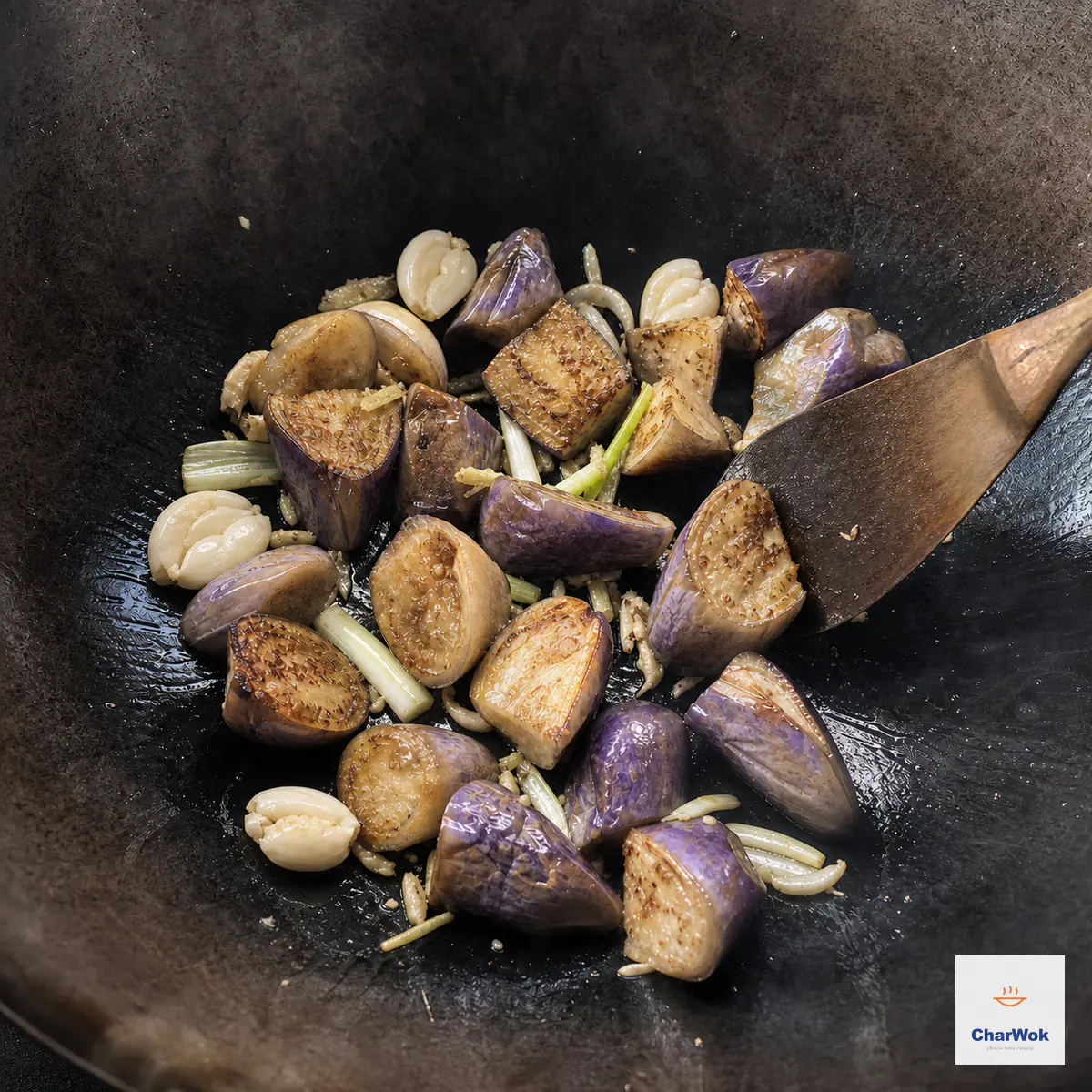
Sear the pre-softened chunks for about one minute, stopping when the exposed flesh has patchy light-brown marks
- Glaze and finish. Drop the flame to low and add the bowl of glaze straight into the pan, then toss in the chili and the green scallion tops. Fold gently until each piece is lacquered and the sauce has reduced to a glossy coat that hugs the eggplant, roughly half a minute. The moment it tightens, take the pan off the heat and bring it to the table, over rice, while it is still gleaming.
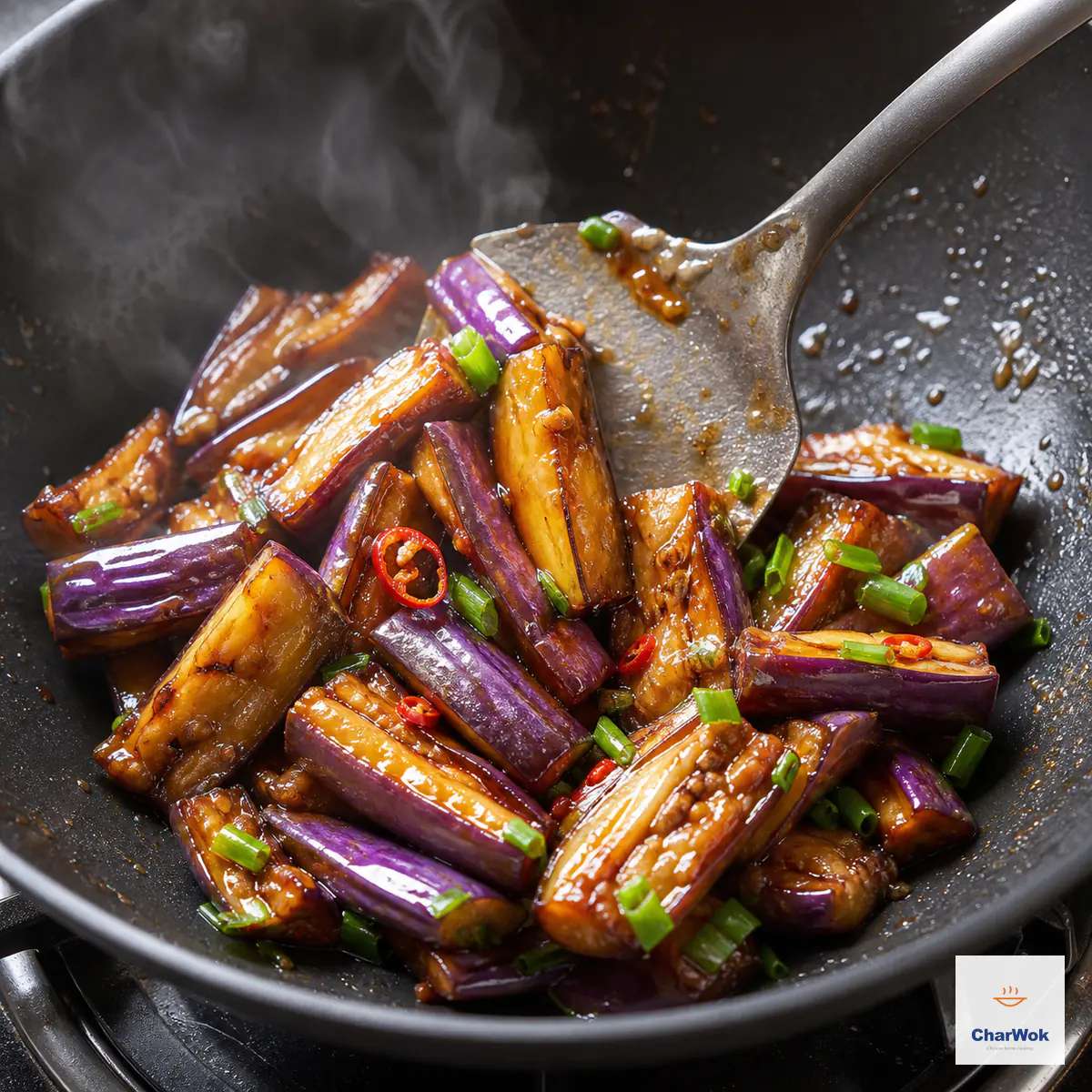
Lower the heat and fold gently until the glaze clings to every piece and almost no loose sauce remains in the wok
For the steaming step, a bamboo steamer gives the most even result; the bamboo steamer guide walks through setup if you have not used one before.
When it goes wrong, and the fix
The eggplant is rubbery and gray. You skipped the pre-cook, or the pan was not hot enough. The fix is preventive; you cannot rescue rubbery eggplant mid-stir-fry. Next time, steam or microwave first, and make sure the wok is genuinely hot before the oil goes in.
The eggplant disintegrates into strings. You over-steamed it. Stay inside the 3-to-4-minute window for bite-size chunks, and lean toward the lower end if they are on the small side. Test one piece with a paring knife at the 3-minute mark; it should yield, not split.
The garlic burns and turns bitter. Crushed garlic in a smoking wok blackens in under 15 seconds. Two defenses: crush rather than mince (less surface area to scorch), and add the garlic a beat after the oil, off the peak of the heat, before the eggplant goes in to cool the pan.
The sauce is too sweet or sits in a puddle. Plum sauce brands vary wildly in sugar and thickness. Taste the glaze before it goes in. If it reads as candy, add a few drops of rice vinegar. If the sauce pools instead of coating, you used too much water; boil it down for another 15 seconds before pulling off the heat.
Variations and what to serve alongside
This is a side built for a simple meal. I usually plate it with rice, a quick green like garlic bok choy, and a protein. For a one-bowl dinner, fold the glazed eggplant straight into the rice and top with a fried egg.
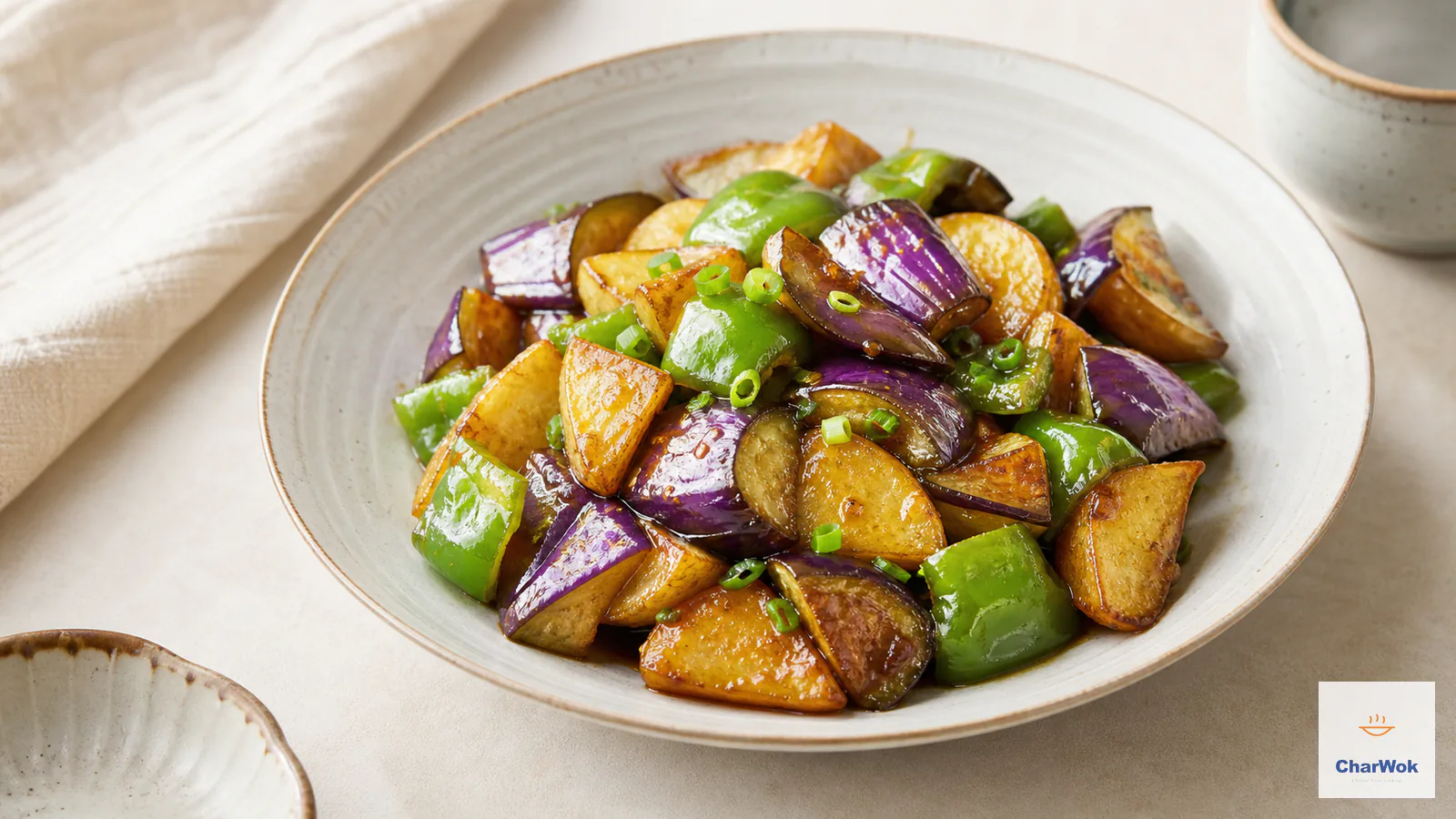
Flavor-wise, the dish bends easily. Whisk a teaspoon of honey into the glaze in place of the plum sauce and you have a honey-garlic eggplant. Scatter toasted sesame seeds over the finished dish for a nuttier finish. Toss in a handful of minced pork right before the eggplant and you have a heartier version that eats like a main. It belongs in your weeknight rotation and especially in a summer lineup when eggplant is at its peak.
Storage and reheating
Eggplant is best the day it is cooked, but leftovers keep, covered, in the fridge for up to 2 days. Reheat gently in a dry pan over medium-low heat; microwaving works but softens the texture further. The dish does not freeze well; the flesh goes spongy on thaw.
FAQ
Do I need to peel the eggplant?
No. The skin keeps the chunks intact once the flesh softens, and it browns nicely in the pan. Peel only if the skin is thick and tough, which is more common with older globe eggplants.
Can I skip the pre-cook and just stir-fry raw eggplant?
You can, but you will need far more oil to get a tender result. Without pre-cooking, raw eggplant soaks up everything in the pan and still risks staying rubbery inside. The 2 to 4 minutes of steaming or microwaving is what makes a one-tablespoon stir-fry possible.
Is plum sauce the same as plum sauce used for Peking duck?
Closely related, yes. The jar labeled "plum sauce" or su mei jiang works for both. The thinner, sweeter "duck sauce" sold in American takeout packets is a different product and will make this dish too cloying.
My microwave is a different wattage. How do I adjust the timing?
The 2-minute time was developed on an 800-watt oven, which is the baseline to work from. If your oven runs 1000 watts or more, the same batch will get there faster, so check a minute and a half in and add short bursts only if the flesh is still firm. On a lower-wattage model, expect to add time. The reliable test is the knife, not the clock: the eggplant is ready when it yields with a little resistance, not when the timer beeps.
Can I make this vegan?
It already is vegan as written, as long as your plum sauce does not contain added fish or oyster extract. Check the label; most standard brands are plum, vinegar, sugar, and chili only.