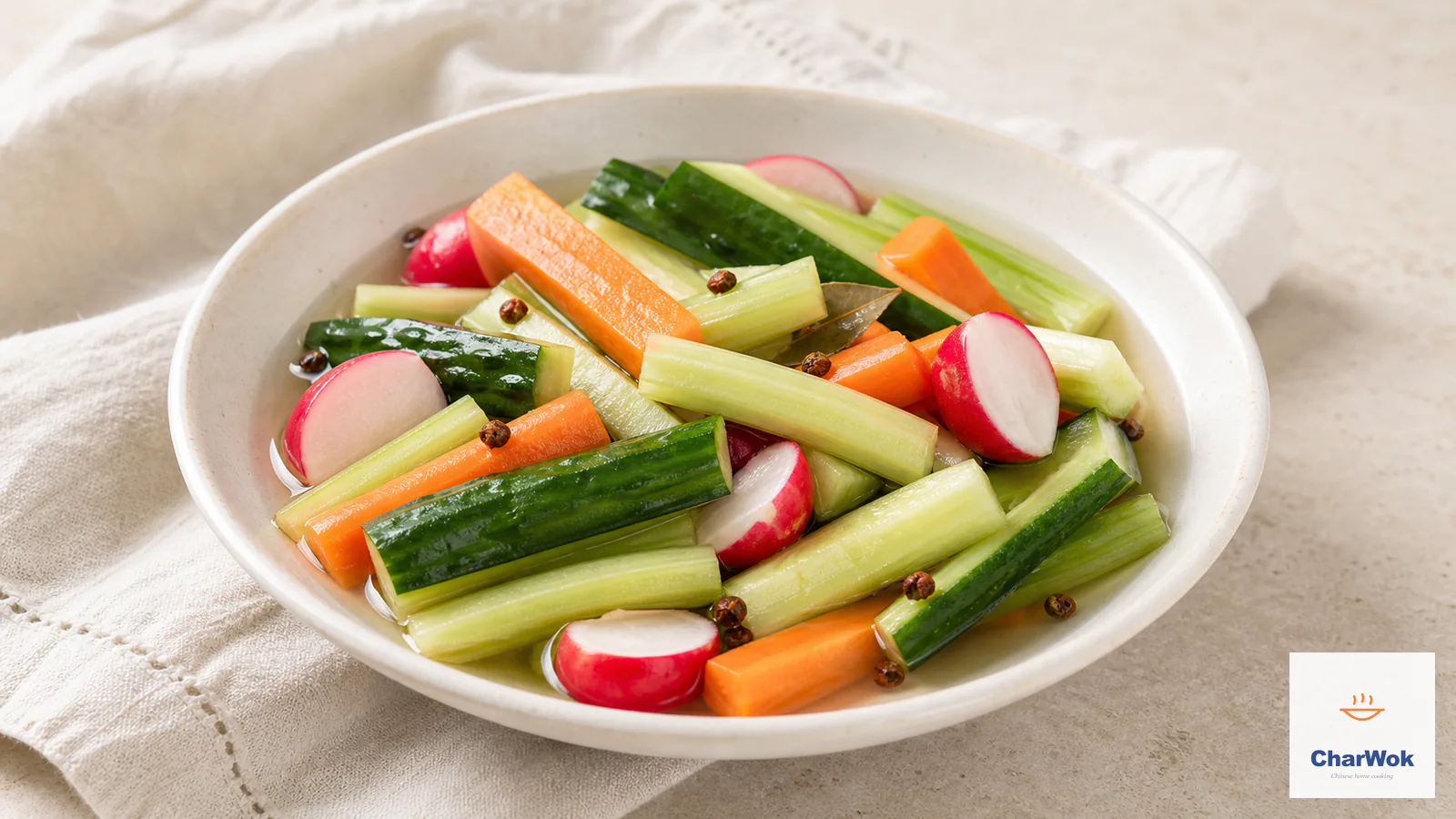
The crunch is the whole point. You want a pickle that snaps when you bite it, with a clean, bright tang and a low hum of Sichuan aroma behind it. The version most home cooks are missing is xi zao pao cai, which translates literally to "bath pickle" — vegetables that take a short, cold soak in a spiced brine overnight rather than fermenting for weeks in a clay crock. The first time I tried it I cut the cucumber too thin and got limp ribbons by morning. The fix was one small change to how I cut, and once you understand why, this becomes a five-minute habit you repeat all summer.
Ready in 12 to 16 hours of unattended fridge time, with about 20 minutes of real work. The non-negotiables: cut everything into sturdy sticks (not slices), pull moisture out with salt before brining, and dissolve the spices in hot water so the Sichuan peppercorns and star anise actually give up their flavor. Skip the preshower and your pickles go soft.
What "bath pickle" actually is
This is a Sichuan pantry staple with roots in the broader world of Sichuan pepper-seasoned preserved vegetables, but it lives in a different category from the long-fermented pao cai you may have seen in jars. Real fermented pao cai relies on a living salt brine that builds lactic acid over days or weeks. Bath pickle skips the biology entirely. There is no culture, no fizz, no room-temperature aging. You make a flavored vinegar brine, pour it cold over crisp vegetables, and let salt and acid do a shallow, surface-level job overnight.
That is both the strength and the limit of the technique. Because nothing is fermenting, the texture stays firm and the flavor stays clean and vegetal. But nothing keeps improving past day two or three, either. This is a same-week pickle, not a pantry project, and trying to stretch it longer is where people get disappointed.
The ingredients, with opinions
Ingredients at a glance
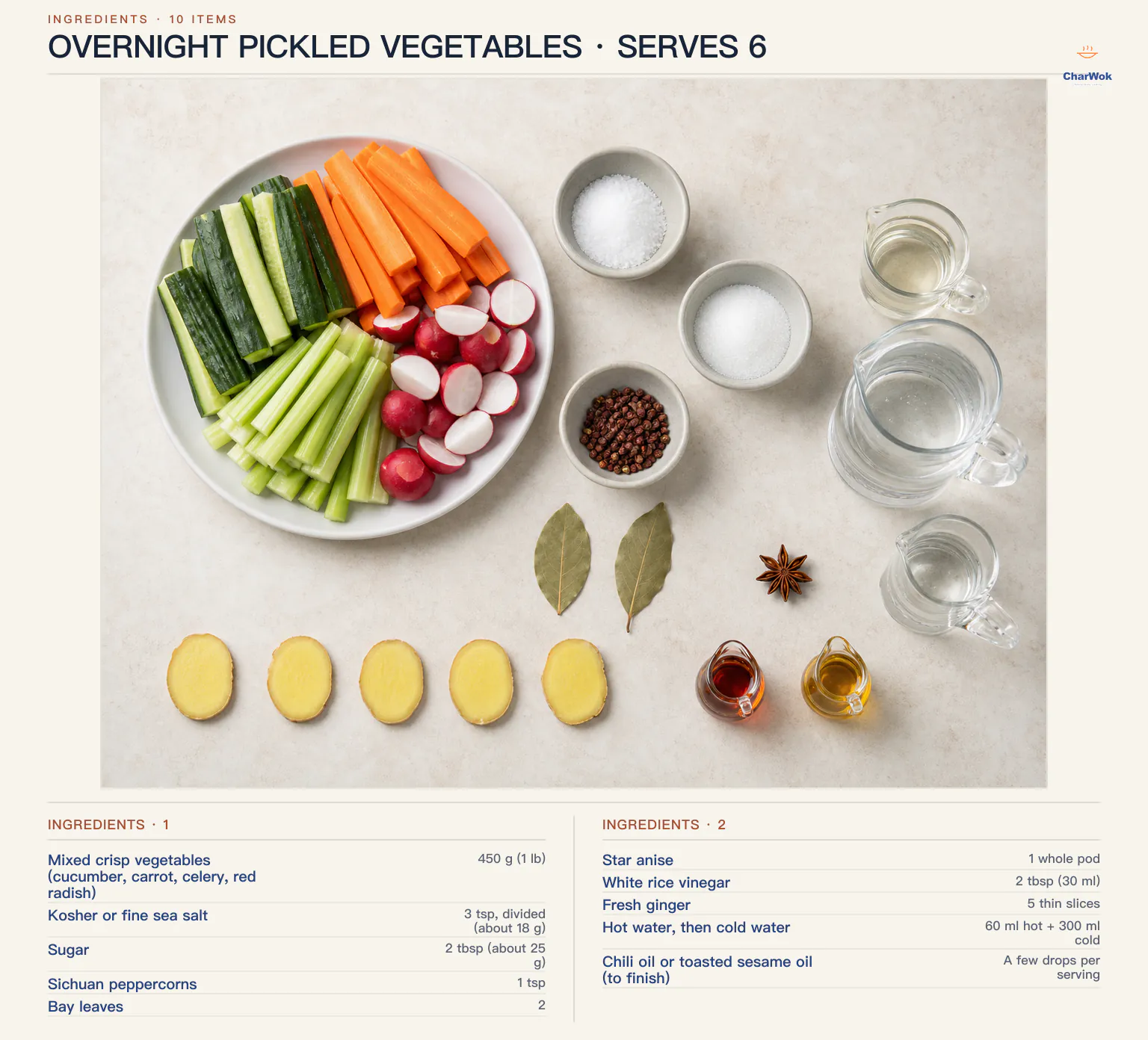
| Ingredient | Amount | Notes / substitute |
|---|---|---|
| Mixed crisp vegetables (cucumber, carrot, celery, red radish) | 450 g (1 lb) | See vegetable notes below; avoid soft or leafy types |
| Kosher or fine sea salt | 3 tsp, divided (about 18 g) | 1 tsp for the preshower, 2 tsp for the brine; table salt works too |
| Sugar | 2 tbsp (about 25 g) | White sugar is standard; the sugar balances acid, do not cut it to zero |
| Sichuan peppercorns | 1 tsp | Red Sichuan peppercorns give the classic numbing aroma; toast lightly for more punch |
| Bay leaves | 2 | Whole, dried; fresh bay is fine if that is what you have |
| Star anise | 1 whole pod | One is plenty; more overpowers everything else |
| White rice vinegar | 2 tbsp (30 ml) | Distilled white vinegar works but is sharper; for the softest bite use rice vinegar, not black vinegar |
| Fresh ginger | 5 thin slices | Smack each slice with the side of a knife to release flavor |
| Hot water, then cold water | 60 ml hot + 300 ml cold | Tap water is fine if yours tastes clean; filtered is insurance, not a requirement |
| Chili oil or toasted sesame oil (to finish) | A few drops per serving | Stir in at the table only, never into the storage jar |
Choosing vegetables that survive the bath
The rule is simple and I break it for nothing: the vegetable has to be crunchy when raw and it has to stay crunchy after a night in liquid. Cucumber, carrot, celery, and red radish are the reliable four. Persian or English cucumbers work better than the thick waxed kind because the seed cavity is smaller and holds less water. Daikon, bell pepper, celtuce, and firm napa cabbage ribs (not the leafy parts) are all fair game.
Tomatoes, zucchini, leafy greens, and anything already soft are out. If you want a more pungent, fermented-tasting jar, you can add a spoonful of pickled chili garlic sauce to the brine, but keep the vegetables themselves in the crisp category.
Why two temperature waters, and why the salt preshower matters
Most of the failures I see come from skipping the reasoning behind two steps, so here it is plainly. The spices in this brine are oil-bearing aromatics. Sichuan peppercorns, star anise, and bay leaves release their volatile oils into hot water readily and into cold water barely at all. If you dump everything into cold water, you get a brine that tastes of salt and vinegar with the spices as an afterthought. Sixty milliliters of hot water is enough to bloom them; you then cool the brine down with the remaining cold water so you are not pouring hot liquid onto vegetables and partially cooking them.
The salt preshower is the other half. Cucumber and radish are mostly water. If you put them straight into brine, that water leaches out, dilutes the brine overnight, and leaves you with a jar that is cloudy, weak, and soggy by morning. Tossing the cut vegetables with a teaspoon of salt and waiting twenty minutes pulls a surprising amount of liquid out through osmosis first. You drain that off, and what enters the brine is already partly collapsed and seasoned. This is the single step that separates a crisp pickle from a floppy one.
Method, step by step
- Cut into sticks, not slices. Wash and peel the carrot and celtuce if using. Cut cucumber, carrot, and celery into chunky sticks about the length of your index finger and the thickness of a Sharpie. Halve small red radishes; quarter large ones. Chop any fresh chili into big pieces. The thickness matters: a stick has less surface area per unit of volume than a thin slice, so it takes on flavor without going soft. This is the change that fixed my limp-ribbon problem.
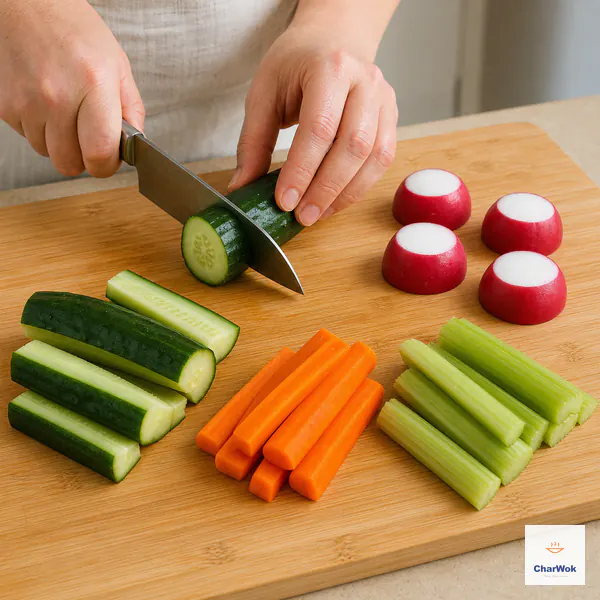
Keep cucumber, carrot, and celery chunky and finger-length, and halve small radishes; thin slices absorb too fast and lose their crunch
- Preshower in salt for 20 minutes. Put all the cut vegetables in a wide bowl, sprinkle with 1 tsp salt, toss well, and leave at room temperature. You will see a puddle of liquid at the bottom of the bowl. Drain it off thoroughly and discard it. Do not rinse the vegetables; the salt on their surface is now part of the seasoning.
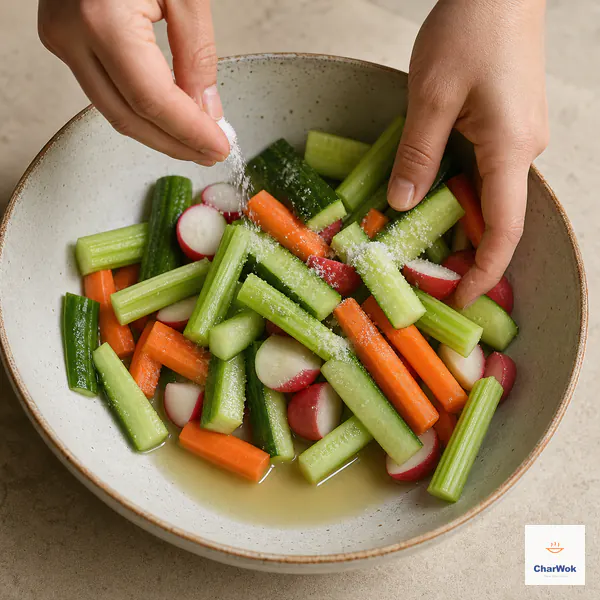
Toss with 1 teaspoon salt, rest 20 minutes, then drain the visible puddle thoroughly without rinsing the vegetables
- Bloom the spices in hot water. In the container you will pickle in (glass, ceramic, or food-grade plastic, never bare aluminum), combine the remaining 2 tsp salt, the sugar, Sichuan peppercorns, bay leaves, and star anise with 60 ml hot water straight off the boil. Stir and let it sit about 10 minutes. The liquid will cool and the salt and sugar will fully dissolve. Smell it; it should already read as aromatic, not just salty.
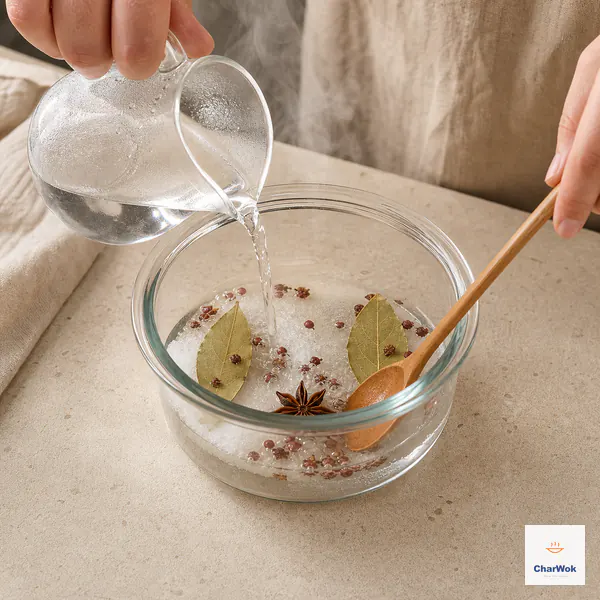
Use only 60 ml just-boiled water to dissolve the salt and sugar and bloom the spices, then let the mixture cool for about 10 minutes
- Finish the brine cold. Add 300 ml cold water, the rice vinegar, and the smashed ginger slices. Stir. Now taste the brine on the tip of a spoon. It should read slightly salty, lightly sweet, and gently tangy. This is your last chance to adjust before the vegetables go in, so trust your tongue over the recipe.
- Submerge and seal. Add the drained vegetables. Press them down; if anything pokes above the surface, top up with a little more cold water until everything is covered. Lid the container and refrigerate.
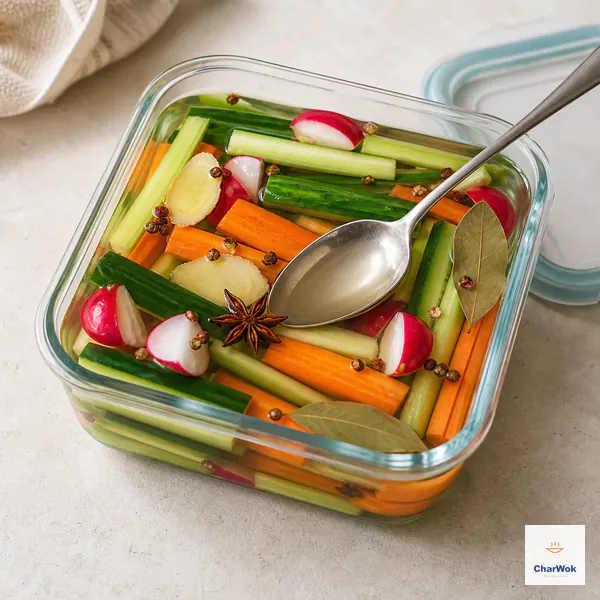
Add the drained vegetables and enough cold water to keep every piece under the clear brine before sealing and refrigerating
- Wait 12 to 16 hours. The pickles are ready the next day. The first 24 hours are the peak. Eat within five days, and always fish pieces out with clean, dry chopsticks.
- Finish at the table. Lift a portion into a small dish, then add a few drops of chili oil or toasted sesame oil. Never put oil into the storage jar, or you will seal the surface and starve the brine of oxygen in a way that invites spoilage.
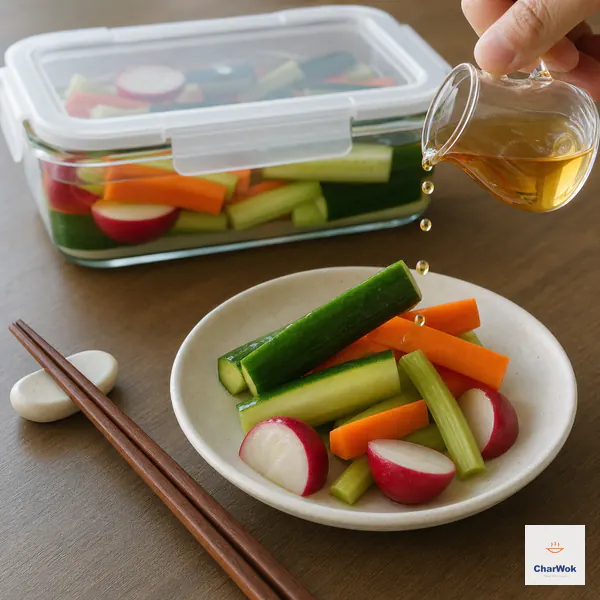
Lift out one portion with clean dry chopsticks and add only a few oil drops to the serving dish, never to the storage brine
When the pickle goes wrong
- Soft or limp by morning. Two usual causes: you sliced instead of stick-cutting, or you skipped the salt preshower and the vegetables wept into the brine. Cut thicker next time and always drain the preshower liquid. A batch that is already soft cannot be saved; the texture is gone.
- Brine is weak and bland. The vegetables diluted it. Either you did not preshower, or you topped up with too much water in step 5. Fix forward by tasting the brine before adding vegetables and being stingy with top-up water.
- Overpowering star anise or medicinal taste. You used more than one pod, or you left the spices in for days. One pod is the ceiling for this volume. Fish the spices out after 24 hours if you are keeping the jar longer.
- Cloudy brine or off smell. This is the one to take seriously. A faint sediment is normal; a milky, slimy brine with a sour or yeasty odor means unwanted microbes have taken hold, usually from a wet utensil or from oil that snuck into the jar. Throw the batch out and sterilize the container. Food safety trumps thrift here.
- Pickles are too salty. Kosher salt and table salt measure differently by volume. If your salt is fine-grained, drop the brine salt to 1.5 tsp and adjust up next time.
I will be honest about the limits: this method does not produce the deep, complex funk of a weeks-old fermented pao cai, and no amount of spice will fake that. What you get instead is a clean, snap-fresh side that you can make on a Tuesday and eat on a Wednesday. Different goals, both worth having.
Variations and pairings
For a hotter, more grown-up version, add a dried chili or two to the blooming spices. For a sweeter, almost relish-like pickle, push the sugar to 3 tbsp and add a peeled, sliced shallot to the vegetable mix. A few strips of young ginger pickled alongside the vegetables gives a pink-tinged, slightly spicy jar that is excellent with fried rice.
Where this pickle earns its keep is as the cold, crunchy counterweight to rich and savory food. It is the thing you want next to braised pork belly, sweet and sour ribs, or a saucy main like three-cup chicken, cutting through the fat and resetting your palate between bites. It also belongs in the cold-dish rotation alongside smashed cucumber salad, a napa cabbage salad, and a glass noodle salad when you want a spread of small plates on a hot night.
For noodles, lift a few sticks out, cut them into thin strips, and pile them on top of Dan Dan noodles, cold Sichuan noodles, or a plain bowl of scallion oil noodles for crunch and tang. At breakfast, a few pieces alongside a bowl of congee are exactly the wake-up a slow morning needs. You can even tuck strips into folded bao buns as the crisp element against a savory filling.
Storage and reheating
Keep the jar sealed in the fridge. The pickles are at their best in the first two days, acceptable through day five, and should be finished or composted after that. There is no reheating; these are served cold. If you want to keep a steady supply, start a new small batch every few days rather than doubling one batch and trying to make it last a week. The brine itself can be reused once for a second, quicker batch, but it will be weaker; after that, start fresh.
FAQ
Can I use tap water, or do I need filtered? Tap water is fine as long as it tastes clean. Filtered water removes a faint chlorine note some people notice, but it does not change the safety or the texture of the pickle.
Why are mine soft the next morning? Almost always the cut. Thin slices absorb brine too fast and collapse. Cut sturdy sticks and do the 20-minute salt preshower so the vegetables are not bleeding water into the jar overnight.
How long do they keep? Five days in the fridge, refrigerated the whole time, with clean dry utensils. Peak crunch is in the first 48 hours. If the brine turns milky or smells yeasty, throw it out.
Can I ferment these for weeks like real pao cai? No. This is a vinegar quick-pickle, not a lactic ferment, and it will not improve or stay safe past a few days. For long-fermented flavor you would need a different salt-brine method and an active culture.
Do I have to use Sichuan peppercorns? They define the flavor, but if you cannot find them, substitute a dried chili and an extra bay leaf for a different but still good pickle. You will lose the signature tingle.