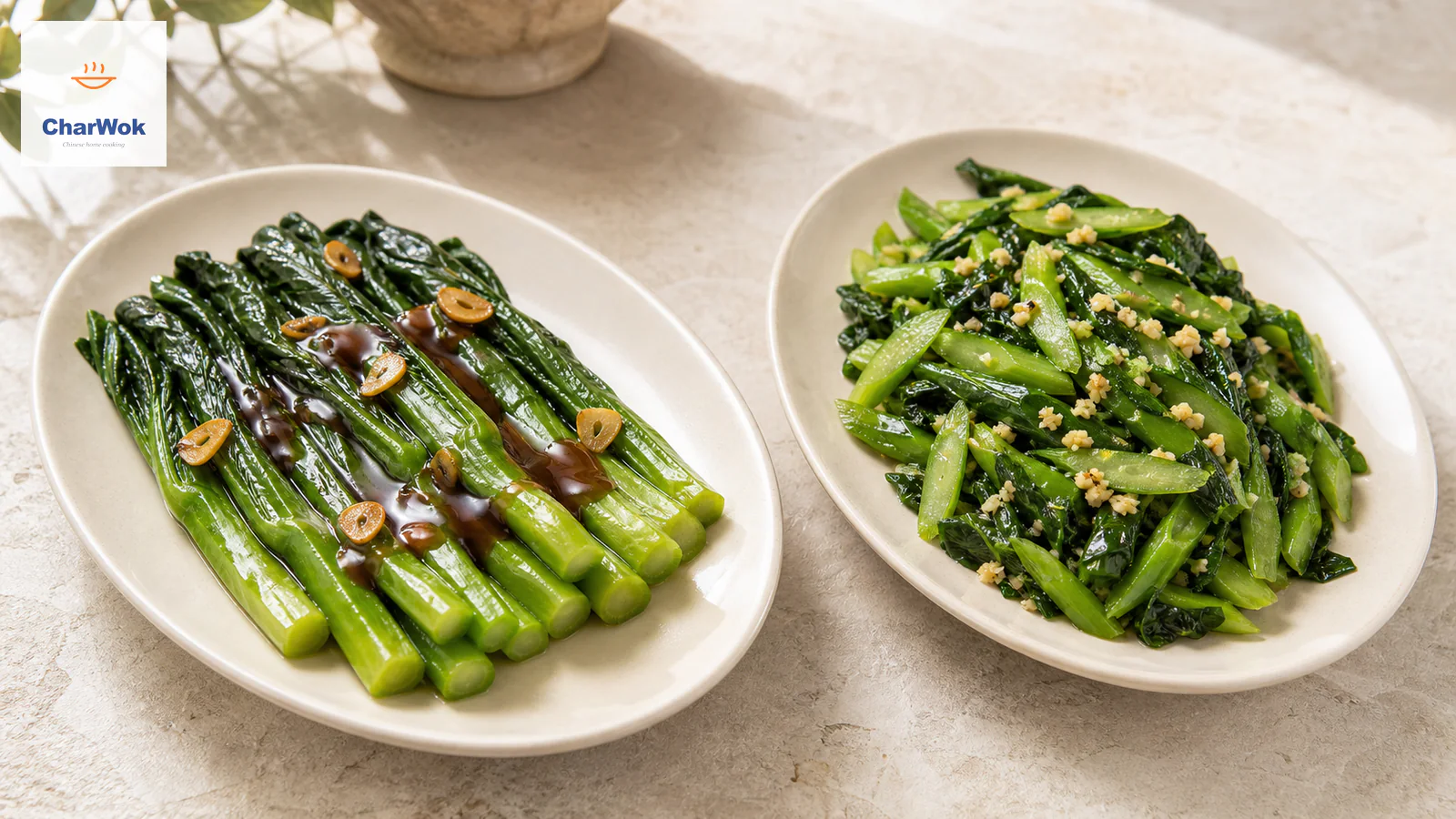
The dish that taught me how a Cantonese kitchen thinks is a plate of gai lan with oyster sauce. There is almost nothing to it: stems, sauce, done in three minutes. And yet the first dozen times I made it at home, the result looked like a wilted heap at the bottom of a cafeteria tray. The stems were either stringy and bitter or limp and gray-green, the sauce sat on the plate in a sad puddle. The restaurant version, by contrast, stands up straight and glossy, each stalk still snapping when you bite it.
The gap is not about ingredients. It is about two decisions most home recipes skip: how hot the blanching water is, and whether you cook the stems and leaves on different clocks. Once I started treating gai lan like a two-part vegetable, everything clicked. That insight is what this article is built around, and it is also why I give you two complete methods here, the blanched-and-sauced dim sum classic and a fast ginger-garlic stir-fry. Both depend on the same underlying logic.
At a glance: Gai lan's stems are dense and fibrous; its leaves are thin and tender, so they want different cooking times. Blanch in a large volume of fully rolling, well-salted water with a teaspoon of oil, about 60 seconds stems-first, and shock only if you are not serving at once. The whole dish lives or dies on heat and salt in the water, not on the sauce.
What gai lan actually is, and why it behaves differently from broccoli
Chinese broccoli, gai lan (芥蓝), is a leafy brassica with thick stalks, big flat leaves, and occasionally a few tiny bud clusters tucked in among the foliage. It is a close cousin of regular broccoli and of choi sum, but it does not build the tight flower head you see on Western broccoli. What it builds instead is stem. That is the whole point of the vegetable, and the reason it carries a faint bitterness that some people love and a few find off-putting.
The bitterness is real, and it is the reason the dish needs sugar in the sauce, not because the recipe is sweet but because a small amount of sugar rounds the bitter edge the same way a pinch of sugar tames the sharpness of a tomato sauce. If you have only ever had Western broccoli with garlic sauce, expect a deeper, more mineral flavor here, closer to a leafy green than to a floret.
Because gai lan is all about the stem, the cooking problem is structural. A stalk the thickness of a sharpie needs a full minute of rolling boil to turn tender-crisp. A leaf needs about ten seconds at that temperature before it goes sludgy. Recipes that tell you to throw the whole bunch in together and pull it out at one timer are setting you up for either leathery stems or disintegrating leaves. I split them.
Buying and storing
Look for stalks that are firm and straight, with leaves that stand up rather than flop. The base of the stem should look freshly cut, not dried and hollow. If you see open yellow flowers on the bud clusters, the bunch is past its peak and the stems will be more fibrous and more bitter than they should be. Tight green buds are fine; open blooms are a warning.
Gai lan does not keep the way kale does. It loses moisture fast. I take it out of any plastic, wrap it loosely in a damp paper towel, and seal it in a bag with the air pressed out; it holds three, maybe four days in the crisper. Do not wash it until the day you cook it, because wet leaves rot quickly. If you cannot find gai lan, broccolini is the closest stand-in for both recipes below and the one substitution I would actually endorse, since broccolini is itself a gai lan hybrid. Regular Western broccoli works in a pinch for the stir-fry but not for the blanched version, where the long stalk is the whole point.
Two methods, one principle
Every quick green vegetable in the Cantonese playbook, from lettuce with oyster sauce to garlic bok choy, runs on the same idea: get the vegetable in and out of intense heat as fast as possible so it stays bright and crisp, then add flavor on top. The two recipes below are the two main ways that idea gets applied to gai lan. The first cooks the vegetable in water and adds a glossy sauce. The second cooks it in a smoking-hot wok with aromatics and a splash of wine.
I cook both regularly. If I am serving something rich like red-braised pork belly or soy sauce chicken, I want the blanched version, because its clean bitterness cuts the fat. If dinner is plain rice and a stir-fried protein, I want the ginger-garlic stir-fry, because the rendered aromatics carry the meal. They are not interchangeable on the plate even though they use almost the same ingredient list.
Method one: blanched gai lan with oyster sauce
This is the dim sum order. Whole stalks, served lying the same direction, sauce pooled on top. The trick is that the sauce is barely seasoned; the vegetable is the seasoning. The oyster sauce is mainly here for body and a glossy sheen, the dark soy for color, the sugar to soften the bitter notes.
Ingredients
Ingredients at a glance
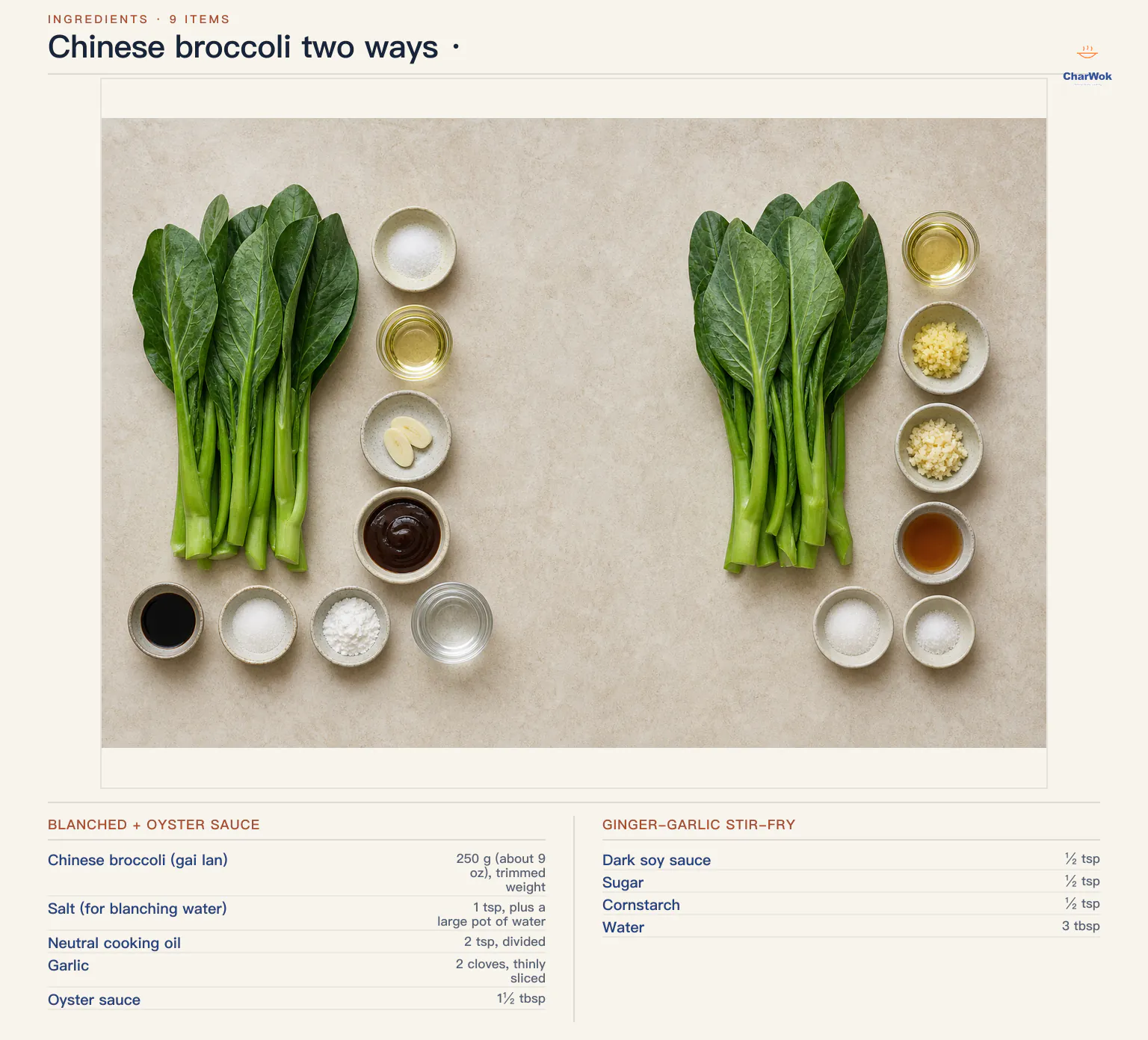
| Ingredient | Amount | Notes / substitute |
|---|---|---|
| Chinese broccoli (gai lan) | 250 g (about 9 oz), trimmed weight | Broccolini is a direct swap; avoid regular broccoli here |
| Salt (for blanching water) | 1 tsp, plus a large pot of water | Water should taste like the sea |
| Neutral cooking oil | 2 tsp, divided | 1 tsp in the water, 1 tsp for the sauce; avocado or canola |
| Garlic | 2 cloves, thinly sliced | Ginger sliced into matchsticks is a common variant |
| Oyster sauce | 1½ tbsp | Vegan: mushroom stir-fry sauce; GF: gluten-free oyster sauce |
| Dark soy sauce | ½ tsp | For color; see my light vs. dark soy sauce breakdown |
| Sugar | ½ tsp | Rounds bitterness; do not omit |
| Cornstarch | ½ tsp | Thickens the sauce so it clings to the stems |
| Water | 3 tbsp | Combine with the sauce ingredients before cooking |
Method
- Prep the vegetable. Soak the gai lan in a sink or bowl of cold water for a few minutes to release grit from the leaf joints, then rinse and rub each stalk. Snap or cut the woody bottom half-inch of each stem. With a vegetable peeler, strip the tough outer skin from the lower two-thirds of the thicker stalks, the way you would peel the base of asparagus. This peeling step is not optional for the blanched version: the skin is the fibrous part, and once it is gone the inner stem cooks quickly and eats tender.
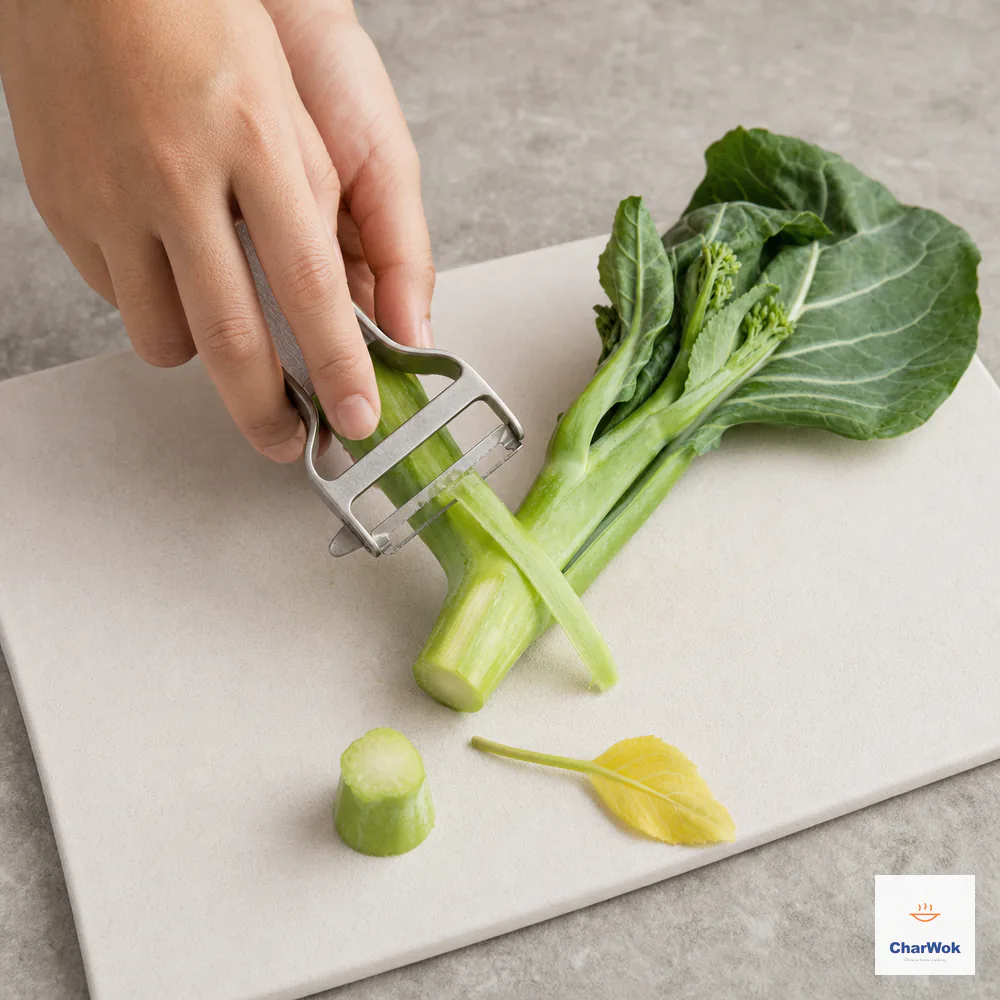
Trim the hard ends, peel only the tough lower outer skin, and remove any yellow leaves
- Bring a real pot of water to a true rolling boil. Use at least 2 liters. Add the salt and 1 tsp of the oil. The volume matters: a small pot of water will drop below a boil the instant the vegetable goes in, and a stalled boil is what produces dull, olive-colored greens. Salt at roughly sea-strength keeps the chlorophyll bright by slowing the conversion of chlorophyll to the gray pheophytin. The oil does very little chemically; it coats the drained stalks and gives them shine.
- Blanch stems first, leaves second. Hold a stalk by the leaf end and slide the stem into the water, leaf end up and out of the pot. After about 45 seconds, push the leaves under. Cook another 15 to 20 seconds, then lift the bunch straight out. The total time is around 60 seconds. You want the stem to bend slightly under its own weight but still snap when you press it with a fingernail.
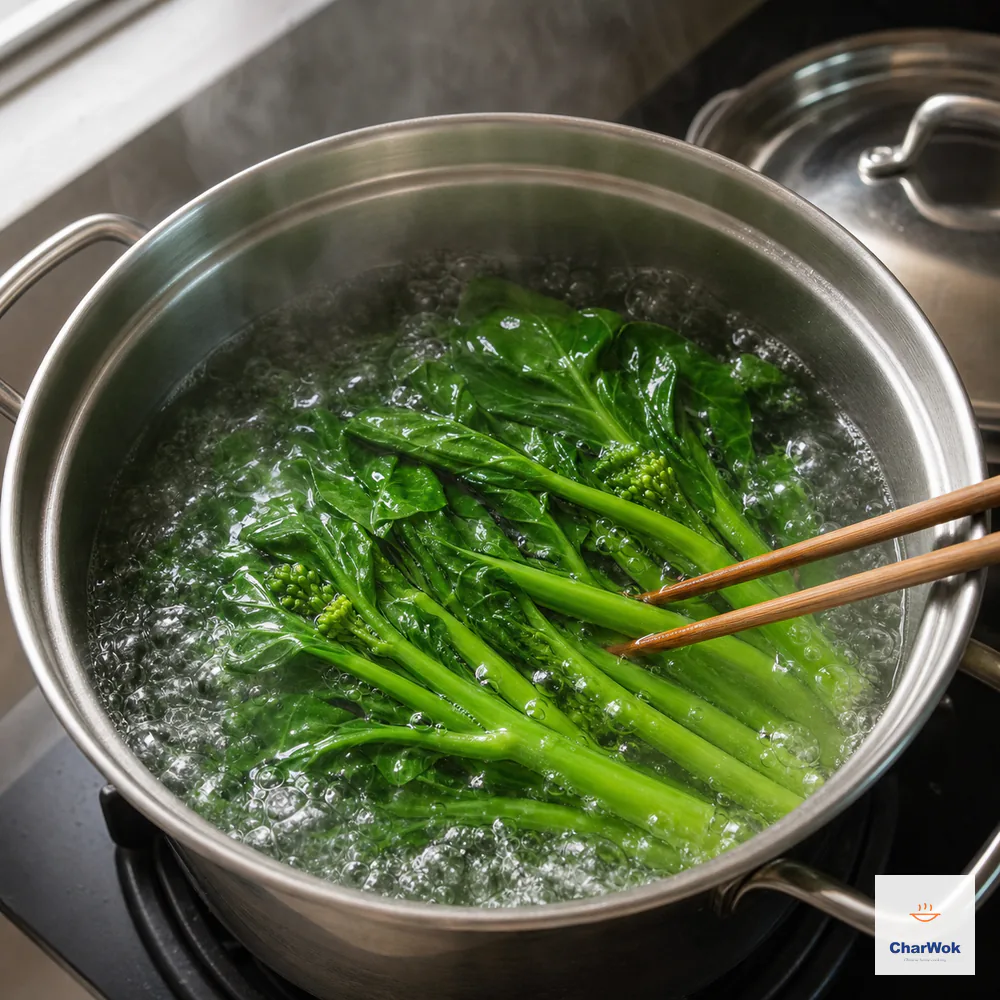
Use a large rolling boil with salt and 1 teaspoon oil; immerse the gai lan fully and blanch for about 1 minute until tender-crisp
- If not serving immediately, shock in ice water. Otherwise the residual heat keeps cooking the stalks and they go soft within a minute. If you are plating right away, skip the ice bath and just drain very well.
- Make the sauce while the vegetable drains. In a small bowl, stir together the oyster sauce, dark soy, sugar, cornstarch, and the 3 tbsp water until the cornstarch is fully dissolved. Heat the remaining 1 tsp oil in a small pan over low heat and sizzle the sliced garlic just until fragrant, about 15 seconds, then pour in the sauce mixture. Stir constantly as it comes to a bare simmer. The cornstarch will thicken it almost immediately into a glossy coating consistency. Pull it off the heat the moment it coats a spoon; it continues to tighten as it sits.
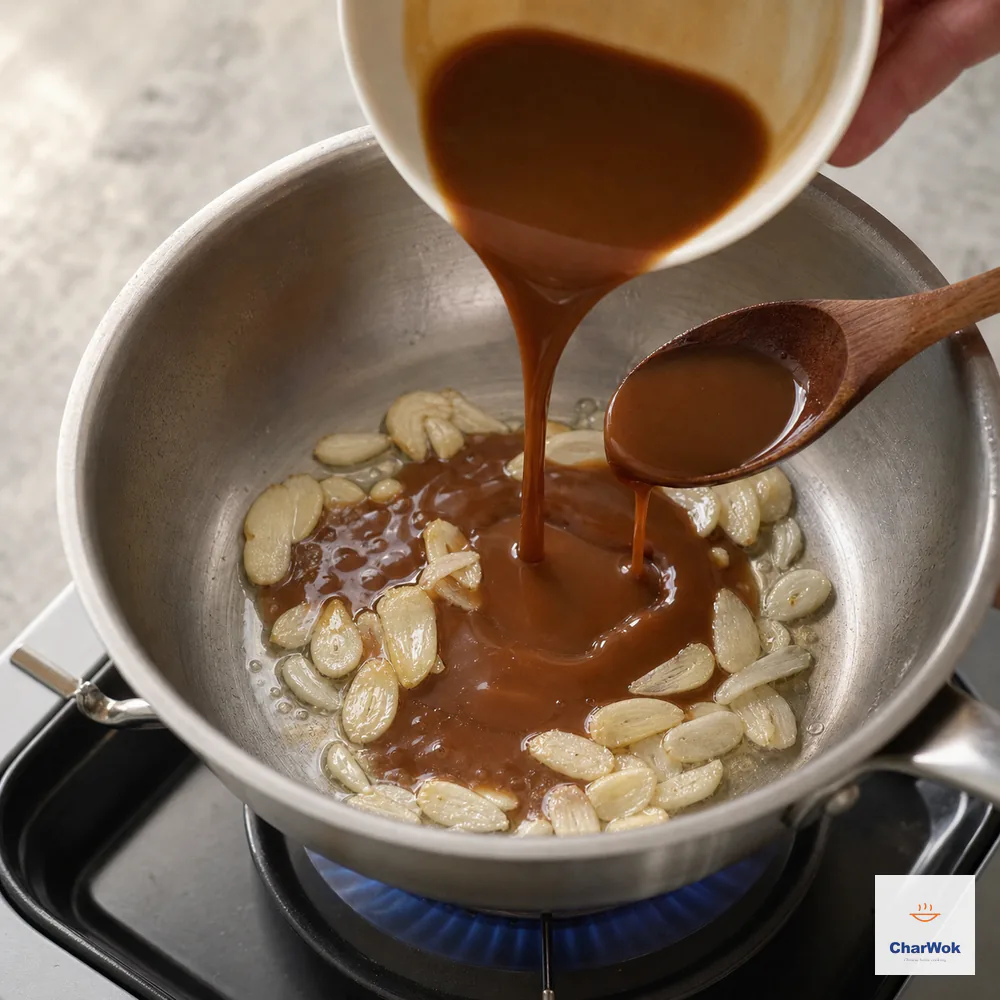
Sizzle the sliced garlic in the remaining oil, then simmer the fully mixed sauce over low heat until glossy but still pourable
- Plate like the restaurant does. Lay the stalks in a single layer, all pointing the same direction, stems neat. Pour the sauce down the center so it pools and runs over the leaves. Serve at once with freshly steamed rice.
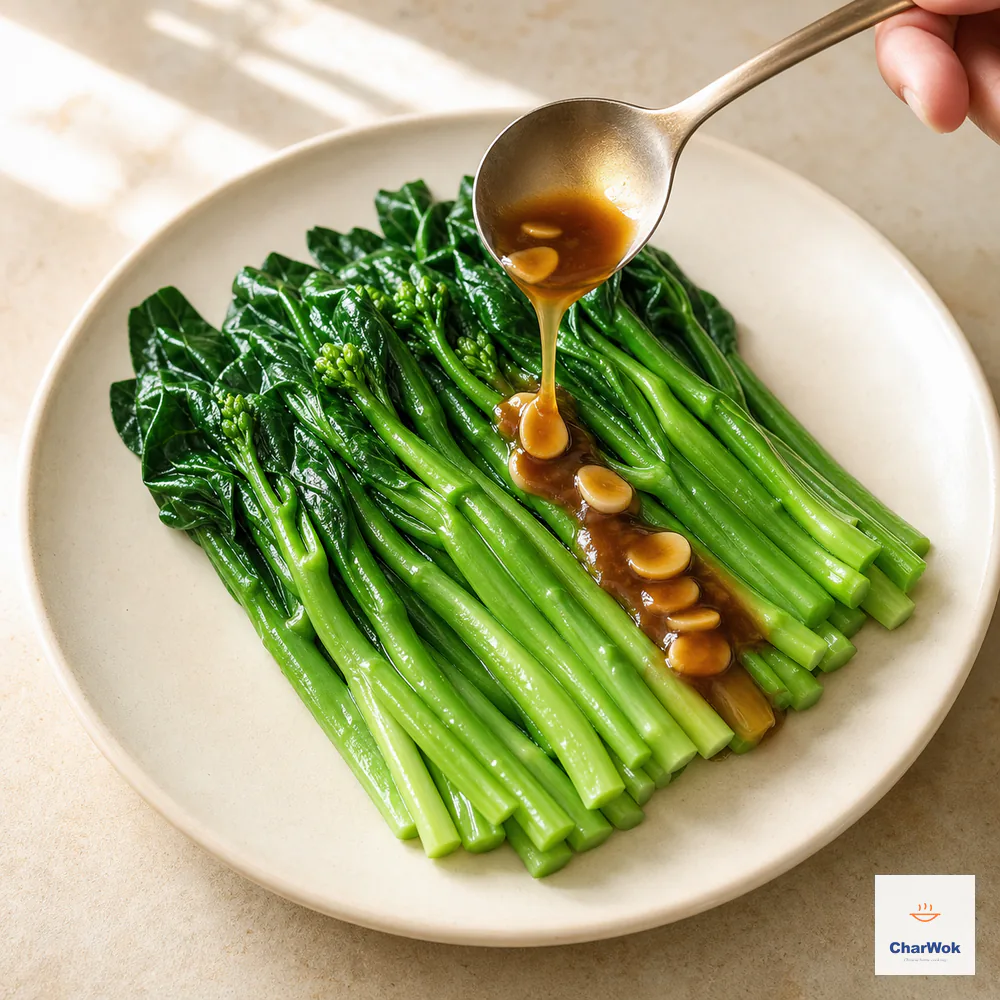
Align the drained whole stalks in one direction and spoon the thin sauce with garlic down the centre
Method two: ginger-garlic stir-fried gai lan
This version skips the sauce entirely. The flavor comes from oil that has been infused with aromatics, a hit of Shaoxing rice wine to deglaze and perfume, and a finishing pinch of sugar and salt. It is faster and lighter, and it is the one I reach for on a weeknight. Because there is no cornstarch sauce to hide behind, the wok technique has to be right.
Ingredients
| Ingredient | Amount | Notes / substitute |
|---|---|---|
| Chinese broccoli (gai lan) | 250 g (about 9 oz), trimmed | Cut into bite-sized diagonal pieces this time |
| Neutral cooking oil | 1 tbsp | Lard or chicken fat is more traditional and more flavorful |
| Ginger, minced | 1 tsp | Fresh; dried powder will not work here |
| Garlic, minced | 1 tsp | Use more if you like, but balance with salt |
| Shaoxing rice wine | 1 tsp | Dry sherry or Chinese rose wine work; skip for alcohol-free |
| Sugar | ½ tsp | Same role: taming the bitterness |
| Salt | ¼ tsp | To taste; add less and adjust at the end |
Method
- Prep and separate. Wash and trim the gai lan as above, but this time cut it into pieces: leaves in wide ribbons, stems in thin diagonal slices about 5 mm thick. The diagonal cut exposes more surface area so the stems cook through in the short stir-fry window, and it is what you see in dishes like dry-fried green beans and hand-torn cabbage stir-fry. Keep the stems and leaves in two separate piles. This separation, more than anything else, is what makes a stir-fried green taste like a restaurant's instead of a home cook's.
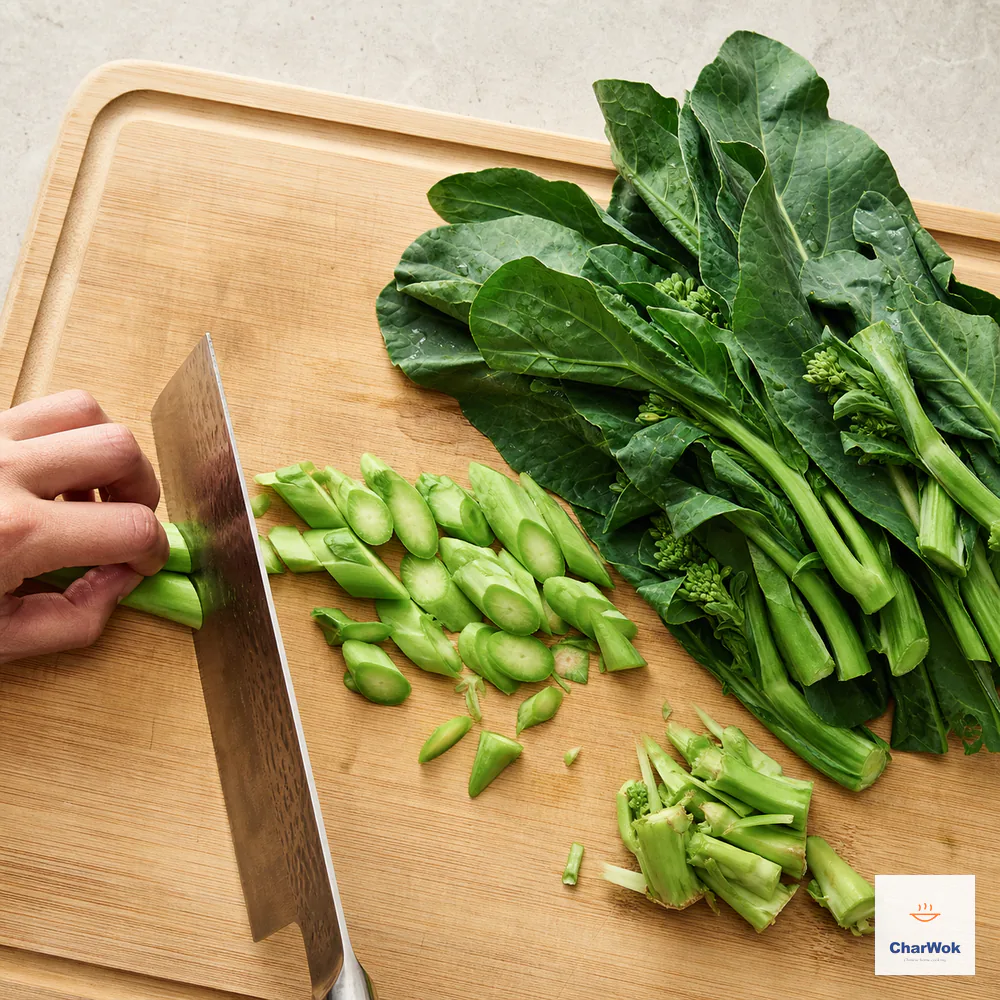
Cut the stems diagonally into thin pieces and keep the broad leaves separate so each can cook for the right length of time
- Heat the wok until it smokes. Set a carbon-steel or cast-iron wok over high heat until a drop of water dances and evaporates on contact and you see the first wisp of smoke. Add the oil, swirl to coat, then add the ginger and garlic. Stir for about 10 seconds, no more. You are flavoring the oil, not browning the alliums, and burnt garlic will turn the whole dish bitter in a way no amount of sugar can fix. If you are using a non-stick pan, do not preheat it empty; add the oil to a cool pan, then turn on the heat.
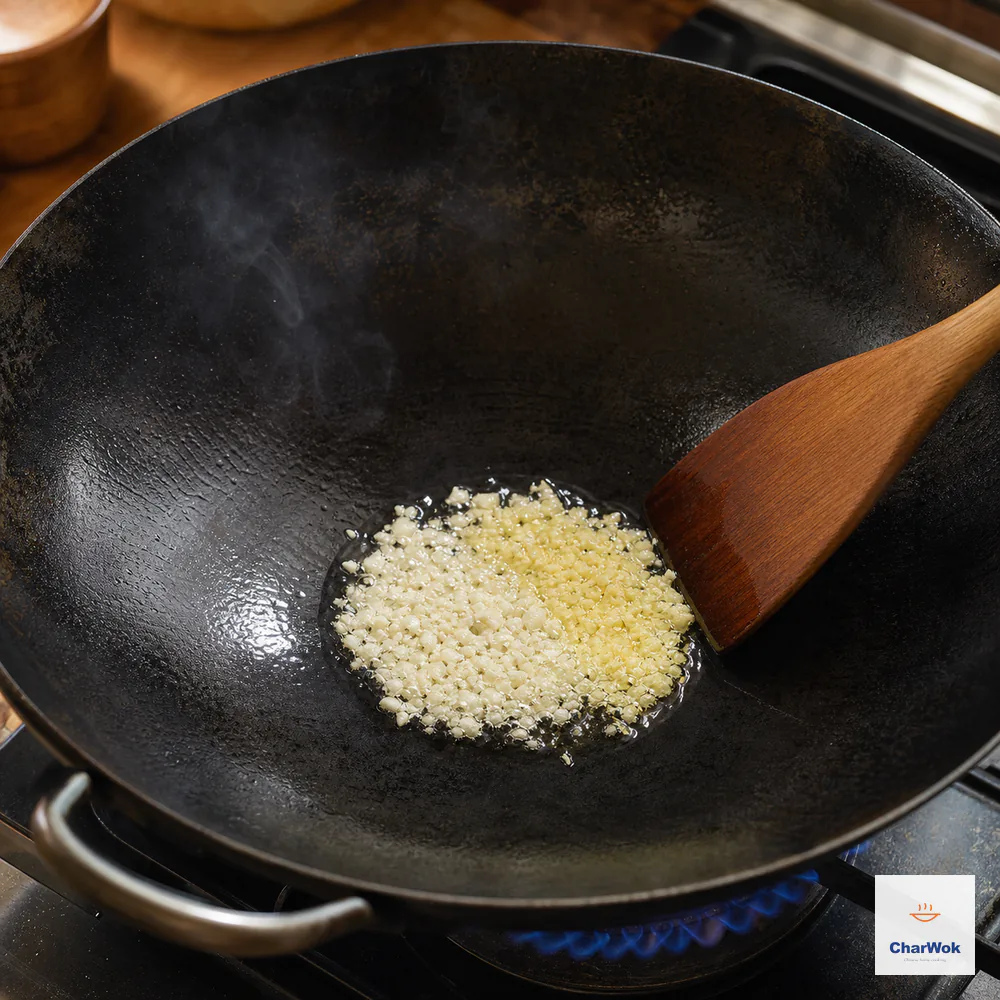
Heat the wok to its first faint smoke, add oil, then sizzle the ginger and garlic for under 10 seconds without browning
- Add the stems first, then the wine. Tip in the stem pieces and toss to coat in the aromatic oil. After 20 seconds, splash the wine down the side of the wok so it vaporizes instantly and carries the aromatics onto the vegetable. Cover with a lid for about 45 seconds. The trapped steam finishes the stems; without it you would have to stir-fry so long that the leaves would disintegrate when you add them.
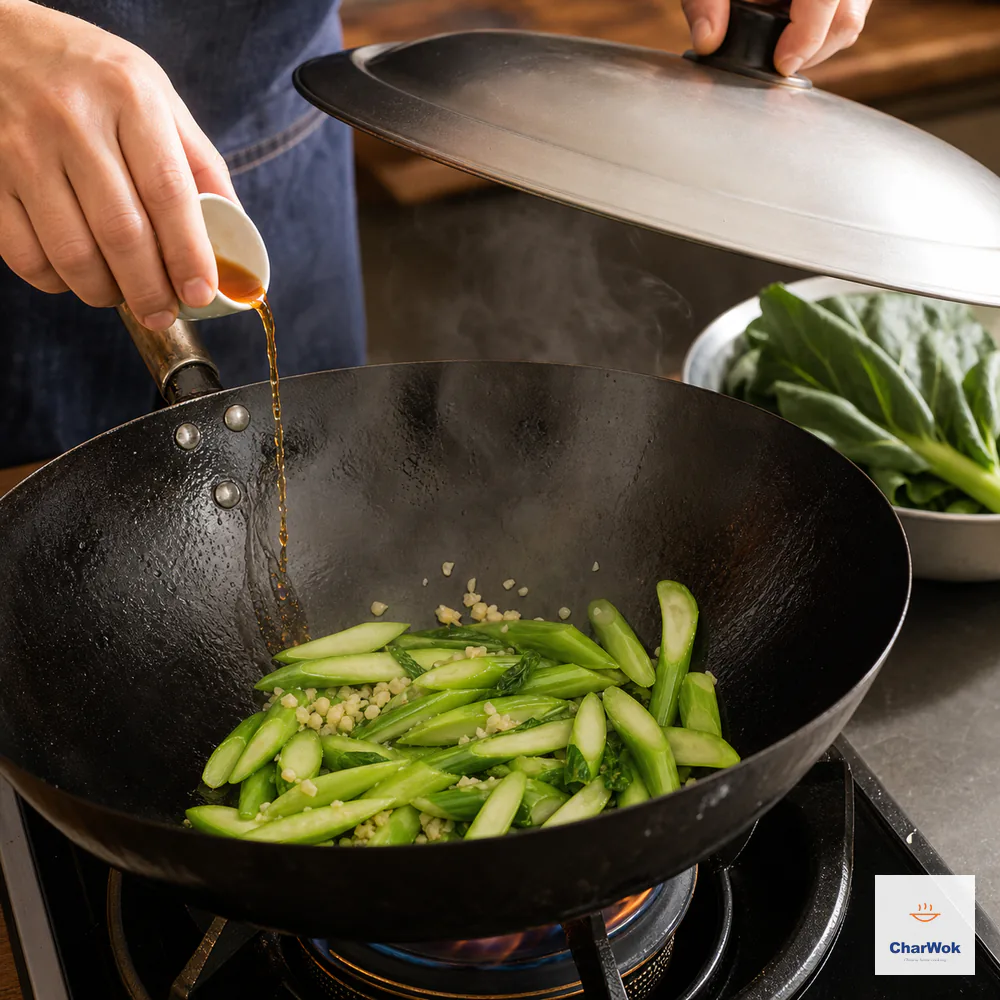
Stir-fry the stems, splash the Shaoxing wine down the hot wok wall, then cover immediately and steam for about 1 minute
- Add the leaves and finish. Uncover, add the leaves, and toss over high heat for another 20 to 30 seconds until they just wilt and brighten. Sprinkle the sugar and salt over the top, give two final tosses to distribute, and taste a stem. It should be fully tender-crisp with no raw fibrousness. Pull the pan off the heat the instant it is done; stir-fried greens overcook in the time it takes to carry them to the table.
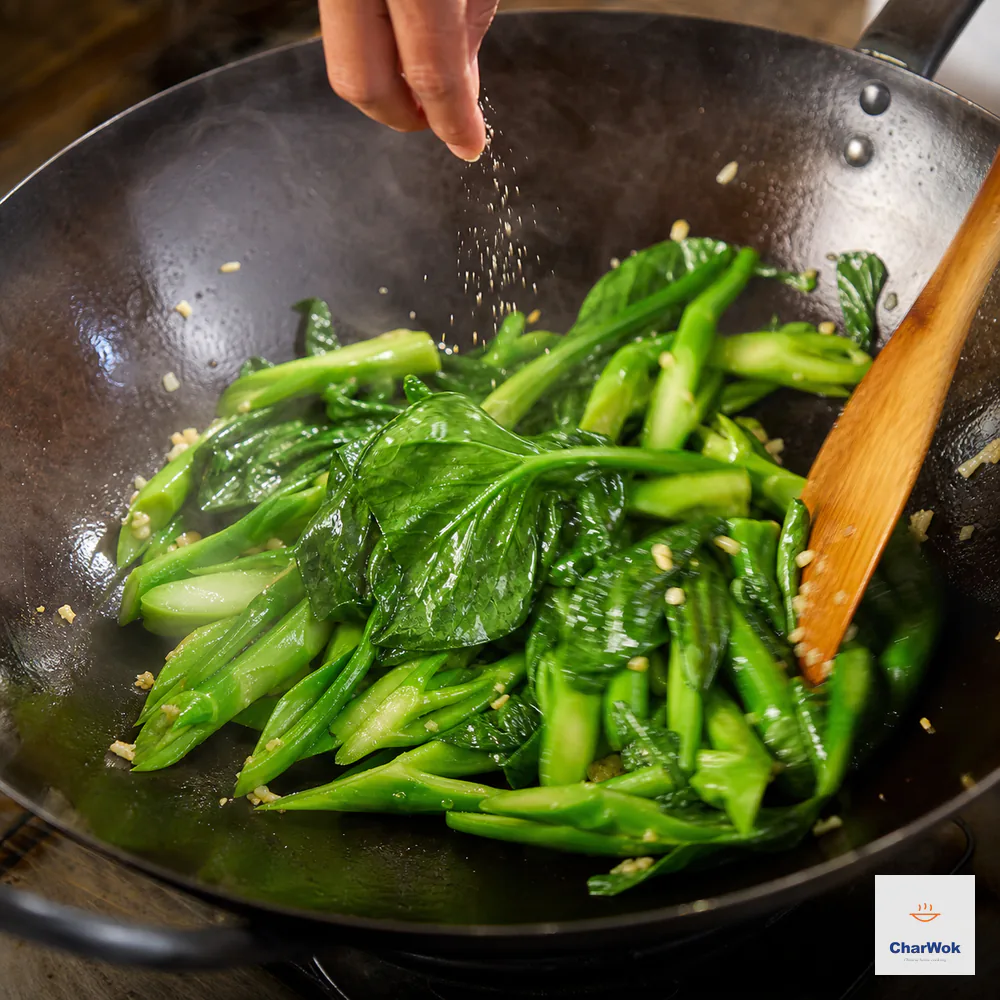
Add the leaves with sugar and salt and toss for about 30 seconds, stopping while the greens are bright and tender-crisp
When it goes wrong, and how to fix it
The two recipes above are short, and the short ones punish sloppiness. Here are the failures I have personally produced and what fixed them.
- Dull olive-green color. The water was not hot enough, or you crowded the pot. Use more water, wait for a hard rolling boil, and blanch in two batches if your pot is small. A pinch of baking soda in the blanching water will keep the green intense, but I avoid it because it makes the texture mushy; salt alone is the better tool.
- Stringy, woody stems. You skipped the peeling step, or the bunch was old and flowering. Peel aggressively; if a stalk still looks woody after peeling, halve it lengthwise so the heat penetrates.
- The sauce broke or went gummy. Either the cornstarch was not dissolved before it hit the pan, or the sauce boiled hard for too long. Cornstarch thickeners actually thin out again if overcooked. Stir the slurry smooth off the heat, add it to warm (not screaming hot) oil and garlic, and pull the pan off the moment it glosses up.
- Stir-fry tastes burnt and bitter. The garlic burned. Garlic mince scorches in seconds in smoking oil. Two defenses: add the oil first and let it cool the pan for a beat before the aromatics go in, or drop the heat to medium-high for the aromatics and back up to high when the vegetable goes in.
- Leaves turned to mush in the stir-fry. You added them at the same time as the stems, or you cooked the dish in a lukewarm pan. Separate the parts and keep the heat genuinely high.
- Overall bitterness is too strong. Some of this is the bunch, especially late in the season. Up the sugar to ¾ tsp, or blanch the stems 30 seconds longer before the stir-fry to leach some of the bitter compounds.
Variations and pairings
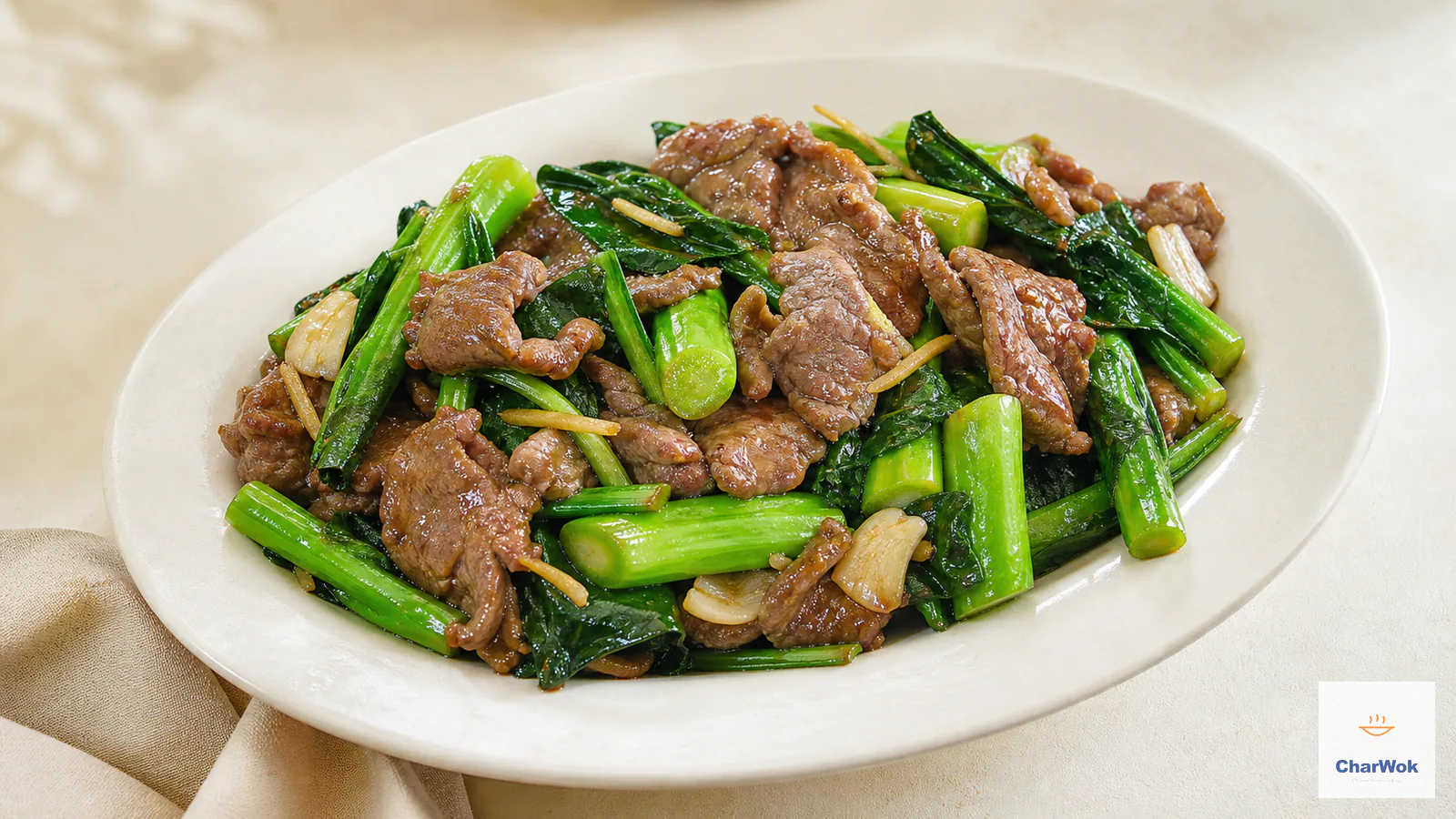
The blanched version takes additions well. A teaspoon of toasted sesame oil in the sauce adds a nutty top note. A small spoonful of fried shallots or a pinch of toasted sesame seeds on top gives crunch. If you want the dish to stand on its own as a light meal, lay a few slices of oyster-sauce-braised chicken over the stalks, or fold in the beef from a beef and gai lan stir-fry; the sauce recipe here works as a finishing glaze for that combo too.
For the stir-fry, the easy variations are aromatic. Add a teaspoon of fermented black beans, rinsed and mashed, with the garlic, or finish with a few dried chilies bloomed in the oil. Oyster mushrooms or king oyster mushrooms sliced and stir-fried alongside make the dish substantial enough to be a main; the garlic-sauce treatment in king oyster mushroom with garlic sauce is a close cousin worth borrowing from.
For the table, these dishes are sides. Serve either one alongside a saucy braise like Sichuan boiled fish or a simple stir-fried protein. The bitterness and the clean green taste are exactly what a heavy or salty main course needs next to it. A primer on the condiments used here is worth keeping handy if you are building out the pantry.
Storage and reheating
Cooked gai lan does not improve with time, and the blanched version reheats better than the stir-fried one. Leftovers keep one day, refrigerated, in an airtight container. Reheat the blanched stalks gently in a covered pan with a splash of water, or briefly in the microwave; expect some loss of crunch. The stir-fried version is best eaten immediately, and if you must reheat it, do it fast in a hot pan, never in a slow microwave, which turns the leaves gray and slimy. I do not recommend freezing either dish.
Questions home cooks actually ask
Below is a quick FAQ, and the structured data for it follows so search engines can surface these answers directly. The wording is intentionally tighter than the explanations above.
FAQ
- Can I use regular broccoli instead of gai lan? Yes for the stir-fry, less so for the blanched version. Gai lan's long peeled stem is the point of the oyster-sauce dish; standard broccoli florets will not give you the same texture or the balancing bitterness.
- Why is my gai lan so bitter? Late-season bunches and ones with open yellow flowers are more bitter. Peel the stems fully, blanch stems a little longer to draw out bitter compounds, and do not skip the sugar in the sauce.
- Do I need a wok for the stir-fry? No. A wide skillet works if you keep the heat high and avoid overcrowding. The one rule: never preheat a non-stick pan empty; add oil first, then heat.
- Is there a vegan or gluten-free option? Yes. Swap oyster sauce for mushroom vegetarian stir-fry sauce for a vegan version, and use tamari or gluten-free soy sauce along with gluten-free oyster sauce for gluten-free.
- Can I make the sauce ahead? You can mix the sauce ingredients a day in advance, but cook it fresh. Cornstarch thickeners break down and weep if held warm for long.