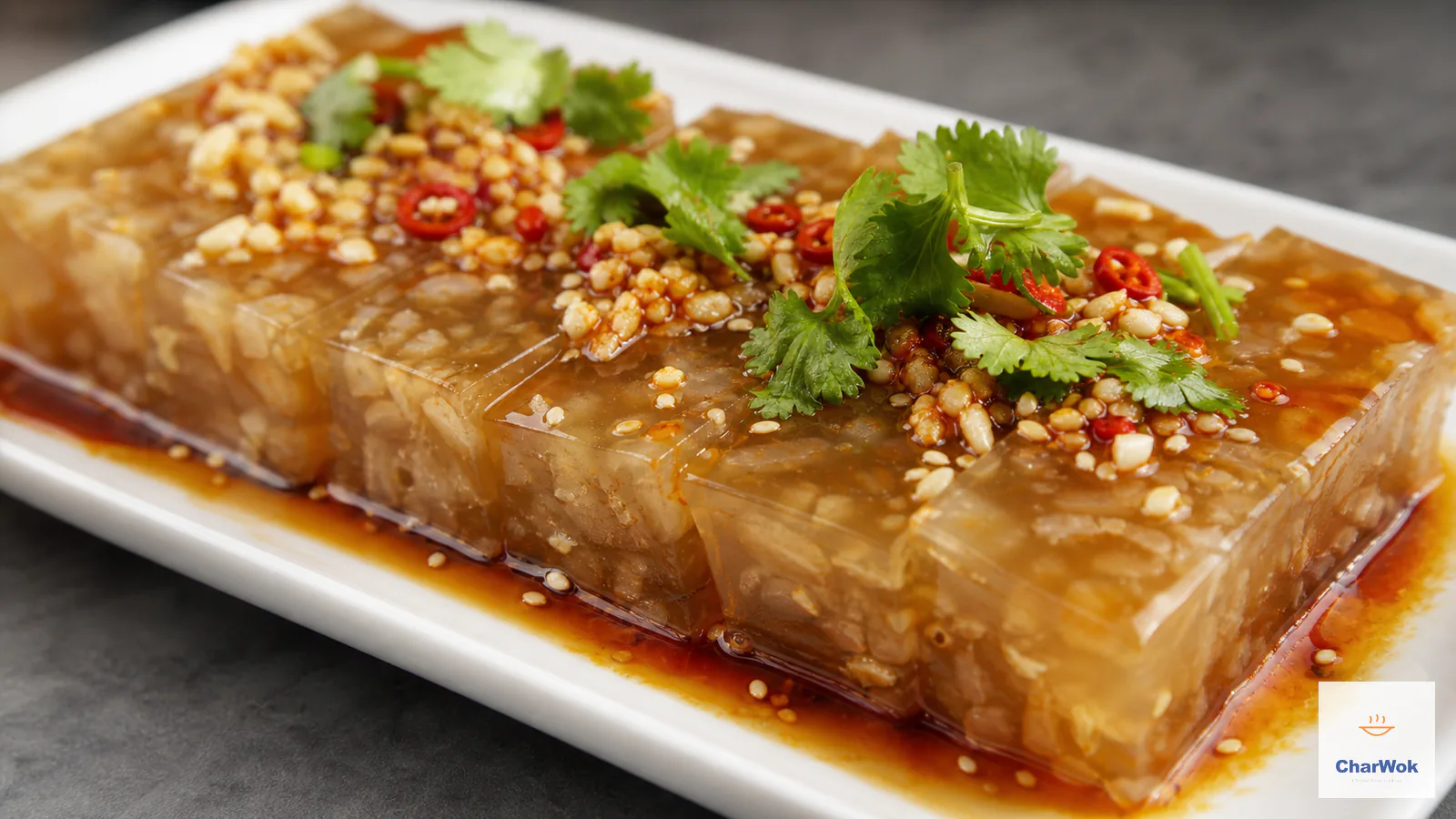
The first time a friend handed me a slice of cold pork rind jelly dressed in black vinegar and chili oil, I trusted none of it. The block was translucent amber with pale ribbons running through it, it wobbled when the plate moved, and it had clearly spent the night in the fridge. I was sure I was about to eat leftover gravy. One bite fixed that. It was clean, bouncy, and savory in a way cold gravy could never be, and the dressing cut right through the richness. I've been making it every few months since, usually in summer when the idea of standing over a wok is unbearable.
Pork rind jelly (rou pi dong, 肉皮冻) is the Chinese branch of a very old idea: simmer collagen-rich skin and bone in water, then let the liquid set into a tender, sliceable aspic. No packets of powdered gelatin, no shortcuts. The set comes entirely from the collagen that dissolves out of the rind during a long, gentle simmer and then re-forms a gel as the broth cools. It is one of the most honest dishes in the Northern Chinese cold-table repertoire, and once you understand the one rule that decides whether it sets, it is nearly impossible to get wrong.
At a glance: Use roughly 1 part trimmed pork rind to 3 parts water by weight (200 g rind to 600 ml water here). Simmer, covered, 50 to 60 minutes until the rind is tender enough to mash, then chill at least 4 hours. The single make-or-break detail is the water ratio, too much and you get a wobbly soup that never firms up.
What pork rind jelly actually is, and where it comes from
This is a cold appetizer from the Northern Chinese and Shandong tradition, the same branch of cooking that gives us garlic-slicked cold pork and the chilled poultry of the dim sum cart. In a classic multi-dish Northern meal it appears as a small plate near the start, meant to wake up the palate with acid, garlic, and a low hum of chili. You will also see a nearly identical technique behind the scenes of soup dumplings, where a clear, jellied pork stock is folded into the raw filling so that it melts into soup inside the steamer. Same science, two completely different destinations.
What surprises people is that nothing artificial is happening. Collagen is the structural protein that makes raw skin tough and rubbery. Heat it in water and the long collagen fibers unwind into shorter strands called gelatin. Cool those strands and they tangle back into a three-dimensional net that traps the surrounding liquid, which is exactly what a gel is. Reduce the heat too far and you stop extracting collagen. Add too much water and you dilute the gelatin below the concentration needed to set. That is the whole dish, distilled.
The ingredients, and the calls I make on each
Complete ingredients for Chinese pork rind jelly salad
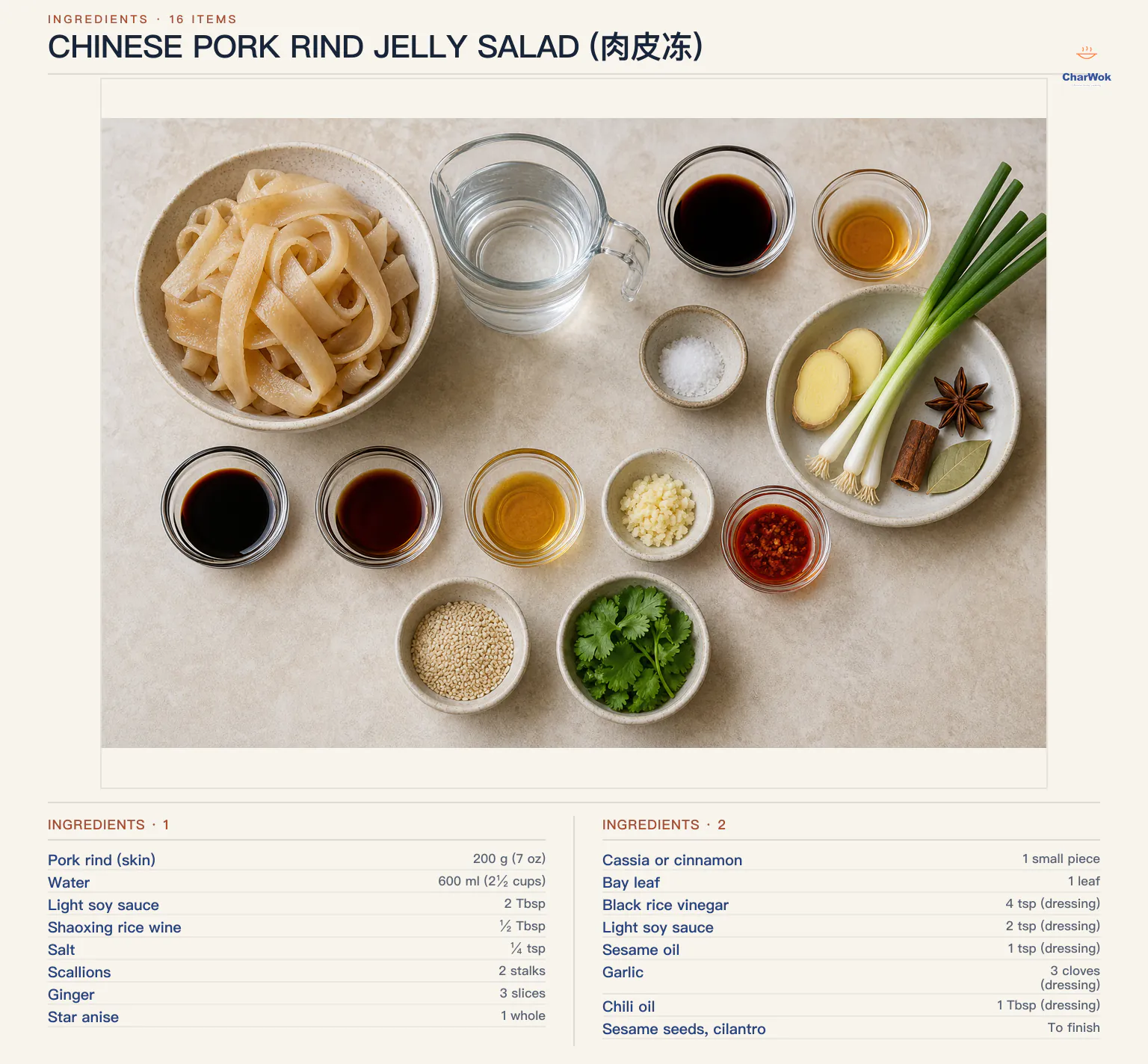
Pork rind is the only ingredient you cannot swap. You want skin from a part of the pig with a thick, clean dermis, belly or shoulder rind both work, and you want it trimmed of the fat layer underneath. Fat does not contain collagen and it makes the finished jelly cloudy and greasy, so scrape it off. Most Asian grocers sell raw pork skin cheaply; a good butcher will also save it for you if you ask.
The aromatics, soy, and wine go into the braise to give the broth a backbone. They are not negotiable in spirit but they are flexible in form: scallion, ginger, star anise, cassia, and bay are the standard five, and you can lean on Shaoxing rice wine to round off any barnyard edge from the skin. For the dressing I use a black rice vinegar base because its malty depth matters more here than the sharper ping of plain rice vinegar; if you only have the latter, it will still work, just less interestingly.
| Ingredient | Amount | Notes / substitute |
|---|---|---|
| Pork rind (skin) | 200 g (7 oz) | Trim all visible fat off the underside. Belly or shoulder rind both work. |
| Water | 600 ml (2½ cups) | Keep the 1:3 ratio. More water = softer, possibly unset jelly. |
| Light soy sauce | 2 Tbsp | For the braise. Light, not dark, so the jelly stays pale amber. |
| Shaoxing rice wine | ½ Tbsp | Removes any piggy smell. Dry sherry is a fair substitute. |
| Salt | ¼ tsp | The dressing carries most of the seasoning; keep the base lightly salted. |
| Scallions | 2 stalks | Halved, smashed lightly to release flavor. |
| Ginger | 3 slices | Smashed. Do not skip; it does most of the deodorizing. |
| Star anise | 1 whole | One pod only, more overwhelms. |
| Cassia or cinnamon | 1 small piece | Cassia is more authentic; regular cinnamon is fine. |
| Bay leaf | 1 leaf | Standard Turkish bay works. |
| Black rice vinegar | 4 tsp (dressing) | Chinkiang-style black rice vinegar preferred. |
| Light soy sauce | 2 tsp (dressing) | For the dressing. |
| Sesame oil | 1 tsp (dressing) | Toasted, pure sesame oil. |
| Garlic | 3 cloves (dressing) | Crushed to a rough paste. |
| Chili oil | 1 Tbsp (dressing) | Homemade chili oil with its sediment is best; minced fresh chili works too. |
| Sesame seeds, cilantro | To finish | Toasted sesame seeds and chopped cilantro (coriander) over the top. |
Step by step, with the why built in
- Blanch the rind before you do anything else. Drop the whole piece of pork skin into boiling water for about 3 minutes, then drain and rinse under cold water. This does two things you need: it shrinks and softens the skin so you can actually cut it, and it flushes out the surface scum that would otherwise cloud your jelly. Skipping this is the most common reason a batch turns out gray instead of clear.
- Scrape the fat while the skin is still warm. Lay the blanched rind skin-side down on a board and scrape the fat layer with the back of a knife or a bench scraper. You want to see clean white dermis. This step is tedious and it is the difference between a jewel-clear jelly and a greasy one, so do not rush it.
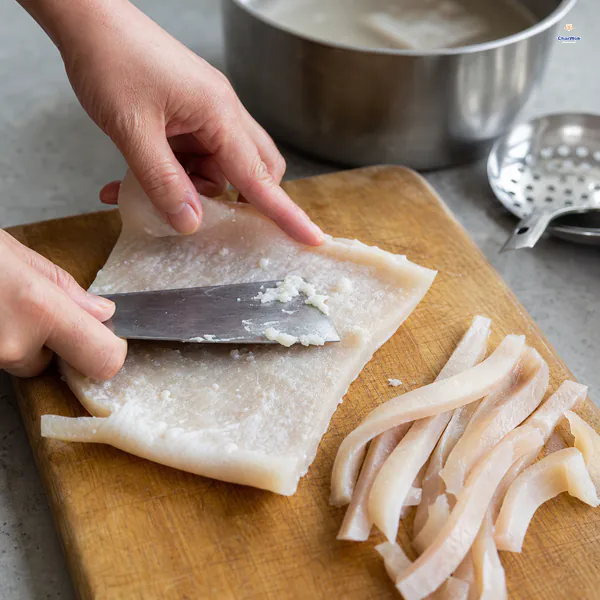
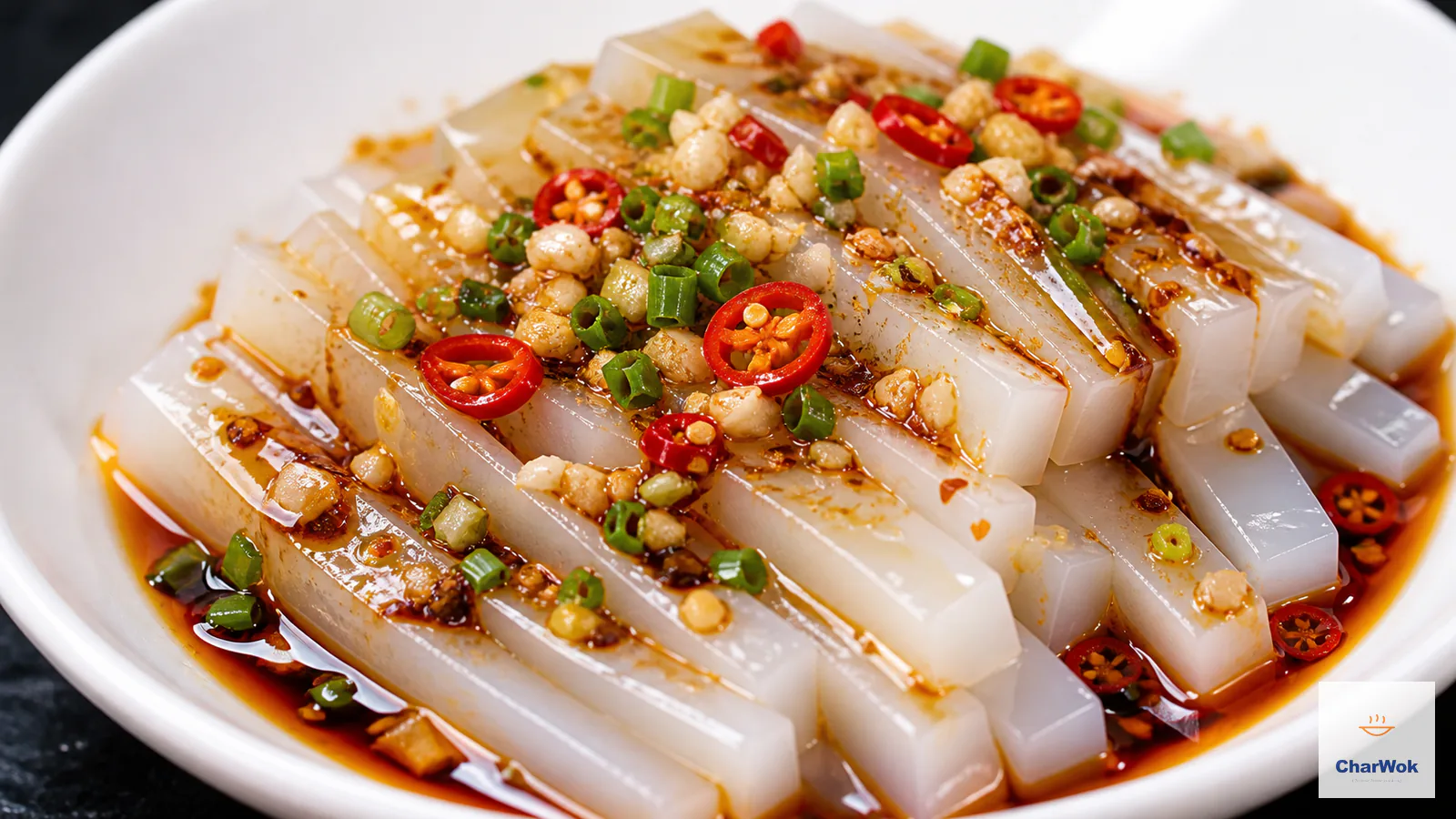
Blanch the pork rind for three minutes, scrape the warm inner side until no fatty layer remains, then cut it into narrow even strips.
- Cut into narrow strips. Slice the scraped rind into strips about 1 cm (just under ½ inch) wide. Thin strips expose more surface area, which means more collagen extracts in less time. Big chunks simmer forever and still feel rubbery in the center.
- Simmer, covered and gentle, 50 to 60 minutes. Combine the rind strips with the water, soy, wine, salt, scallions, ginger, star anise, cassia, and bay in a clean pot. Bring it to a boil, then drop the heat to the faintest simmer and cover. You want the occasional small bubble, not a rolling boil. A hard boil emulsifies fat into the broth and clouds it; a true simmer keeps the liquid clear while the collagen dissolves. The rind is done when a strip pressed between your fingers turns to mush.
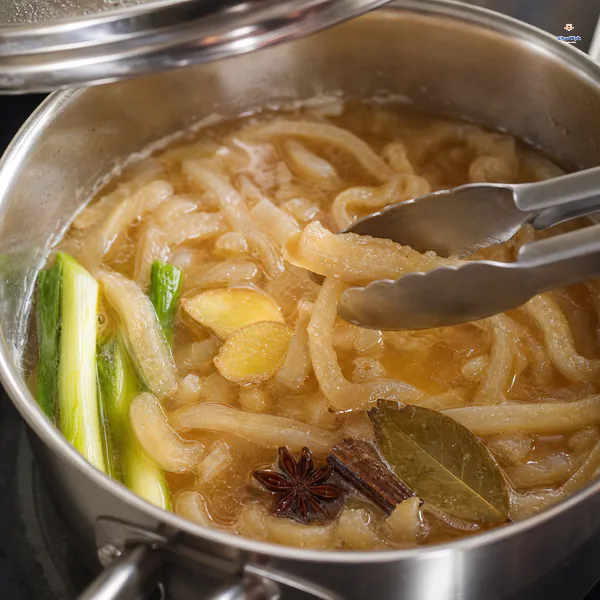
Cover and simmer the skin strips with the measured water and braising ingredients for 50 to 60 minutes, until a strip breaks easily.
- Strain out the solids. Fish out and discard the scallions, ginger, and whole spices. The tender rind strips go into the container too; they will be suspended in the set jelly and are part of what you eat.
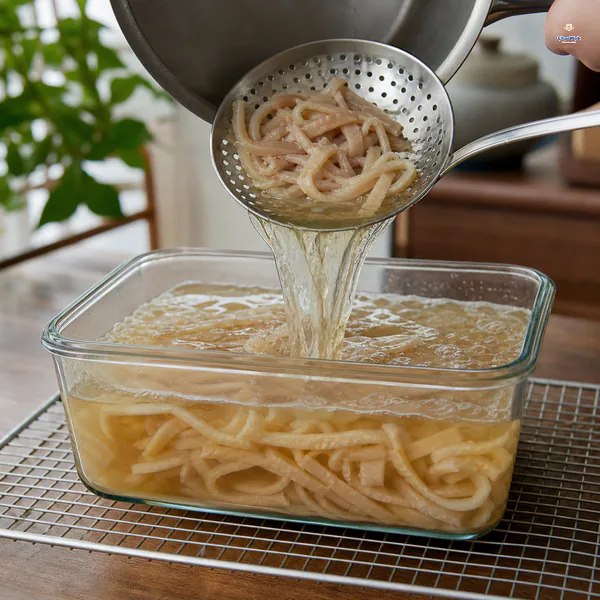
Remove the scallions, ginger and whole spices completely, then pour the broth and skin strips into a clean container and cool at room temperature.
- Pour into a container and cool to room temperature first. A loaf pan or a glass dish works. Let it sit on the counter until it is no longer warm before it goes into the fridge. Putting hot broth straight into the fridge can raise the temperature of everything around it and cause condensation that waters down the surface.
- Chill at least 4 hours, ideally overnight. The jelly needs to be cold all the way through to set firmly. Overnight gives a cleaner texture and a neater slice.
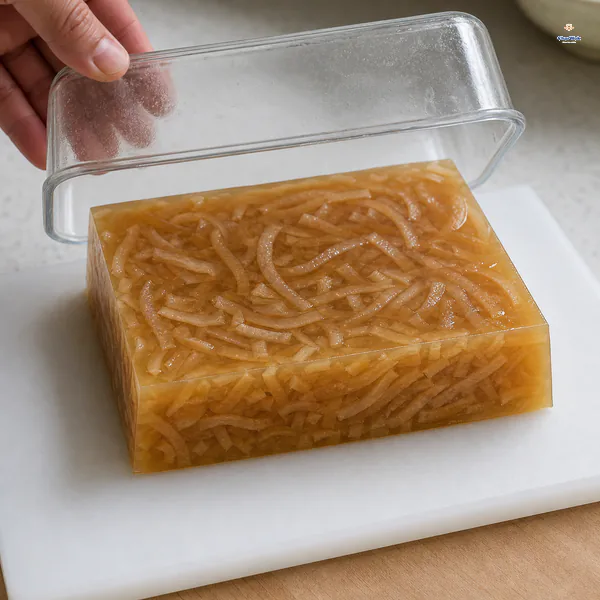
Refrigerate for three to four hours until the jelly becomes a hard block that releases cleanly and holds its own weight.
- Slice and dress just before serving. Cut the cold block into thin slices or small cubes, however you like to eat it, and arrange on a plate. Whisk the dressing ingredients together, pour it over, and finish with toasted sesame seeds and cilantro.
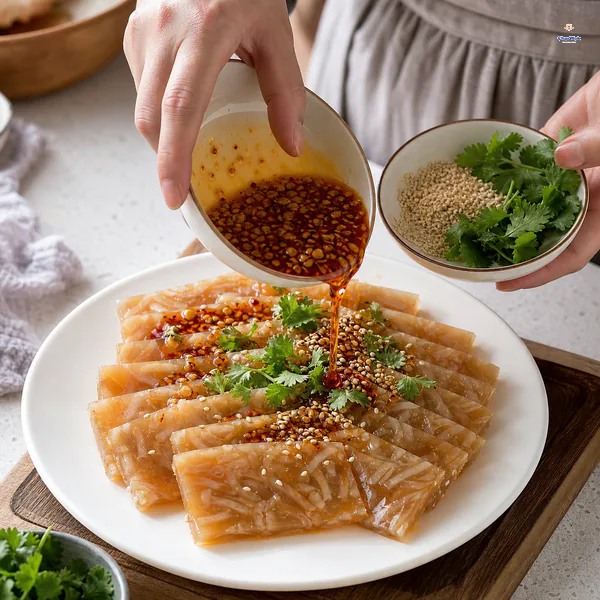
Slice the cold block, mix the complete dressing, pour it over the jelly and finish only with toasted white sesame and cilantro.
When it refuses to set, and other failures I have personally made
I have ruined this dish more times than I have nailed it, always for the same handful of reasons. Here is how to recognize each failure and rescue it.
The jelly is liquid after a full night in the fridge. Almost always a water-ratio problem. You either added too much water or the lid was off and you lost track. Taste the unset broth; if it tastes dilute, pour it into a wide pan and reduce it by a third over low heat, then re-chill. The gelatin is already in there, you just need to concentrate it. If the broth tastes rich but still will not set, the rind was too fatty or you did not simmer long enough, and there is no rescue; start over with better-trimmed skin.
The jelly is cloudy or gray. Two causes: you skipped the blanch, or you boiled instead of simmered. Both whip proteins and fat into suspension. Next time, blanch religiously and keep the simmer so gentle you can count individual bubbles.
The jelly is rubbery and dense. You used too little water or simmered too long and the broth reduced past the point of a tender set. It is still edible, just slice it thinner and lean harder on the dressing.
A greasy film sits on top. Fat was left on the rind. You can shave the solidified fat off the chilled block with a knife before slicing; the jelly underneath is usually fine.
It tastes bland. The base broth is meant to be lightly seasoned because the dressing does the heavy lifting. If the slices themselves taste flat, your dressing is too timid. Add more vinegar and garlic before reaching for salt.
The dressing is half the dish
Treat the dressing as a cold noodle sauce and you will not go far wrong. The version below is the same family as what I pour over smashed cucumber salad or glass noodle salad, and it does triple duty as a quick seasoning for stir-fries like egg fried rice noodles when you have nothing else planned. The balance you want is sharp vinegar up front, salt from the soy, fragrance from sesame oil, and a slow chili heat underneath. Taste it before you commit; the vinegar should bite, because the jelly will mellow it.
For a Sichuan-leaning plate, swap the chili oil for a spoonful of the fragrant chili oil you would use on Chongqing noodles, or finish with ground roasted Sichuan pepper for the numbing lift that pairs so well with cold, fatty textures.
Variations, and how to use leftover jelly
The most useful offshoot of this recipe is the clear aspic for dumpling fillings. After simmering, strain the broth through a fine sieve, discarding the rind strips this time, and chill just the liquid. Once set, mince it fine and fold it into a pork filling. Inside xiaolongbao or any pork and cabbage dumpling, the jelly melts in the heat of cooking and becomes the soup. This is the trick that separates a dumpling with broth from a dumpling without.
For the salad itself, a few directions worth trying: fold a little very finely julienned cucumber or rehydrated wood ear mushroom into the broth before it sets, so they are suspended in the jelly like fruit in a Jell-O mold. Or spike the braise with a dried chili and a pinch of Sichuan pepper for a warmer, spiced jelly that needs less dressing. For a banquet-style plate, serve the slices alongside Sichuan bang bang chicken and century eggs as part of a cold appetizer spread, the kind of spread that lets you feed a table without ever turning on the stove at the last minute.
Storage, and what it does to the texture
Keep the jelly, undressed and covered, in the fridge for up to 3 days. It will weep a little clear liquid as it sits, which is just the gel relaxing, and it will firm up slightly more on day two before softening again. Do not freeze it; frozen gelatin breaks into a grainy sponge when it thaws and never recovers. Dress only what you will eat at that meal, because once the vinegar and garlic hit the surface the jelly starts to weep faster and goes soft at the edges within a couple of hours.
A note on patience
This is not a weeknight dish in the usual sense. The active time is short, maybe ten minutes of scraping and a five-minute dressing, but the dish demands a long, unsupervised simmer and an overnight rest. I have tried to shortcut both and the jelly always suffers for it. Make it the day before you want it, set the container at the back of the fridge, and forget about it until the next afternoon. That is the whole trick, and it is the part no technique can replace.
Frequently asked questions
Can I use powdered gelatin to guarantee a set?
You can, but you lose the point of the dish. Powdered gelatin sets any liquid clear and firm, yet it gives a one-note wobble with none of the resilient bounce that real collagen provides. Reserve it as insurance only if your rind was poor quality and the broth refuses to firm up after reduction and an overnight chill.
Why did my jelly turn cloudy or gray?
Either you skipped the initial blanch, which would have flushed out the surface scum, or the broth was boiling instead of simmering, which whips fat and protein into the liquid. Blanch every time and keep the simmer barely moving.
How long does pork rind jelly keep?
Three days covered and undressed in the fridge. It firms up a touch more on day two, then slowly softens. Never freeze it; the gel structure breaks and turns grainy on thawing.
Is this the same jelly used inside soup dumplings?
Same technique, different use. For dumpling filling, strain out the rind strips and chill only the clear broth, then mince the set jelly into the raw pork mixture. It melts back to liquid during steaming and becomes the soup inside the wrapper.
Can I make it without pork, using chicken skin or feet?
Chicken feet and chicken skin set even more firmly because they are richer in collagen, and the flavor is lighter. The method is identical. Expect a paler, more delicate jelly that pairs especially well with the same ginger-soy dressing.