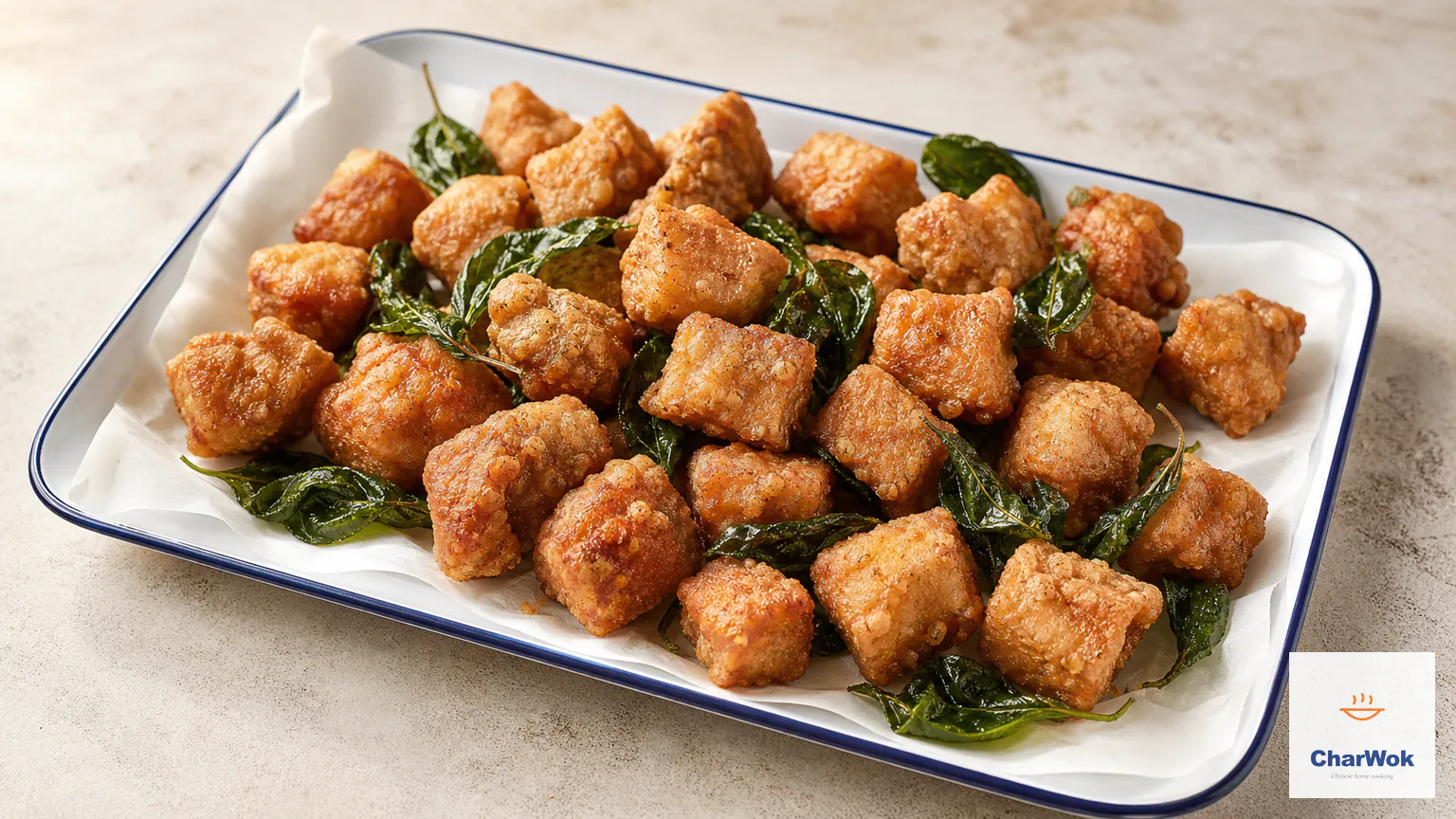
Taiwanese popcorn chicken should have a thin, crisp coating, juicy chicken, fried basil, and a light dusting of salt and five-spice. A coating that slips off or turns soggy usually points to one of three things: a marinade without enough starch to bind it, oil that has not recovered between batches, or a skipped second fry. This method addresses each one.
Taiwanese Yan Su Ji, commonly called popcorn chicken in English, is a night-market snack of bite-size chicken with a crisp coating and seasoned fried basil. This version uses a thin starch slurry, a dry starch-flour coating, two short fries, and a finishing dust of five-spice, salt, and optional chili. It can sit alongside Lu Rou Fan or Three Cup Chicken as part of a Taiwanese-style meal.
At a glance: cut boneless chicken into even 2.5 cm (1 inch) cubes, marinate for 15 minutes in the refrigerator, coat, then fry in batches at about 180°C (350°F). The first fry sets the coating; a short second fry crisps it. Time and color are guides only: check several of the largest pieces with a clean food thermometer and make sure every tested center reaches 74°C (165°F).
Why the marinade matters more than the coating
Most fried-chicken recipes use the marinade for flavor and add a separate coating. Here the marinade does both jobs. It is loose, almost like a thin batter, because it carries cornstarch and a little flour in suspension. That starchy paste clings to every cube, then grabs the dry coating when the pieces are rolled through it.
The baking soda in the marinade is the other quiet ingredient. A quarter teaspoon, dissolved in the water, gently raises the pH on the surface of the meat. That slight alkalinity keeps the proteins loose so the chicken stays tender through the hot oil instead of seizing into dry strings. It is a small amount on purpose, enough to soften the bite without leaving a metallic taste. More is not better. If you push it past half a teaspoon the chicken starts to taste soapy.
Five-spice powder goes into both the marinade and the finishing dust, adding the dish's warm anise-and-fennel notes. Ground Sichuan pepper or white pepper can stand in for it, although the flavor will be simpler. Black pepper is another option if that is what you have, but it produces a sharper profile.
Choosing the chicken
Boneless, skinless chicken breast cooks quickly but can dry out if it stays in the oil too long. Boneless thigh meat has more fat and is more forgiving when the oil temperature fluctuates. Either cut works; use the same safety check rather than relying on the cut, color, or a fixed frying time.
Cut the meat into roughly 2.5 cm (1 inch) cubes. Smaller and they overcook before the crust sets; larger and the outside burns waiting for the center. Try to keep them close in size so they finish together.
Ingredients
Ingredients at a glance
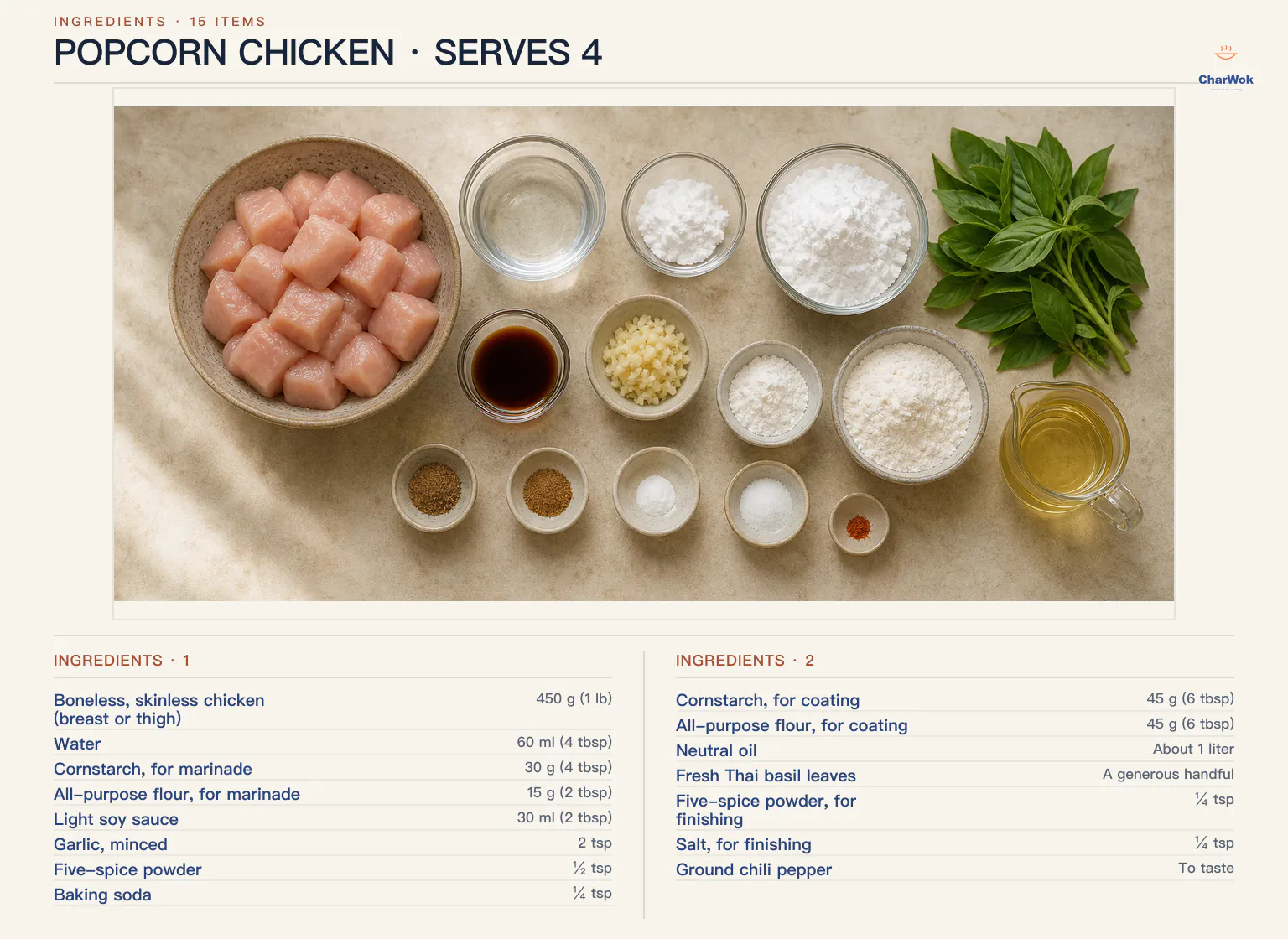
| Ingredient | Amount | Notes / substitute |
|---|---|---|
| Boneless, skinless chicken (breast or thigh) | 450 g (1 lb) | Breast is leaner; thigh is more forgiving during frying |
| Water | 60 ml (4 tbsp) | Forms the thin slurry that holds the coating |
| Cornstarch, for marinade | 30 g (4 tbsp) | The binder that locks the coating on |
| All-purpose flour, for marinade | 15 g (2 tbsp) | Helps the slurry cling |
| Light soy sauce | 30 ml (2 tbsp) | Light, not dark; dark will stain the crust |
| Garlic, minced | 2 tsp | Fine mince so it adheres |
| Five-spice powder | ½ tsp | Or ground Sichuan pepper, or white pepper |
| Baking soda | ¼ tsp | Optional; more may leave a soapy taste |
| Cornstarch, for coating | 45 g (6 tbsp) | Adds a crisp texture |
| All-purpose flour, for coating | 45 g (6 tbsp) | Adds structure to the coating |
| Neutral oil | About 1 liter | Sunflower, canola, peanut, or avocado; enough for 5 cm depth |
| Fresh Thai basil leaves | A generous handful | Optional; dry completely before frying |
| Five-spice powder, for finishing | ¼ tsp | Mixed with the salt |
| Salt, for finishing | ¼ tsp | Adjust to taste; kosher or fine sea salt |
| Ground chili pepper | To taste | Optional |
Method
- Cut and marinate in the refrigerator. Cube the chicken to about 2.5 cm (1 inch). Add the water, cornstarch, flour, soy sauce, garlic, five-spice, and baking soda. Stir until the liquid is cloudy and lightly coats every cube. Cover and refrigerate for 15 minutes, or up to 4 hours; keep the chicken cold until you are ready to coat and fry it.
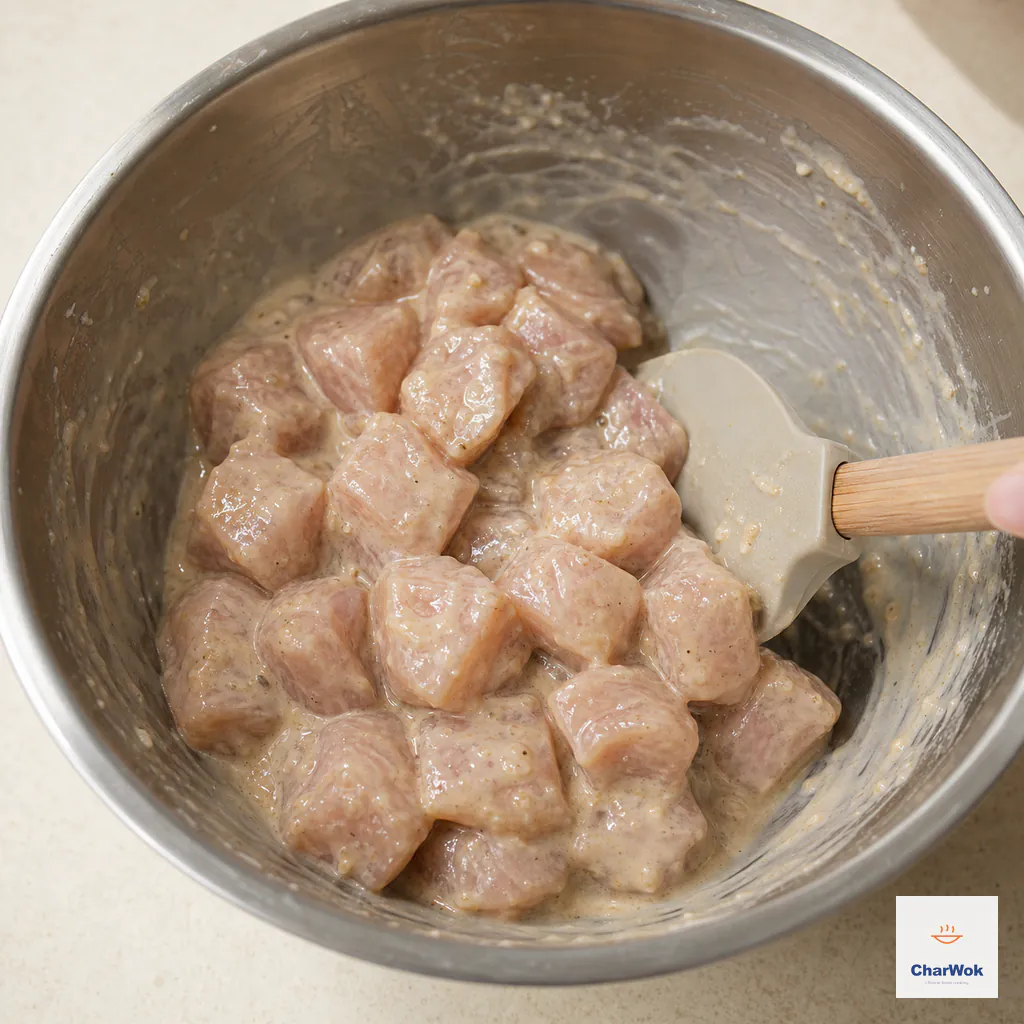
Coat every 2.5 cm cube with the thin slurry, then cover and refrigerate for 15 minutes; keep the raw chicken cold until coating
- Mix the coating. In a wide, shallow dish, whisk the 45 g cornstarch and 45 g flour together. A 1:1 ratio is what makes the crust shatter crisply, starch alone turns gluey, flour alone turns tough. The blend gelatinizes in the oil and sets into a glassy shell.
- Coat one piece at a time. Lift a cube, let the loose marinade drip off for a second, and roll it in the dry mix. Press lightly so the coating sticks, then shake off the excess. Lay it on a dry plate. Repeat. Coating pieces individually is slow but it is the only way to get an even crust. Dumping the whole bowl in at once leaves bare patches and gummy clumps.
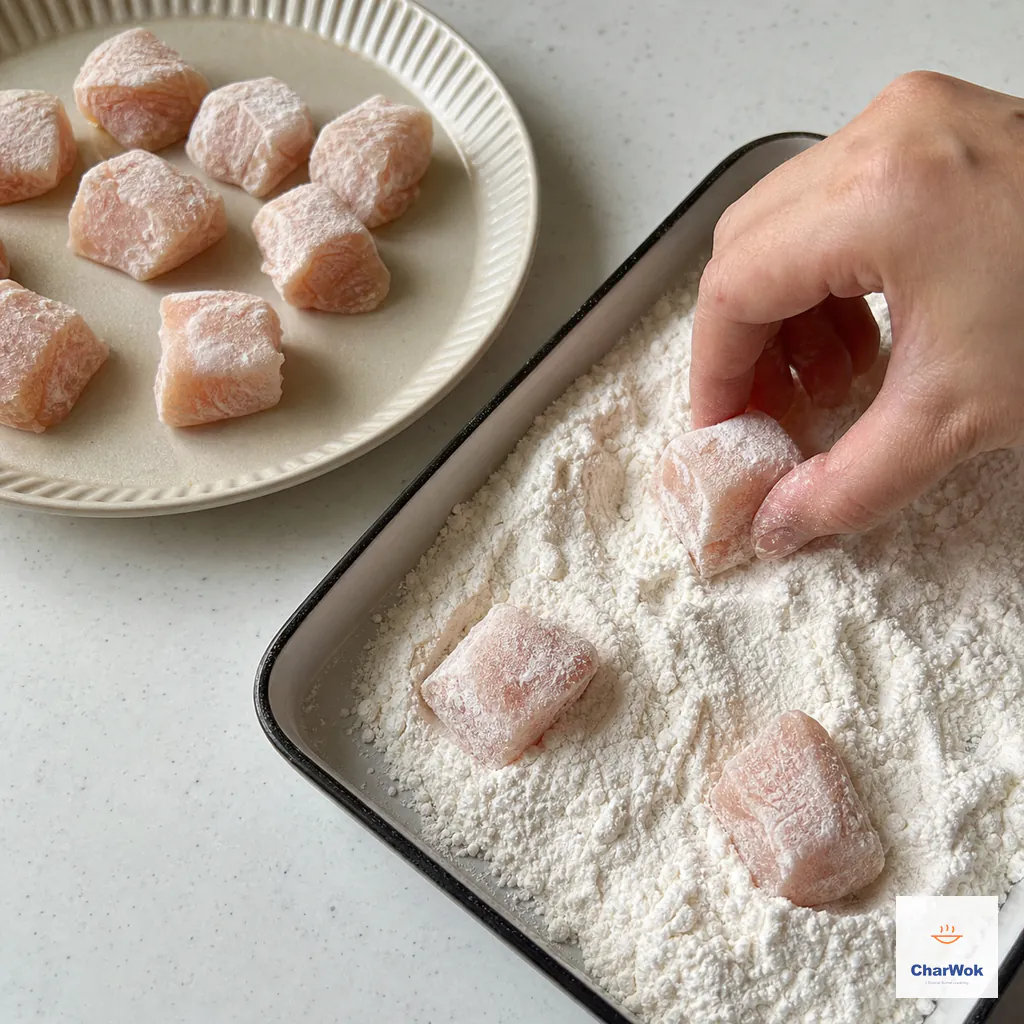
Coat one cube at a time, press lightly, shake off the excess, and leave only a thin snowy film rather than a thick breaded shell
- Heat the oil. Pour oil to a 5 cm (2 inch) depth into a wok or deep, heavy pot, leaving plenty of headroom, and heat it to 180°C (350°F). An oil thermometer is the most reliable guide. Bubbles around a wooden chopstick can suggest that the oil is hot, but they cannot confirm either the oil temperature or whether the chicken is safely cooked.
- Fry the basil first (if using). Make sure the Thai basil leaves are completely dry; water in hot oil splatters violently and can burn you. Drop them in and watch them closely. They crisp in 10 to 15 seconds, sometimes less. Scoop them out the instant they stop violently bubbling and drain on paper towel. They are the garnish that perfumes the whole plate.
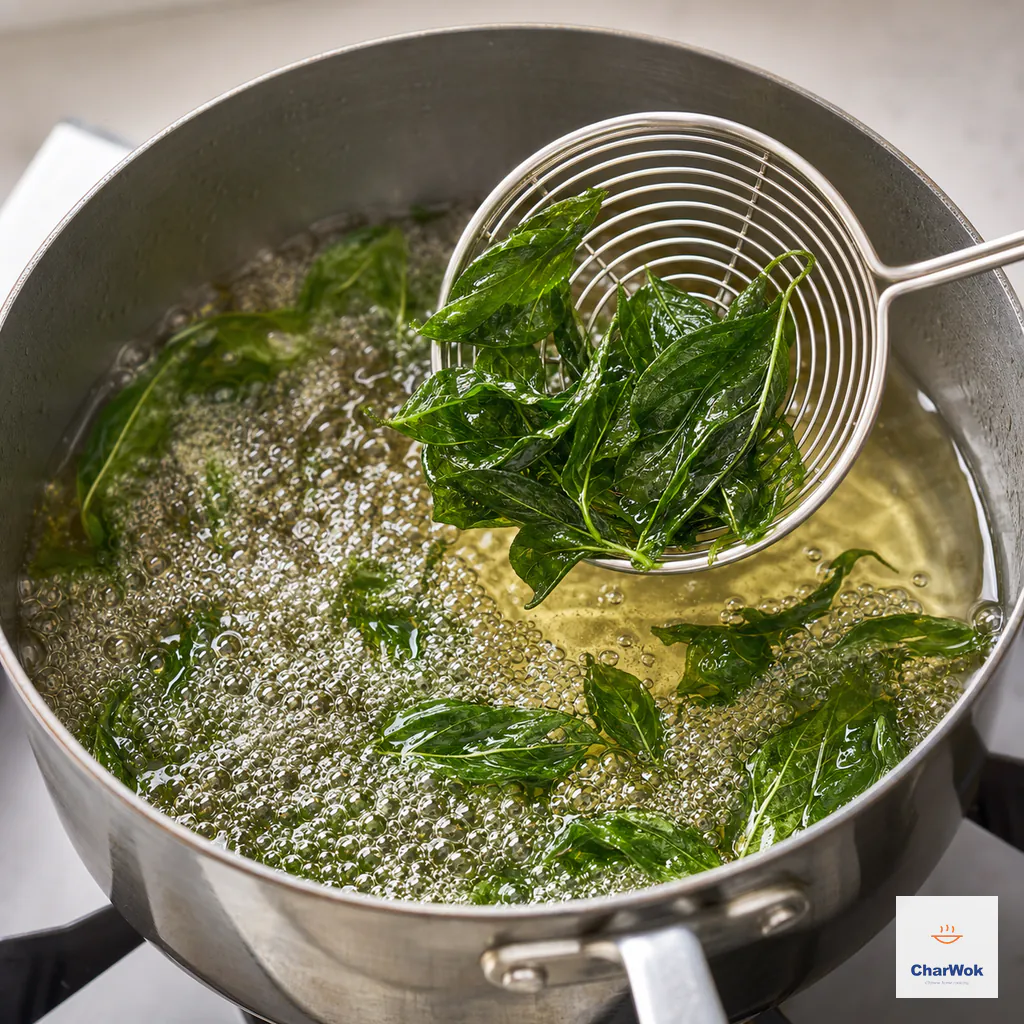
For this English method, add bone-dry basil only after the oil reaches 180°C and remove it as soon as the violent bubbling subsides, usually after 10 to 15 seconds
- First fry, in batches. Lower the coated chicken in one piece at a time so the cubes do not stick together, and do not crowd the pot. Fry in two or three batches until the thin coating looks pale, matte, and set, then remove with a slotted spoon and drain. The exact time depends on the size of the pieces, the pan, and how quickly the oil recovers.
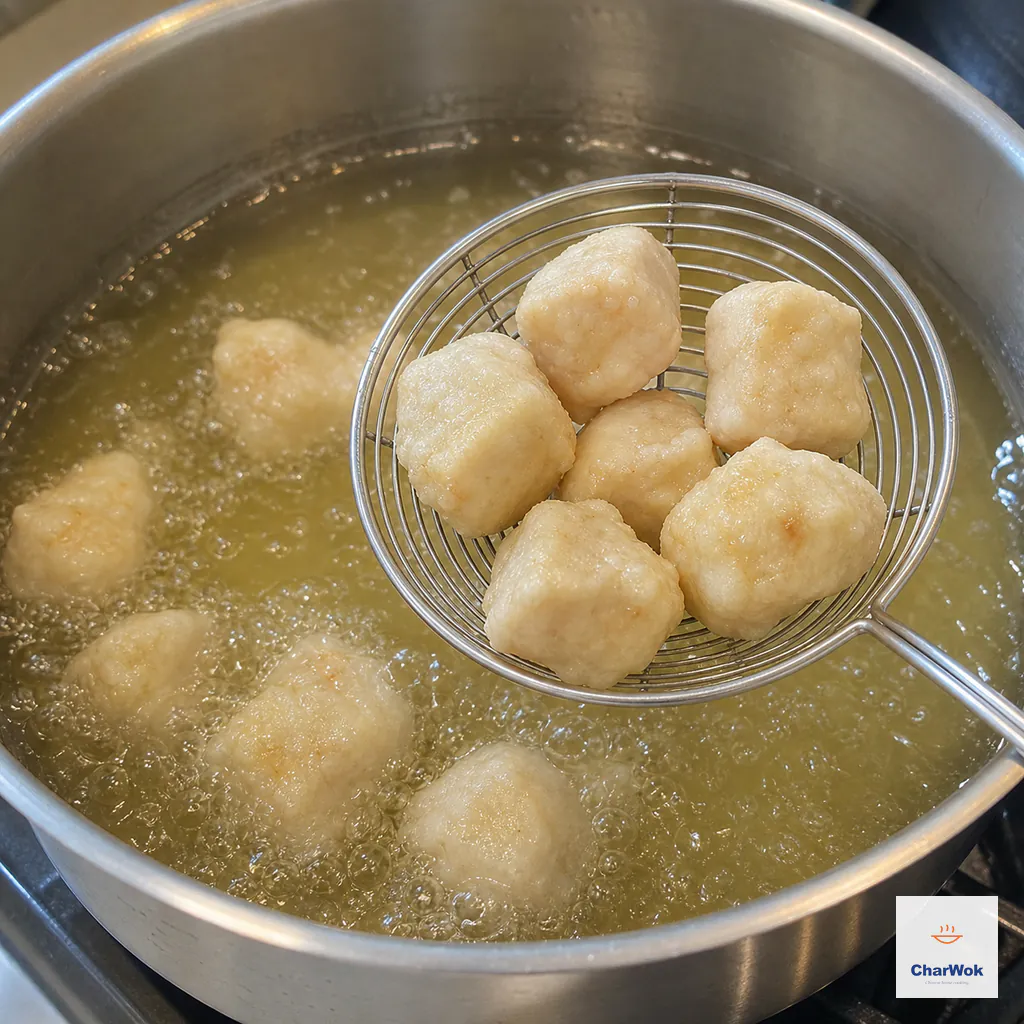
Fry in two or three batches until the thin crust looks pale, matte, and set; this visual cue does not confirm that the chicken center is cooked
- Rest, second fry, then check the center. Let the chicken rest for 30 to 40 seconds while the oil returns to 180°C. Fry it again briefly until the coating is dry and deep golden. Transfer several of the largest pieces to a clean rack or plate and insert a clean food thermometer from the side into the center. Every tested piece must reach 74°C (165°F), the USDA minimum for poultry. If any one is cooler, return that batch to the oil, cook longer, and check again with a clean probe.
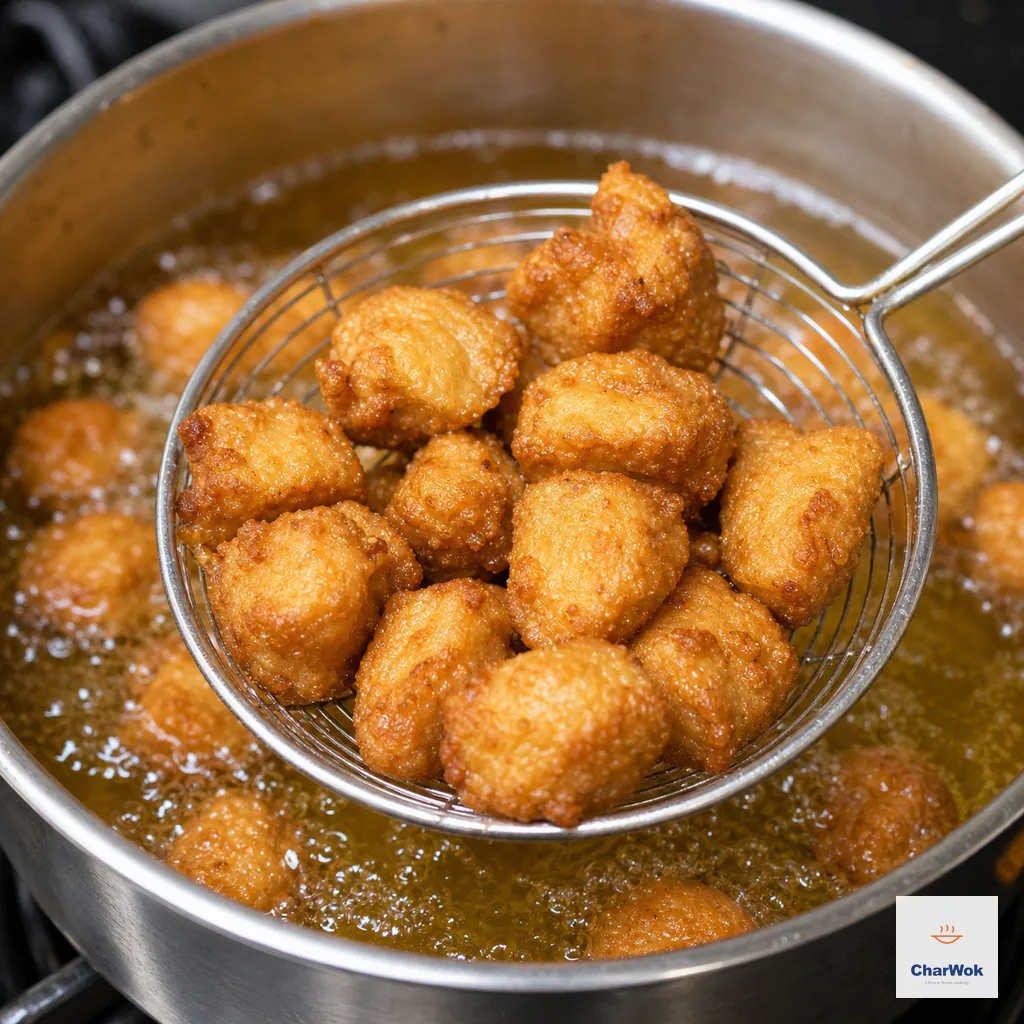
Let the oil recover, fry again until the crust is dry and deep gold, then check several largest pieces from the side; every tested center must reach 74°C (165°F)
- Finish and serve. Pile the chicken on the basil. Mix the finishing five-spice, salt, and a pinch of ground chili if you like heat, and sprinkle it over the hot chicken so it sticks. Eat immediately. Popcorn chicken waits for no one.
When it goes wrong
The crust slides off in the oil. The marinade lacked starch, or the coating was applied too thickly and not pressed on. Fix it next time by making sure the wet marinade is genuinely cloudy with cornstarch and by pressing each cube gently into the dry mix.
The chicken is dry and stringy. The pieces may be too small, the oil may have cooled between batches, or the chicken may have stayed in the oil longer than needed. Keep the cubes even, let the oil recover, and stop cooking once the largest pieces have reached 74°C (165°F). Thigh meat is more forgiving, but it needs the same temperature check.
The coating is pale and soft even after the second fry. Your oil was too cool, or you overloaded the pot and dropped the temperature 20 degrees in one go. Fry in smaller batches and let the oil recover to 180°C before the next round. A pale crust is almost always a temperature problem, never a recipe problem.
The crust blisters and falls apart. Too much water in the marinade, or the pieces were not drained before coating. Shake off the loose marinade so only a thin film remains.
It tastes metallic. You used too much baking soda. Drop it back to a strict ¼ teaspoon per 450 g of chicken and make sure it dissolves fully in the water before the chicken goes in.
Variations and what to serve alongside
The same coating and double-fry method works on other things. Salt and pepper wings and salt and pepper shrimp use a similar finishing dust, and the technique translates directly to squid for a quick salt and pepper squid. If you want heat, scatter Sichuan spicy peanuts over the plate, or serve a small dish of chili oil for dipping. For a Sichuan-leaning cousin that skips the coating, mala chicken (Laziji) buries fried chicken pieces in toasted dried chilies.
As a meal rather than a snack, popcorn chicken sits well next to the rest of a Taiwanese spread. Pair it with Taiwanese beef noodle soup for a soup-and-fry contrast, or keep it lighter with five-spice edamame and a cold drink. If you are building a fried-snack plate, add fried wontons for a different texture. It also earns a spot in a round-up of Chinese chicken recipes by cooking method or among favorite takeout-style dishes to make at home, and it belongs on any summer recipes list when you want something to eat with a beer on the balcony.
Storage and reheating
Popcorn chicken is crispest just after frying. Refrigerate leftovers in a shallow, covered container within 2 hours, or within 1 hour when the air temperature is above 32°C (90°F). Use refrigerated cooked chicken within 3 to 4 days. Reheat in a 200°C (400°F) oven or air fryer until the center reaches 74°C (165°F); 5 to 7 minutes is only a starting point. These storage and reheating limits follow the USDA chicken storage guidance.
Frequently asked questions
Can I skip the double fry? Yes, but the coating will be less crisp. The first fry sets the coating and the short second fry removes more surface moisture. Whichever method you use, verify that several of the largest pieces reach 74°C (165°F).
Can I bake or air-fry instead of deep-frying? Yes. Preheat the air fryer to 200°C (400°F), spray the coated pieces lightly with oil, and start checking after 12 minutes, turning once. Continue until several of the largest pieces reach 74°C (165°F); color alone does not prove doneness. The coating will be drier and less crisp than the deep-fried version.
What does the baking soda do? A small amount raises the surface pH and can make the chicken feel more tender. This recipe uses ¼ teaspoon per 450 g; using more may leave a soapy taste.
Why cornstarch and flour instead of just one? Starch gives the glassy crisp; flour gives structure so the coating holds together instead of flaking off into the oil. A 1:1 blend is the sweet spot for this size of piece.
Can I use chicken with the skin on? Not for this style. Skin traps steam under the coating and makes it bubble and detach. Skinless, boneless cuts are what the technique is built for.
How do I know popcorn chicken is safely cooked? Check several of the largest pieces with a clean food thermometer, inserting the probe from the side into the center. Every piece you test should read at least 74°C (165°F). Frying time, crust color, and clear-looking juices are not substitutes for that measurement.