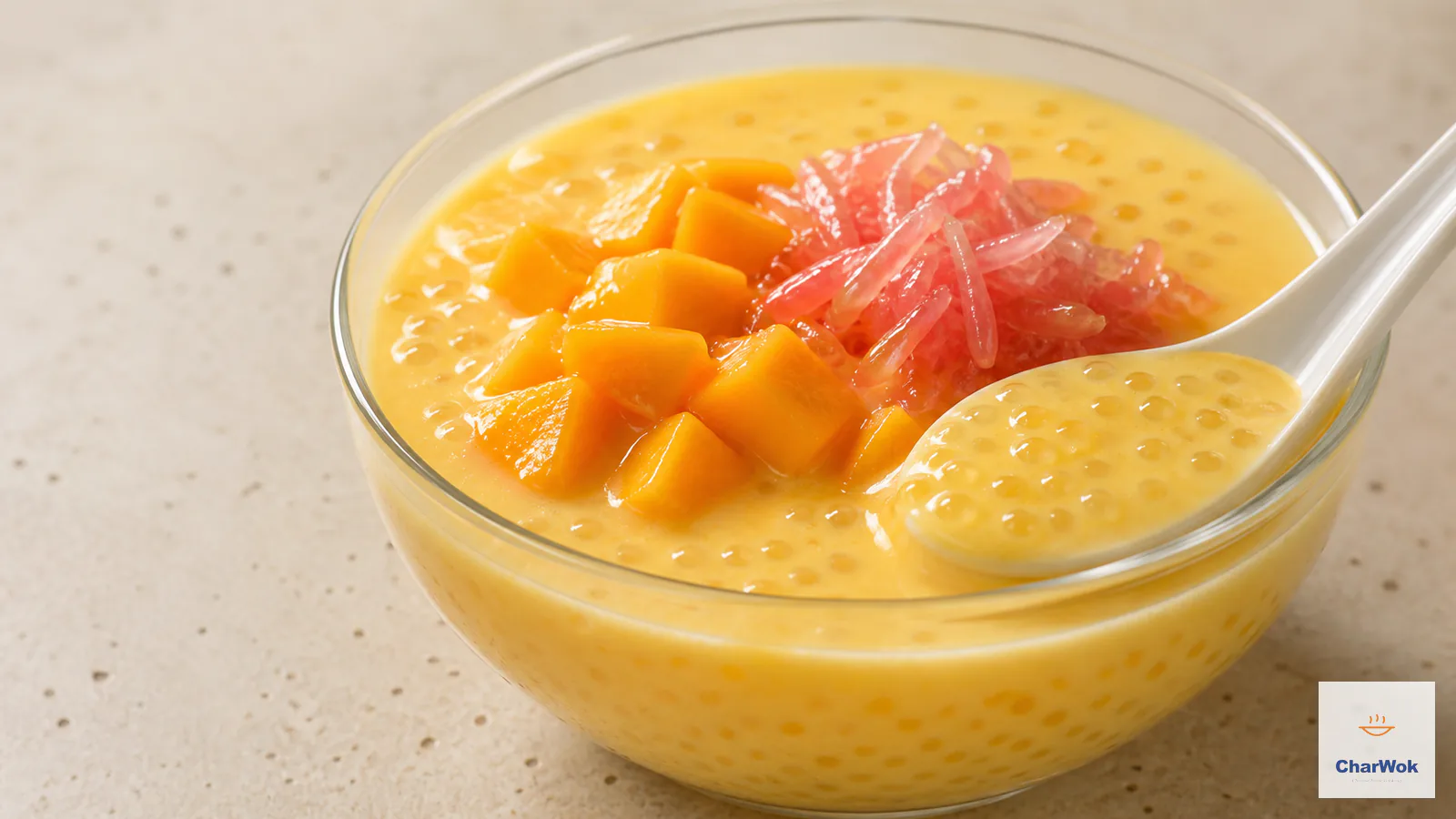
The first time I made mango sago at home, I ended up with a bowl of glue. The pearls had collapsed into paste, the mango had gone brown, and the whole thing tasted like warm baby food on a July afternoon. I had followed a recipe. I had still failed. That failure taught me the thing that matters most about this dessert: mango sago is not really a recipe, it is a timing exercise built around two starches that misbehave the moment you stop paying attention. Get the timing right and you get the Hong Kong cafe version, glossy and cold, the pearls floating like little glass beads in a coconut-mango soup. Get it wrong and you get porridge.
Two ripe mangoes, 40 g of small tapioca pearls, and roughly 25 minutes of cooking plus a 10-minute covered rest. The whole dessert lives or dies on one judgment call: pulling the pearls off the heat when each one is transparent with a faint white pinpoint left in the center, then letting carryover heat finish them. Pull them too early and the core stays chalky; too late and the pearls dissolve into starch slurry.
What this dessert actually is
Mango sago goes by the Cantonese name Yang Zhi Gan Lu, which has nothing to do with its ingredients and everything to do with marketing. The phrase borrows an image from Buddhist storytelling, dew falling from a willow branch, and some clever 1980s Hong Kong dessert-shop owner hung that poetic name on a cold mango soup to make it sound worth ordering. It worked. The dish is now on every Cantonese dessert menu worth its salt, usually listed alongside mango pancakes and other chilled fruit sweets that the Hong Kong school of dessert does better than anyone.
The structure is simple: a silky mango and coconut puree, chewy cooked tapioca pearls, diced fresh mango for bite, and a bitter-sour citrus pop on top. Traditional recipes use pomelo for that last element. I use grapefruit, the pink or ruby kind, because good pomelo is hard to find in a regular American supermarket and ripe grapefruit gives you the same color contrast and the same acidic cut against the mango sweetness. If you happen to have a sweet, low-pith pomelo, use that instead and break the sacs apart gently.
The two ingredients people get wrong
Tapioca pearls, not boba
Buy the small white tapioca pearls, roughly 2 to 3 mm across, sometimes labeled mini sago or small sago. These are the same family of starch balls you cook for bubble tea, but smaller and cooked more gently. The big black boba pearls are too large and too chewy for this dessert; they will overwhelm each spoonful. True sago, milled from the sago palm, is harder to source and cooks into a softer, slightly grainier bead. Tapioca pearls, milled from cassava root, are what most home cooks will find and they give the clean, glassy texture you want here. The two are not the same starch, but for this dessert they cook almost identically and you can swap them gram for gram.
One word of warning: do not buy the quick-cooking or five-minute tapioca. It turns to mush instantly and has none of the bounce.
Mangoes that are actually ripe
An underripe mango ruins this dessert in a way no amount of sugar can fix. You want fruit that yields when you press the skin, smells floral at the stem end, and has flesh that is deep orange all the way through. My first choice is the honey mango, also sold as Ataulfo or Manila mango: small, yellow, almost stringless, with a creamy sweetness that means you can skip added sugar entirely. Champagne mangoes are the same fruit under a marketing name. Tommy Atkins mangoes, the big green-and-red ones, work only if fully ripe, and even then you will battle fibers that clog the blender and string between your teeth. Peel and dice carefully, cutting the cheeks off the pit and scoring the flesh rather than hacking into the fruit.
Ingredients
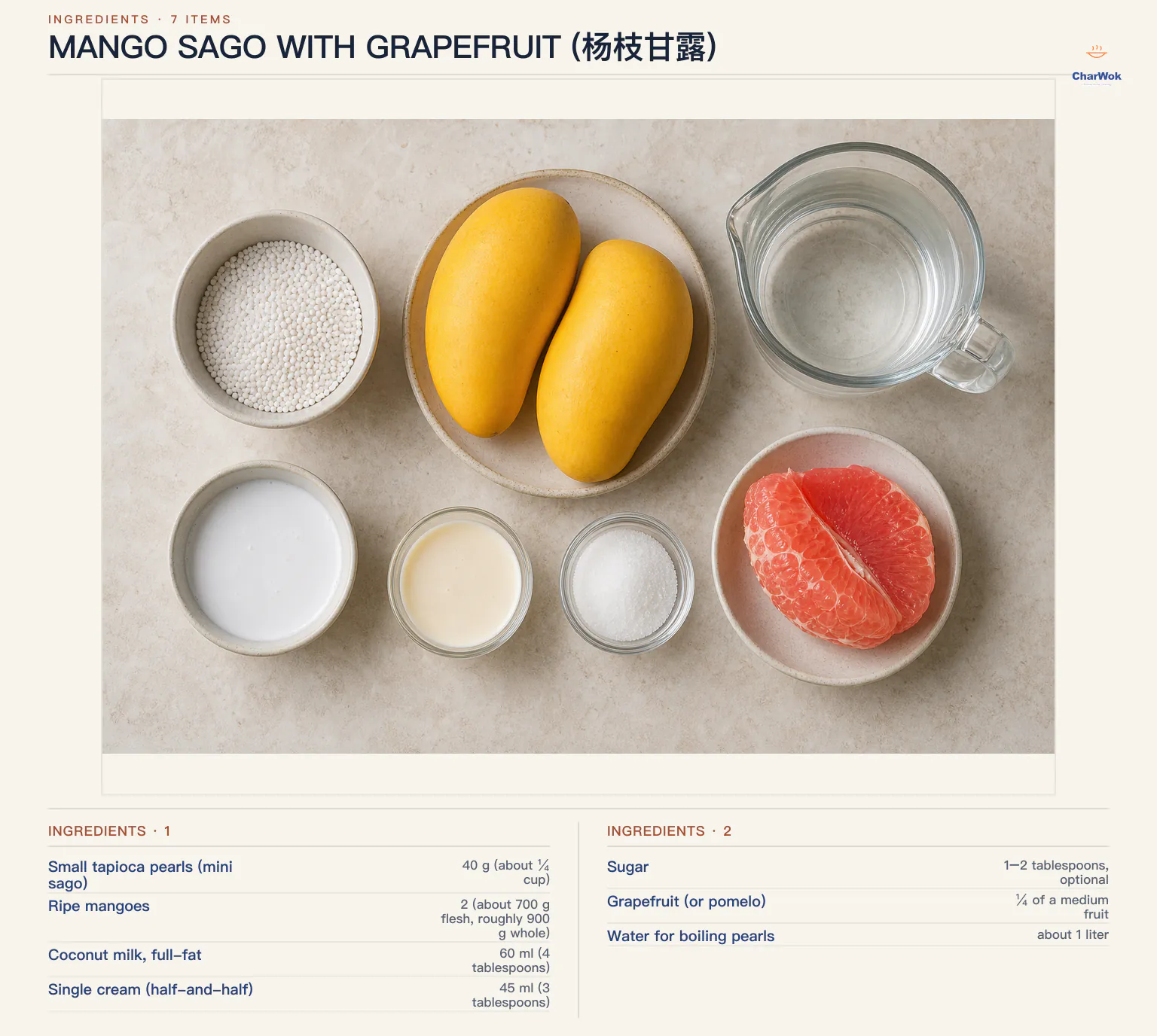
Mango sago ingredients at a glance
| Ingredient | Amount | Notes / substitute |
|---|---|---|
| Small tapioca pearls (mini sago) | 40 g (about ¼ cup) | White, 2–3 mm. Avoid quick-cooking. True sago works gram for gram. |
| Ripe mangoes | 2 (about 700 g flesh, roughly 900 g whole) | Ataulfo / honey / Champagne preferred. Tommy Atkins only if fully ripe. |
| Coconut milk, full-fat | 60 ml (4 tablespoons) | Canned, not the carton drink. Coconut cream thinned with water works. |
| Single cream (half-and-half) | 45 ml (3 tablespoons) | Whole milk for a lighter version; evaporated milk is the classic Hong Kong choice. |
| Sugar | 1–2 tablespoons, optional | Only if mangoes are tart. Honey or condensed milk also work. |
| Grapefruit (or pomelo) | ¼ of a medium fruit | Pink or ruby grapefruit for color. Pomelo if you can find a sweet one. |
| Water for boiling pearls | about 1 liter | Use plenty; the pearls leach starch and the water must stay loose. |
Why each step works
- Boil a full liter of water in a wide pot before the pearls go in. Tapioca is almost pure starch, and the first thing it does in hot water is shed a layer of loose starch granules that thicken the cooking liquid. If you start with too little water, that starch builds up, the water turns syrupy, and the pearls stick and clump before their interiors can cook. A large volume of water keeps the liquid thin enough for the pearls to tumble freely.
- Add the pearls only at a rolling boil, stir once, then drop to a low simmer and cover. The initial boil gelatinizes the outer layer of each pearl and seals it, which is what gives the cooked bead its skin. A hard rolling boil for the full cook, on the other hand, will mechanically bash the pearls apart. Low and covered is the compromise: enough heat to push gelatinization to the center, not so much turbulence that the beads disintegrate.
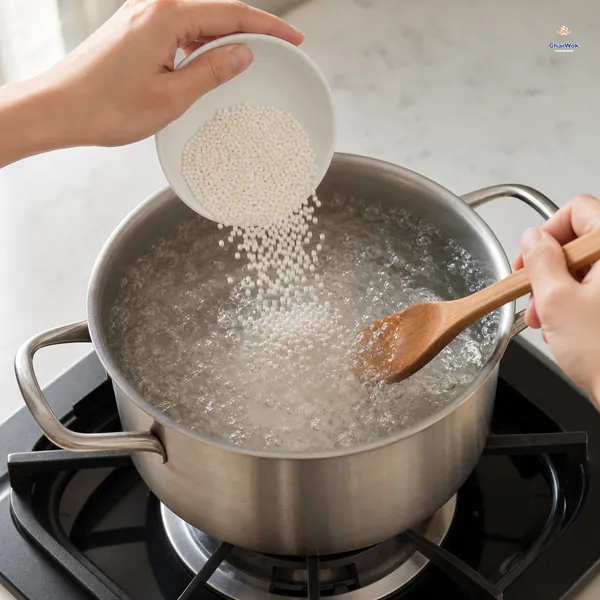
Start with a full liter of water at a rolling boil, add the mini pearls and stir once, then reduce to a covered low simmer.
- Cook 15 minutes, then kill the heat and rest covered another 5 to 10 minutes. This is the make-or-break step. At the 15-minute mark the pearls will look almost done but each one will still have a tiny opaque white dot at its core. That dot is ungelatinized starch, chalky on the tongue. Residual heat in the covered pot finishes it off without further boiling, the same way you finish a roast off the burner. Bite into one pearl to test; it should be tender all the way through with a faint, pleasant chew.
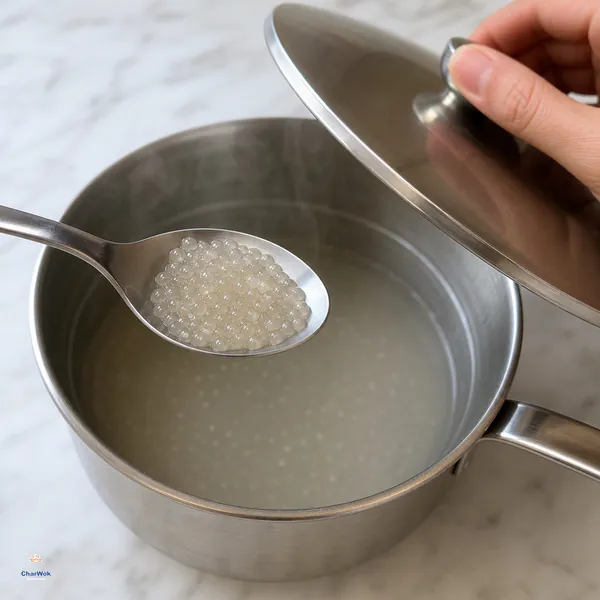
After 15 minutes, look for only tiny white pinpoints; turn off the heat and rest covered for another 5 to 10 minutes, until every pearl is transparent.
- Drain and rinse the pearls under cold running water. Cold water shocks the surface starch, stops the carryover cooking so the pearls do not continue softening into paste, and washes off the sticky film that would otherwise glue them together. Drain them thoroughly; wet pearls will water down your puree.
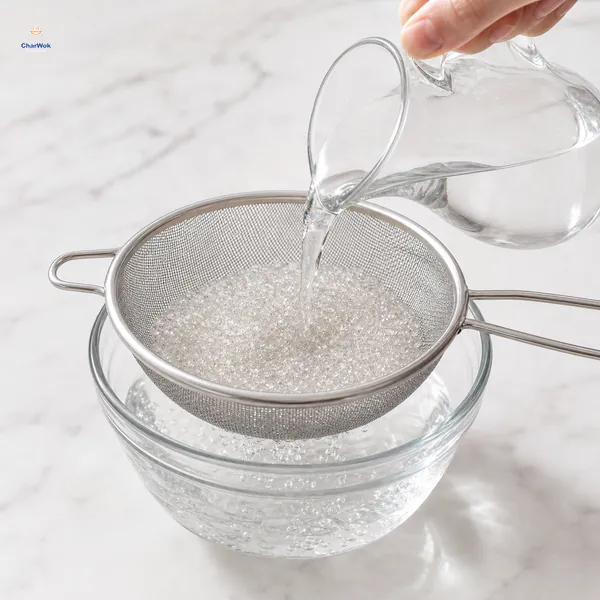
Rinse the cooked pearls with cold water to wash away loose starch and stop carryover cooking, then drain them thoroughly.
- Meanwhile, dice the mangoes. Cut the flesh off both cheeks and the sides, then dice one quarter of it into neat cubes for garnish and dump the rest, the less photogenic pieces included, into the blender. Holding back a portion of intact cubes is what gives the finished dessert its texture contrast; puree everything and you get smooth soup with nothing to chew.
- Blend the larger portion of mango with the coconut milk and cream until completely smooth. The fat in the coconut milk and the dairy carries the mango aroma, which is largely fat-soluble, and gives the puree its body. Blend longer than feels necessary, a full 30 to 40 seconds, so no fibers survive. Taste. Add sugar only if your mangoes were underripe; good honey mangoes will not need it.
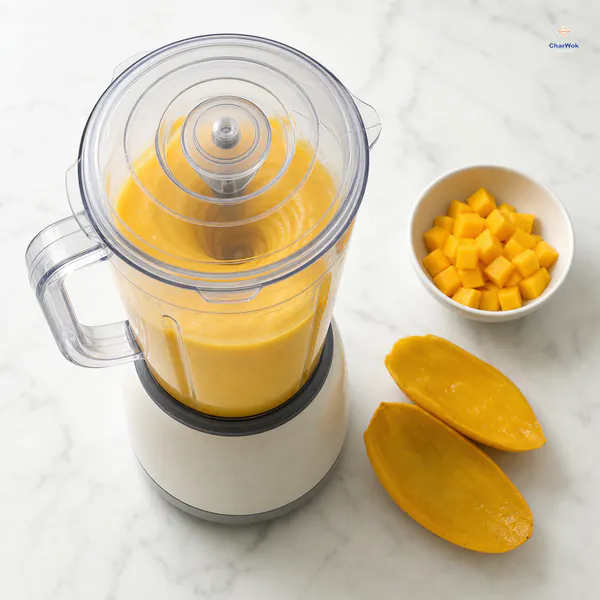
Reserve one quarter of the mango as neat cubes, then blend the rest with coconut milk and cream for 30 to 40 seconds, until completely smooth.
- Segment the grapefruit over a bowl to catch the juice. Cut away the peel and all the white pith, then slide the knife between membranes to release whole juice sacs. Squeeze the spent membrane into the bowl; that juice goes into the puree for a bright, slightly bitter note. If the grapefruit is very bitter, hold back some of the juice.
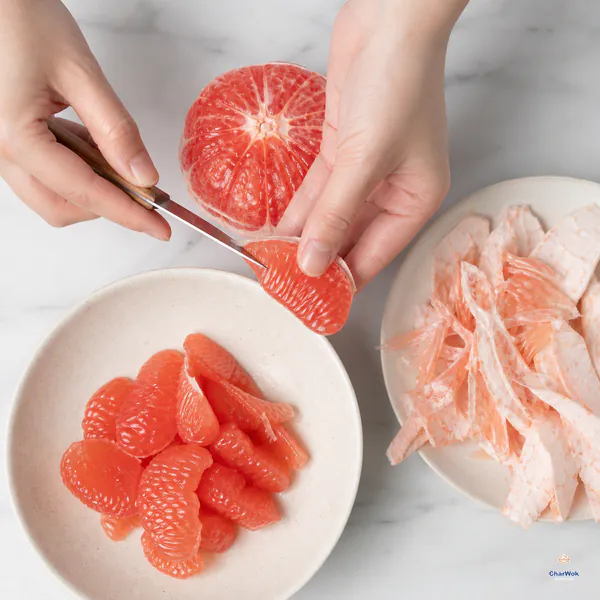
Remove the peel and all white pith, release the grapefruit sacs from their membranes over a bowl, and keep the bitter membranes out of the dessert.
- Assemble cold. Divide the rinsed, drained pearls between four bowls. Pour the mango puree over them, then scatter the reserved mango cubes and the grapefruit sacs on top. Chill at least 20 minutes before serving; the dessert is noticeably better cold than at room temperature because the chill tightens the pearls and sharpens the flavors.
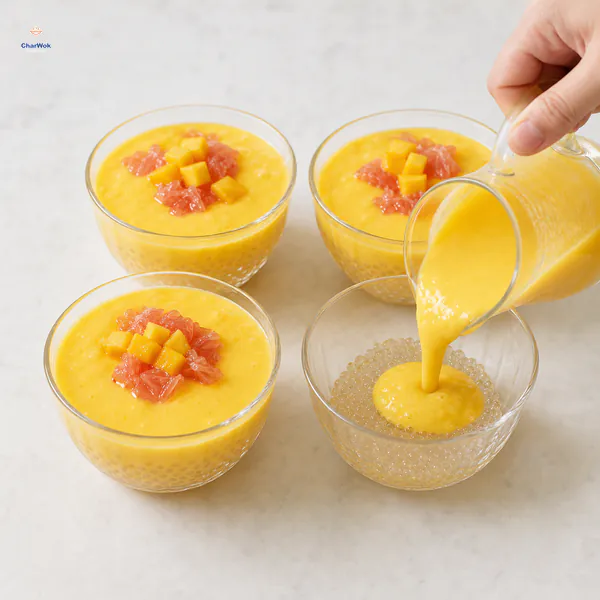
Divide the drained pearls among four bowls, add mango puree, mango cubes and grapefruit, then chill for at least 20 minutes before serving.
When it goes wrong, and how to fix it
I have made every mistake below at least once. Here is what to look for.
Pearls still have a hard white center
You pulled them off too early, or your pot was too small and the water temperature dropped when you added them. Put them back on low heat with a splash of boiling water, cover, and check every two minutes. Next time, start with more water and make sure it is at a true rolling boil before the pearls go in.
Pearls have dissolved into a starchy paste
Either you boiled too hard, cooked too long, or used quick-cooking tapioca by mistake. There is no rescuing dissolved pearls. Drain them off, rinse the pot, and start a fresh 40-gram batch; it is only fifteen minutes of work. The leftover mango puree keeps fine in the fridge while you redo the pearls.
The puree has gone brown or gray
Mango flesh oxidizes once cut, the same way an apple does. The puree will dull within an hour at room temperature. To slow it, blend the mango with the citrus juice from the grapefruit first; the acid and vitamin C in the juice slow browning. Then keep the puree covered and chilled until assembly. A truly brown puree means the mangoes were bruised or overripe; start over with fresher fruit.
The dessert tastes flat
Nine times out of ten the mangoes were not sweet enough, and the cook hoped the coconut milk would carry it. It will not. Fix the current batch with a teaspoon of honey or condensed milk blended into the puree, and next time shop harder for ripe honey mangoes. The other possibility is that the coconut milk was the watery carton kind; canned full-fat coconut milk is non-negotiable here.
Pearls have clumped into a single rubbery mass
They were not rinsed, or were not drained well, or sat too long before assembly. Break the clump apart with wet fingers, rinse again under cold water, and use immediately. Once assembled in the puree, the pearls will separate on their own as the dessert sits.
Variations and pairings
This is a flexible template. Once you trust the pearl-cooking method, you can riff on the fruit freely.
Pomelo classic. Replace the grapefruit with segmented pomelo for the most traditional version. Pomelo is sweeter and less juicy, so the citrus bite is gentler. This is closer to what a Hong Kong dessert shop serves.
Pure vegan. Swap the single cream for coconut cream or oat milk and use canned full-fat coconut milk throughout. The dessert becomes fully plant-based with no real loss in texture.
Papaya or passionfruit twist. Half ripe papaya blended in with the mango adds a melon-like softness. A spoonful of passionfruit pulp pooled on top of each bowl gives an acidic hit that plays the same role as the grapefruit but with tropical aromatics.
Condensed milk Hong Kong style. Replace the single cream with evaporated milk and sweeten the puree with a tablespoon of sweetened condensed milk. This is the richer, sweeter cafe version, closer to a milkshake than a fruit soup.
For pairing, mango sago sits comfortably at the end of a Cantonese meal. Serve it after a round of dim sum favorites, or as the cold contrast to something like ginger milk curd, which is the warm sibling in the Hong Kong sweet-soup family. If you are building a full dessert spread, the bright acidity here cuts through heavier sweets like sesame balls or eight treasure rice pudding. On a hot night it does the same job as red bean popsicles or a bowl of sweet red bean soup, only lighter. Round out a Chinese dessert table with Cantonese mooncakes or no-bake snow skin mooncakes when the season calls for it; the chilled mango soup is a welcome palate cleanser between richer bites. For cooks exploring the broader world of chewy, starch-based Chinese sweets, tang yuan glutinous rice balls and lotus root stuffed with sticky rice are the natural next stops, and a spoonful of black sesame paste made ahead makes a warming companion when the weather turns. It also earns a place in any roster of Chinese summer recipes built around cold, refreshing plates.
Storage and make-ahead
Mango sago is best eaten the day it is made. The pearls continue to absorb liquid and will turn soft and bloated by the second day, losing the chew that is the whole point of the dish. If you must make it ahead, store the cooked rinsed pearls and the mango puree separately in the fridge for up to 24 hours and combine them only just before serving. Do not freeze; thawed tapioca pearls turn to mush and the dairy splits.
A note on honesty
This dessert has a ceiling. Even with perfect technique, mango sago will never have the depth of a slow-braised Chinese sweet or the complexity of a layered pastry. Its job is to be cold, fragrant, and clean, a palate refresher more than a statement. If your mangoes are mediocre, no amount of method will rescue the bowl; spend your effort at the fruit stand, not at the stove. When the mangoes are good, though, and the pearls are cooked just to that translucent-with-a-pinpoint stage, this is one of the most refreshing things in the Cantonese repertoire, and it is on the table in half an hour.
Frequently asked questions
Can I use regular boba pearls instead? No, not for this dessert. Boba pearls are too large and too chewy and will dominate each spoonful. Use the small white tapioca pearls, 2 to 3 mm, sometimes sold as mini sago.
Why do my tapioca pearls have a hard white center? They were undercooked or the cooking water was not hot enough. Cook them at a low simmer for the full 15 minutes, then let them rest covered off the heat until that white dot disappears.
Can I make mango sago vegan? Yes. Use full-fat canned coconut milk and replace the dairy cream with extra coconut cream or oat milk. The texture stays silky.
How long does it keep? Eat it the same day. The pearls soften and bloat overnight. If you need to prep ahead, keep the puree and the cooked pearls separate in the fridge and combine at the last minute.
Pomelo or grapefruit? Pomelo is traditional and sweeter. Grapefruit is easier to find, adds brighter color, and gives a more pronounced bitter-acidic contrast that many people prefer. Use whichever you can get ripe.