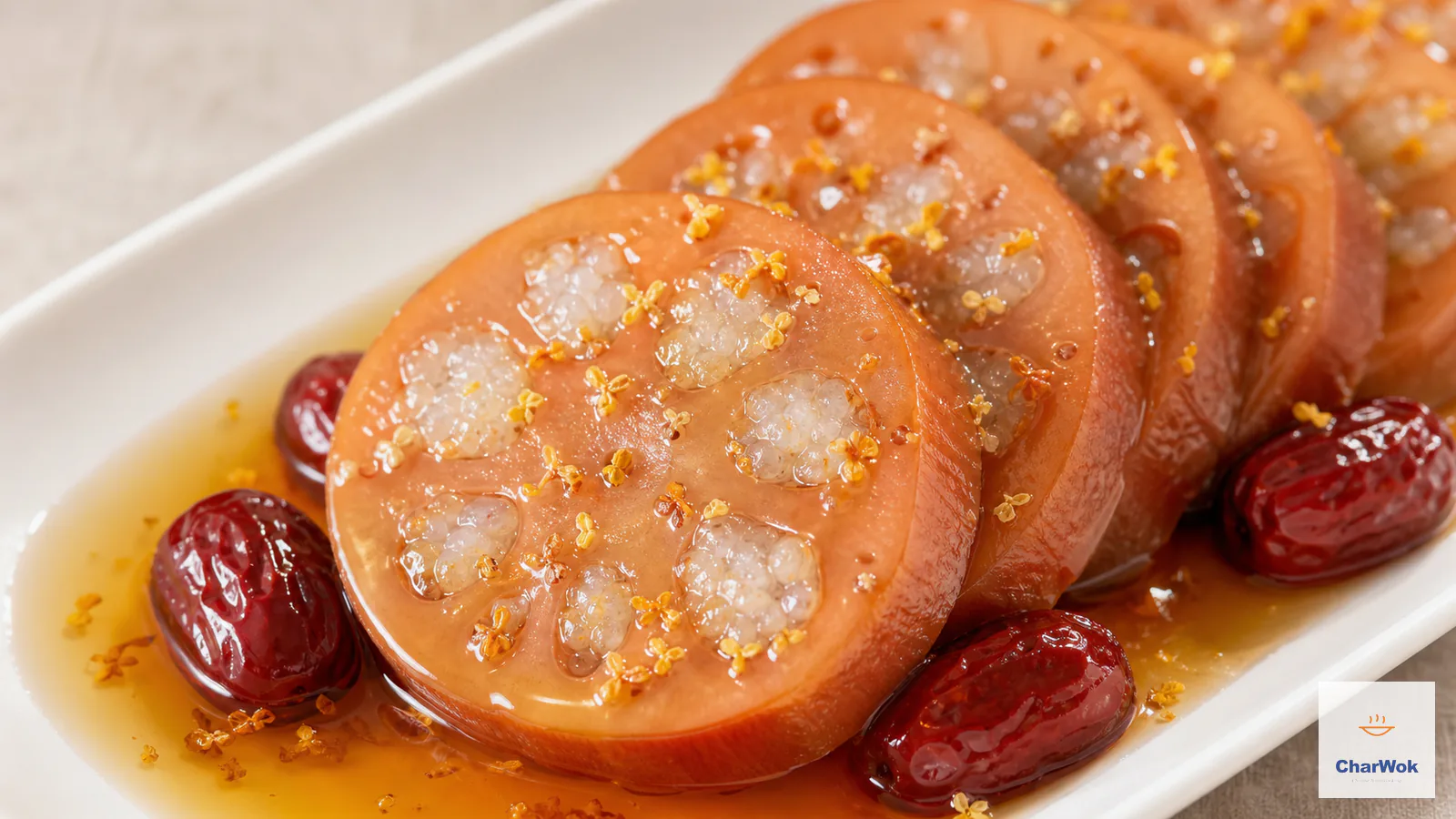
Lotus root is famous for its snap, but the dish I want you to make turns that crispness completely upside down. Sweet lotus root with sticky rice (nuo mi ou, 糯米藕) is two whole sections of lotus root packed tight with glutinous rice, then braised for two hours in dark brown sugar until the flesh turns mahogany and the rice inside swells into a soft, translucent paste. Slice it across, glaze it with osmanthus syrup, and you have one of the prettiest cold plates in the Jiangnan repertoire.
The pain point that trips people up is not the technique, which is honestly gentle. It is the stuffing. Pack the rice too loosely and you cut open hollow pockets; pack it too tightly and the lid blows off the root mid-simmer, dumping a cloud of grains into your sugar pot. I have done both. The fix is a single chopstick and one boring habit, which I will get to below.
At a glance: Two fat lotus root sections, 70 g glutinous rice, 80 g dark brown sugar, a 2-hour low simmer in enough water to cover. The whole dish turns on three things: soak the rice at least 2 hours, stuff the holes by tapping with a chopstick (never shove), and let the root cool in its own liquid before slicing. A pressure cooker cuts the braise to 30 minutes at high pressure.
Where this dish comes from
This is a Jiangnan dish, meaning the lake country around Shanghai, Suzhou, and Hangzhou, where lotus has been cultivated for centuries and features in both savory stir-fries and gentle sweets. Unlike the spicy lotus root stir-fry that celebrates crunch, nuo mi ou is built on the opposite texture: the root is cooked until it yields, and the rice inside turns gummy and faintly sweet. It belongs to a family of mild Chinese sweets that are eaten within a meal, not just after it; you will see it arrive as a chilled appetizer in a banquet, or sold by the slice from a street cart.
The same logic, glutinous rice slowly absorbing a flavored liquid, runs through a lot of the dessert case on this site. It is the principle behind eight treasure rice, nian gao, and the stuffed glutinous rice in lo mai gai. Once you understand how the starch gelatinizes, you can apply it everywhere.
The science: why glutinous rice gets sticky (and is still gluten-free)
Glutinous rice, also called sticky rice or sweet rice, has almost no amylose and is almost pure amylopectin, the branched starch molecule. When amylopectin absorbs water and heats past about 70°C (160°F), it gelatinizes into a cohesive, stretchy mass instead of cooking up fluffy and separate like long-grain rice. That is the gooey texture you are after, and it is why this rice is the right grain for the job.
The word glutinous refers only to that glue-like stickiness. The rice contains zero gluten, same as any other rice, so the dish is safe for anyone avoiding wheat. (If this kind of starch-driven sweet interests you, tang yuan works on a similar principle with glutinous rice flour.)
Ingredients
Ingredients at a glance
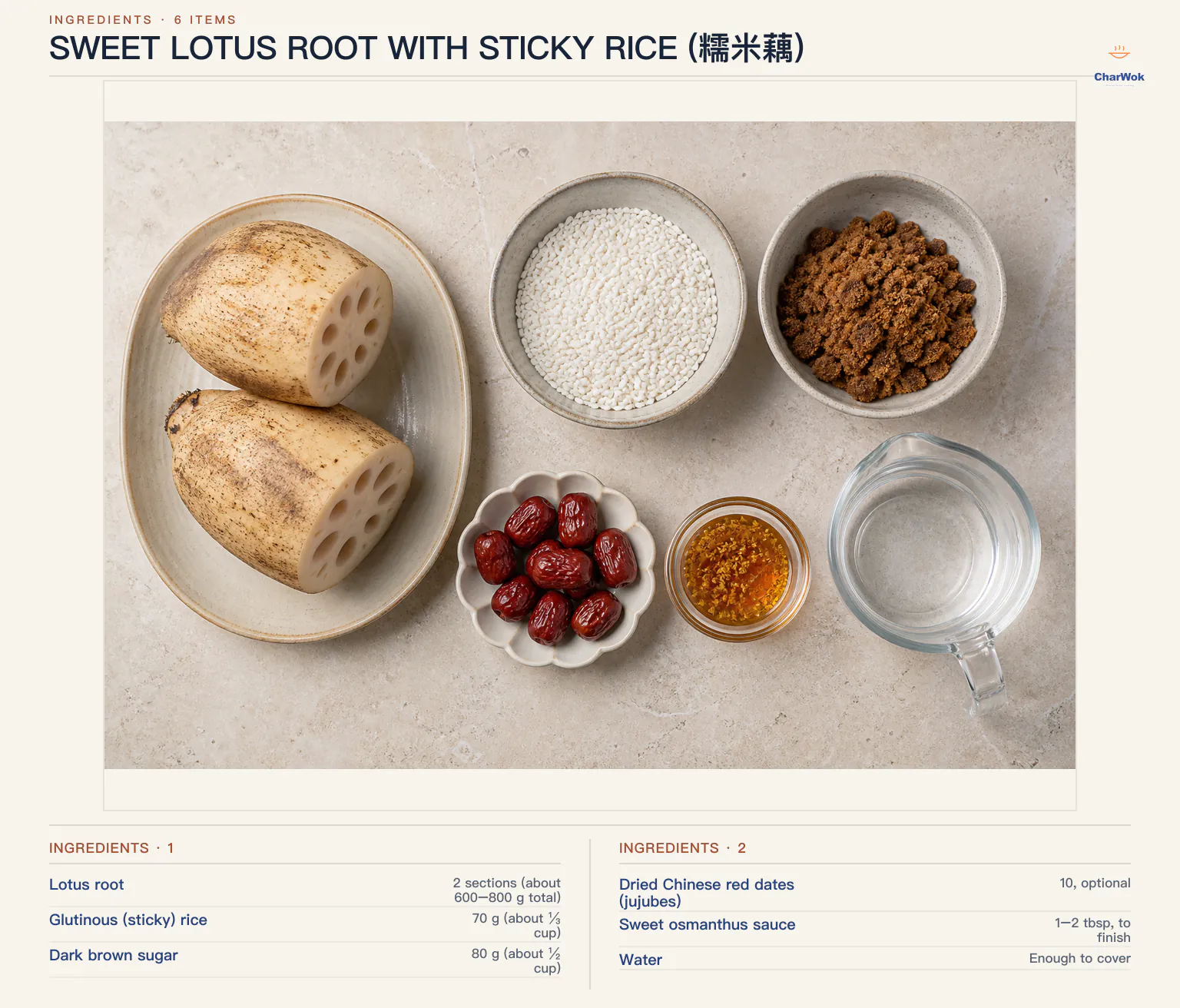
You do not need much. The list below is calibrated for two large sections of lotus root, about 3 servings. If your roots run big and chubby, scale the rice up by a tablespoon or two; better to have soaked a little extra than to run short while stuffing.
| Ingredient | Amount | Notes / substitute |
|---|---|---|
| Lotus root | 2 sections (about 600–800 g total) | Choose the fattest, chubbiest sections you can find; bigger holes hold more rice. Avoid roots with splits or soft spots. |
| Glutinous (sticky) rice | 70 g (about ⅓ cup) | Short-grain Chinese glutinous rice is traditional; long-grain sticky rice works too. Do not substitute regular jasmine or long-grain rice; it will not turn sticky. |
| Dark brown sugar | 80 g (about ½ cup) | Dark muscovado is the best substitute. Light brown sugar works but gives a paler, less caramel color. |
| Dried Chinese red dates (jujubes) | 10, optional | Season the syrup with a mellow, date-like aroma. Skip if unavailable, or add a strip of dried tangerine peel. |
| Sweet osmanthus sauce | 1–2 tbsp, to finish | Sold as gui hua jiang (桂花酱). Honey is the easy substitute; it is sweeter, so use less. |
| Water | Enough to cover | Use the smallest pot that fits the roots so the syrup stays concentrated. |
A note on the sweetener: I reach for dark brown sugar or muscovado specifically because of the molasses. The molasses gives a caramel depth white sugar cannot, and it tints the lotus flesh a deep reddish brown that reads as appetizing on the plate. Rock sugar is the classic sweetener in clearer Chinese sweets like pear with rock sugar, but here you want the color and the molasses bite, so go dark.
Step-by-step method
Read the whole sequence once before you start. The rice needs a 2-hour head start, so plan backward from when you want to eat.
- Soak the rice (at least 2 hours). Cover the glutinous rice with cold water by a couple of centimeters. The grains need to hydrate fully so they cook tender inside the sealed root, where they cannot absorb water freely. Test by pinching a grain: it should split cleanly between your fingers, not feel stony in the center. Drain well before stuffing: wet rice slides instead of packing.
- Peel and cap the roots. Use a vegetable peeler to take off the thin brown skin. From one end of each section, slice off the top 1–2 cm (about ½ inch) to expose the holes. Keep those caps; they go back on as lids.
- Stuff the holes with a chopstick. This is the make-or-break step. Spoon rice into each hole, then tap the rice down with a chopstick, refilling and tapping until the hole feels packed. Do not ram it in. Rice expands roughly 50% as it cooks; you want it snug with a millimeter of headroom, not crammed. Over-packing blows the lid off during the braise.
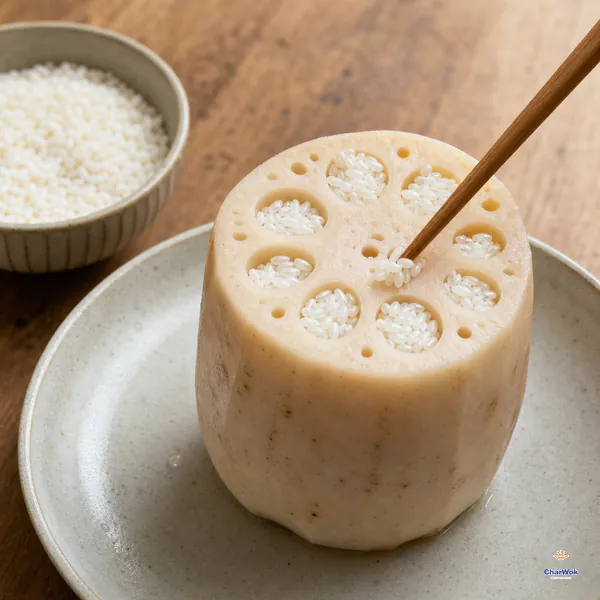
Tap and guide the drained rice into every hole until it is snug but only about ninety percent full; the gap prevents the expanding rice from splitting the root.
- Re-lid and pin. Set the caps back on. Push 3–4 toothpicks through each cap and into the root flesh to hold it shut, angling them slightly so they bite. Go gently: the cooked root is fragile and a hard push can crack the wall and leak rice.
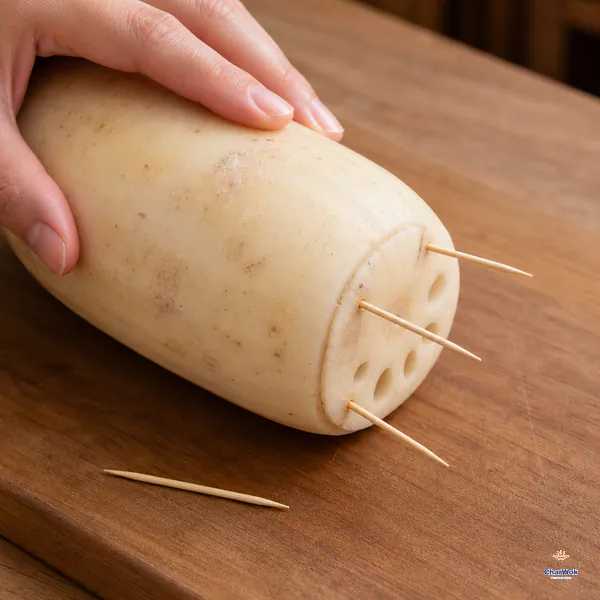
Align the saved cap and pin it gently with three or four angled toothpicks so it stays closed without cracking the root.
- Cover with sugared water. Lay the roots in the smallest pot they fit in. Add the dark brown sugar, the dried red dates if using, and enough water to cover the roots by about 1 cm. A snug pot means less water, which means a more concentrated syrup and a better-colored root.
- Braise 2 hours, low. Bring it to a full boil, then drop the heat to the lowest steady simmer. Cover loosely and leave it for 2 hours. At the 1-hour mark, flip the roots so the top half tints evenly, and top up with hot water if the level drops below the roots. Cold water kills the simmer and stalls the cook.
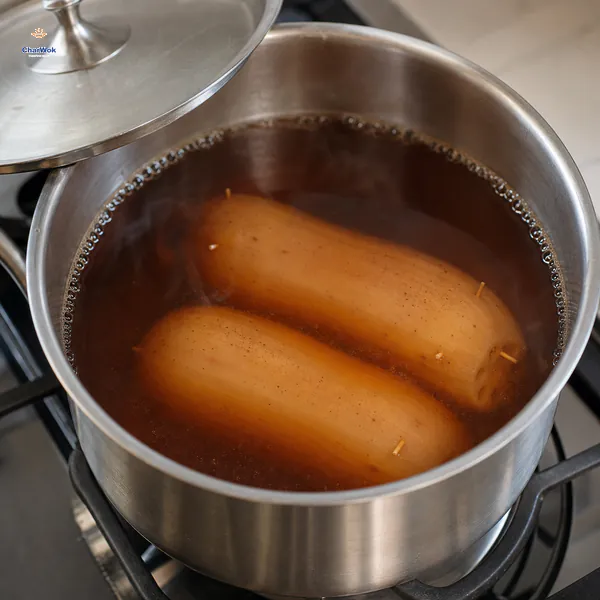
Keep the roots fully covered by the sugar liquid and hold only a quiet edge simmer; top up with hot water if the level drops.
- Cool in the liquid. When a skewer slides through the thickest part with only slight resistance, the root is done. Turn off the heat and leave it in the syrup to cool to room temperature. This is not laziness: the cooling root keeps drinking in sugar and color, and the texture firms up so it slices cleanly instead of crumbling.
- Slice and glaze. Pull the roots out, pick out the toothpicks (count them; you do not want to bite one), and cut crosswise into slices 0.5–1 cm (¼–½ inch) thick. You should see each hole plugged solid with translucent rice. Lay the slices on a plate.
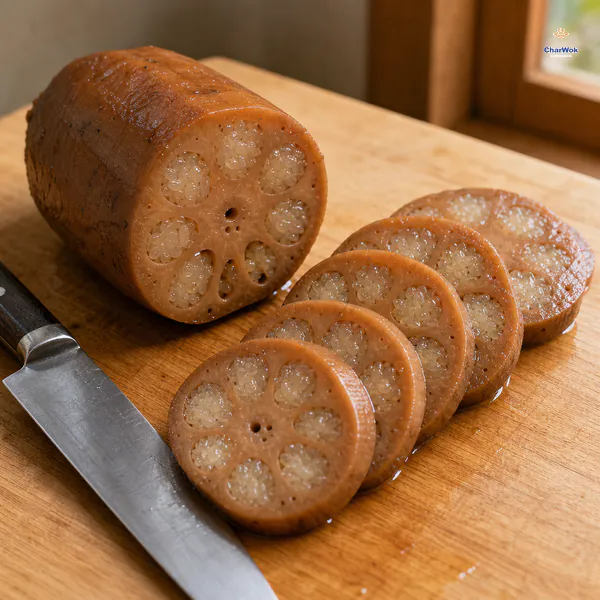
Remove and count every toothpick, then slice the cooled root half to one centimeter thick; the rice should stay packed inside each hole.
- Reduce the syrup. Pour about 100 ml of the cooking liquid into a small pan and boil it down until it coats a spoon, a minute or two. Spoon it over the slices, then finish with sweet osmanthus sauce or honey.
Pressure cooker shortcut: high pressure for 30 minutes, then let the pressure release naturally before opening. The root will be tender and deeply colored, though I find the stovetop version drinks in a touch more flavor during the long cooling soak. If you cook a lot of braises, the festive-dish repertoire rewards patience.
When things go wrong
Most failures come from one of three places. Here is how to read them and fix them.
- The lid blew off and rice escaped into the pot. You packed the holes too tight, or the toothpicks were too few. Next time leave a little headroom and use 4 toothpicks per cap, angled outward. Salvage what you have: fish out the loose rice, finish the braise, and serve the escaped rice spooned over the slices as a sticky garnish.
- The root is still crunchy after 2 hours. Either the simmer was too low (a bare tremble is right, but it must tremble), or the root was an old, woody one. Add hot water, cover tightly, and give it another 30–45 minutes. Next time, buy roots that feel heavy for their size with smooth, unblemished skin.
- The slices fall apart when cut. The root was not cool enough, or you cut too thin. Let it cool fully (even chill it briefly) and use a sharp knife with a gentle sawing motion. A dull knife crushes the tender flesh.
- The syrup is pale and thin. You used too much water or too light a sugar. Reduce what you have harder, or stir in another tablespoon of dark brown sugar while it reduces.
- Holes are only half full of rice. The chopstick-tapping step was skipped or rushed. Refill, tap, refill, tap. It is dull work, but it is the whole job.
Variations and pairings
The classic finish is osmanthus — the dried flowers steeped into a syrup carry a honeyed, apricot-like perfume that is hard to describe but instantly recognizable in a Jiangnan dessert. If you cannot find it, honey is fine; just taste as you go, because honey reads sweeter spoon for spoon.
A few directions worth trying:
- Osmanthus and goji: Scatter a teaspoon of dried goji berries over the slices for color and a faint tart edge against the sugar.
- Chestnut-studded: Tuck a peeled cooked chestnut into one hole of each root before sealing, a Suzhou-style touch.
- Savory-adjacent plating: Serve it as the cold opener of a multi-course meal, followed by something clean and briny. It plays beautifully against the gentle sweetness of red bean soup or a plate of red bean paste buns for a fully dessert table.
- Leftover rice, no waste: Any soaked rice that did not fit goes into a bowl of lo mai fan or eight treasure rice later in the week.
For cooks who enjoy this kind of leaf-wrapped or stuffed sticky-rice project, the technique rhymes with zongzi and the Sichuan leaf-wrapped sticky rice cakes (ye'er ba). Same grain, different wrapper, same patience.
Storing and reheating
Keep the sliced, glazed root in an airtight container in the fridge for up to 3 days; it is actually better the next day, when the syrup has soaked in. Serve it cold, or warm individual slices briefly in the microwave (10–15 seconds) just to take the chill off. Do not reboil; the rice will turn to paste. The leftover cooking syrup keeps a week in the fridge and is lovely stirred into warm milk or drizzled over plain congee.
Frequently asked questions
Can I make this a day ahead? Yes, and you should. The flavor deepens overnight in the syrup. Slice cold, then let the slices sit at room temperature for 15 minutes before glazing.
What if I cannot find glutinous rice? Look for it labeled sticky rice or sweet rice at any Asian grocery. Regular rice will not work: it lacks the amylopectin that makes the filling cohesive. Pearl mochi rice is the same grain under another name.
Is the pressure cooker really as good? Close. It gets the root tender in 30 minutes versus 2 hours, with marginally less syrup penetration. For a weeknight, use it; for guests, take the slow road.
Do I have to peel the lotus root? Yes. The thin skin stays tough and grayish through cooking and shows up as dark flecks in every slice. A standard vegetable peeler takes it off in seconds.
The one judgment that matters
If you remember nothing else, remember the chopstick. Tap, do not shove. That single habit is the difference between a root that slices into neat, fully plugged coins and one that disappoints you at the cutting board. The rest (the dark sugar, the long braise, the osmanthus finish) is just patience and good ingredients. Once it clicks, this dish becomes one of the most reliable show-stoppers in a home cook's sweet repertoire, sitting happily next to baked rice cake and sesame balls on any dessert tray.