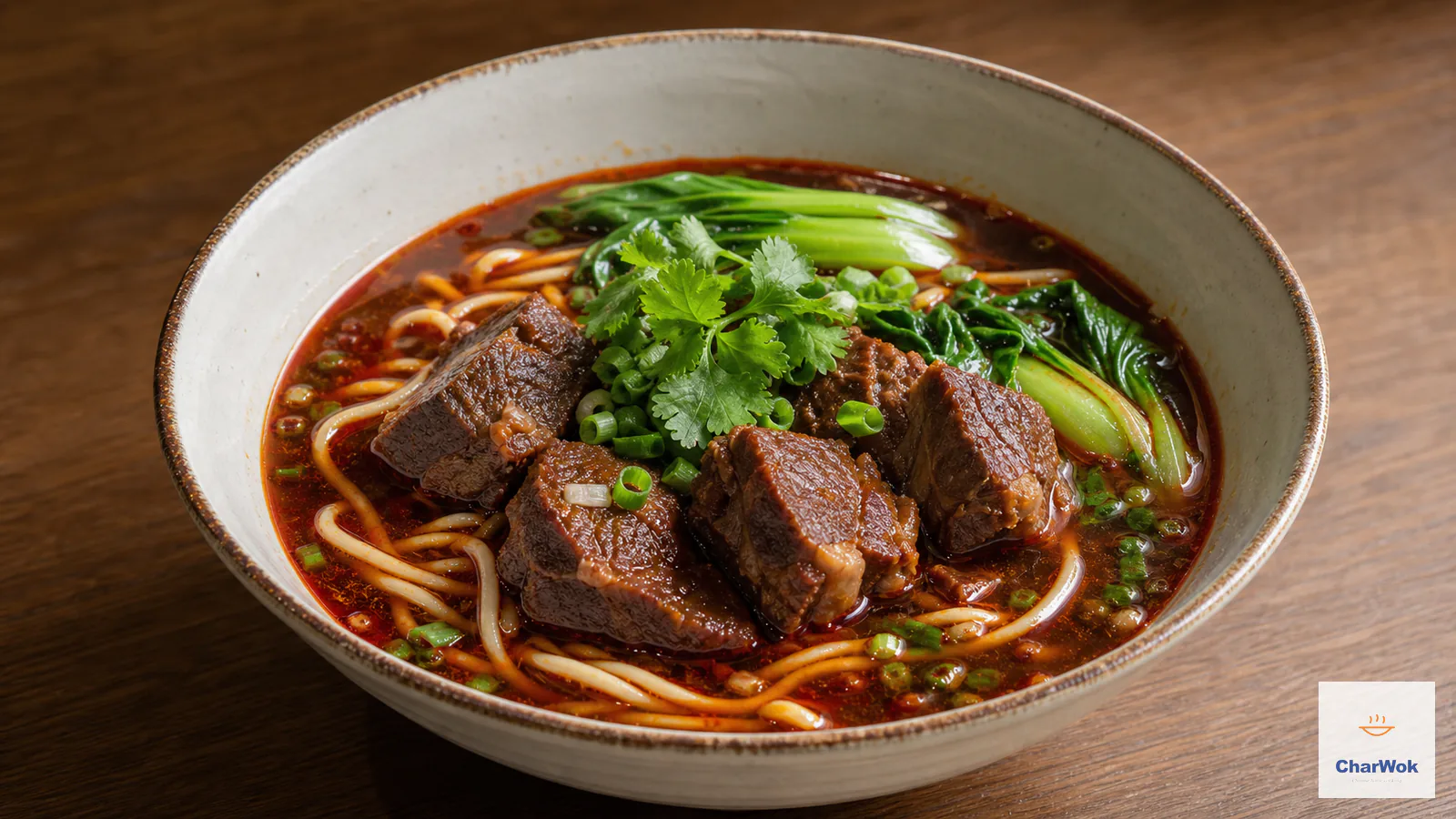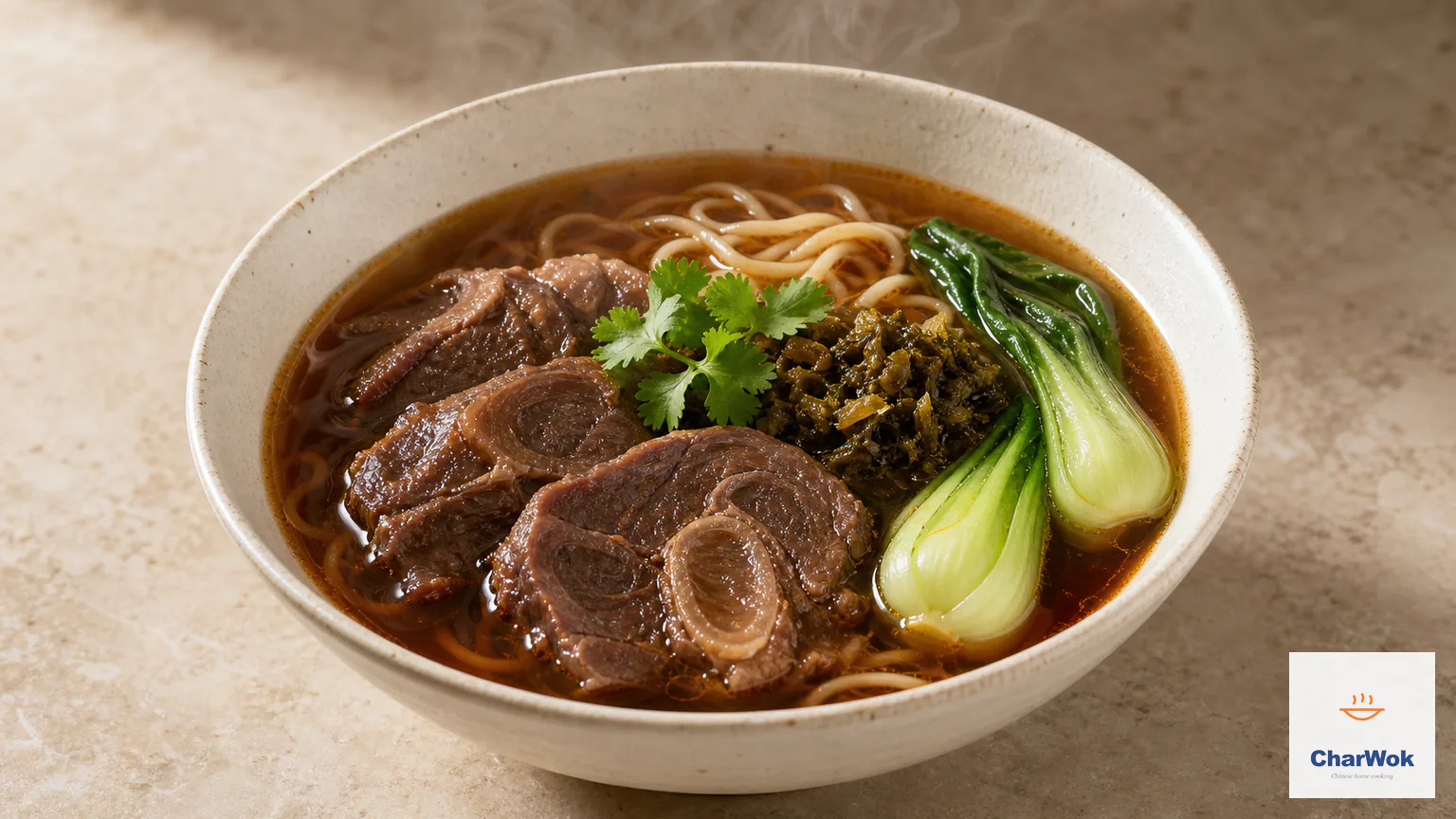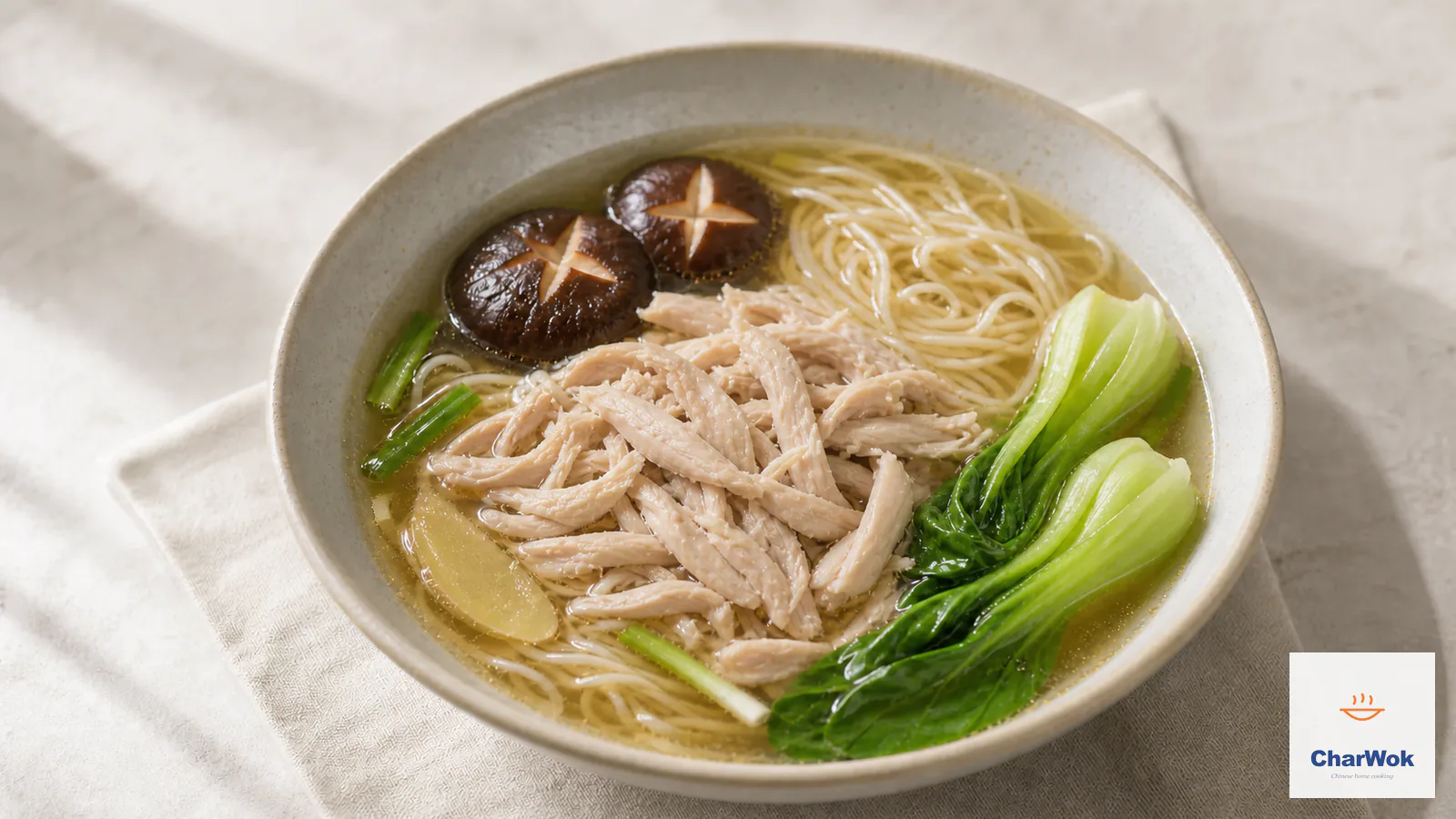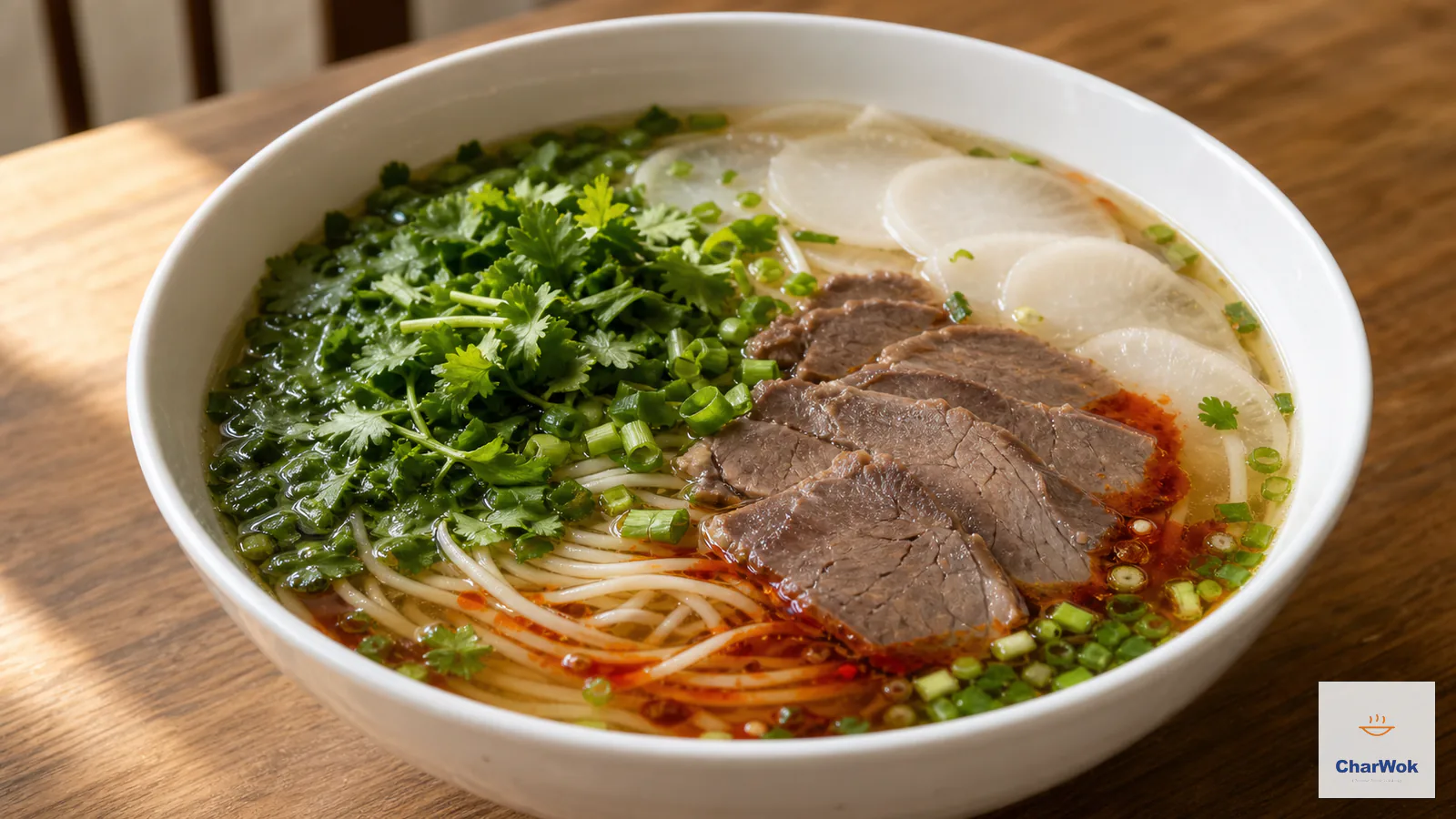
The soul of Lanzhou beef noodle soup (兰州牛肉面) is a clear broth that tastes of beef and nothing else, with a faint warm perfume from spice. Get the broth right and everything else, the noodles, the daikon, the chili oil floating on top, is just staging. Get it wrong and you have a bowl of cloudy dishwater that no amount of garnish can save.
I have ruined this soup more times than I care to admit. The first disaster was a boiling-hot, aggressively stirred pot that came out gray and bitter, because I let the water rage for two hours instead of letting it barely murmur. The second was a spice bag I forgot to remove, leaving a broth that numbed my lips like a Sichuan dish. What follows is the version I actually cook at home, with the failures built in as guardrails so you do not repeat them.
At a glance: plan on roughly 3 hours of mostly hands-off simmering for 6 bowls. Use about 1.4 kg (3 lb) of bone-in beef shank plus a couple of marrow bones to 3 liters of water, hold the simmer at the gentlest tremble, and pull the spice sachet out the moment the broth smells clean and warm. Skim obsessively for the first 30 minutes. Rest the cooked beef cold before slicing.
What you are actually eating
This is the breakfast noodle of Lanzhou, the capital of Gansu province in northwest China, and one of the few Chinese dishes with an unofficial canon. A proper bowl obeys a rhyme traded among noodle stalls: the broth must be clear, the beef tender, the white daikon translucent, the red chili oil vivid, the green herbs fresh, and the yellow noodles springy. Five colors, six elements. The noodles are hand-pulled (La Mian, 拉面) to order, in anywhere from hair-fine to belt-wide, which is part of the theater.
A home kitchen cannot match a stall's master stock that has simmered for days, or a puller who has shaped ten thousand strands. So I will not pretend this is restaurant-authentic. What it is, honestly, is the best version you can make on a Saturday with one pot, a spice sachet, and patience. If you want the deeper, darker, soy-braised cousin instead, that is a different dish entirely and lives over at Taiwanese beef noodle soup. The spicy Sichuan-style beef noodle soup is bolder still. Lanzhou's is the quiet one of the three.
Why the broth is the whole fight
Three things decide whether your broth is clear or cloudy, and they are not about ingredients. They are about heat, skimming, and time.
First, the heat. Cold water draws impurities out of the meat and bones slowly as the pot warms, so you start cold. Once it boils, the albumin proteins coagulate and rise as gray scum. If you keep the water at a hard boil, those proteins emulsify back into the liquid and you get the cloudy, fatty broth of a tonkotsu or a pork rib soup. For Lanzhou you want the opposite, so after the first boil you drop to the lowest possible tremble, a bubble every few seconds. This is the single biggest difference between a home pot that looks like dishwater and one that looks like amber tea.
Second, the skimming. Spend the first half hour with a slotted spoon. It is boring. It is also the entire job.
Third, time. Two hours of a true simmer will cook shank through and give you a clean, light broth. Three to four gives you body and a glossy mouthfeel from the collagen dissolving out of the connective tissue. Go past five and you risk the bones' calcium making it taste chalky. I stop at three.
The cut of beef matters more than the spice list
Use bone-in beef shank or shin. Shank is a working muscle laced with connective tissue and silver skin, which sounds tough but is exactly what you want. That collagen melts into gelatin over a long simmer and is the only reason the meat will slice cleanly instead of shredding into string. Lean loin or round will give you dry, gray cubes no matter how long you cook them. If your market sells beef shank for Chinese braising, that is the cut.
Add one or two marrow or knuckle bones for richness and a little rendered fat. Do not skip them, and do not substitute stock cubes. The faint surface fat is what carries the chili oil later; without it the bowl looks and tastes thin. If you want a heavier beef-and-radish braise rather than a clear soup, the same cut shines in braised beef with daikon.
Ingredients
Ingredients at a glance
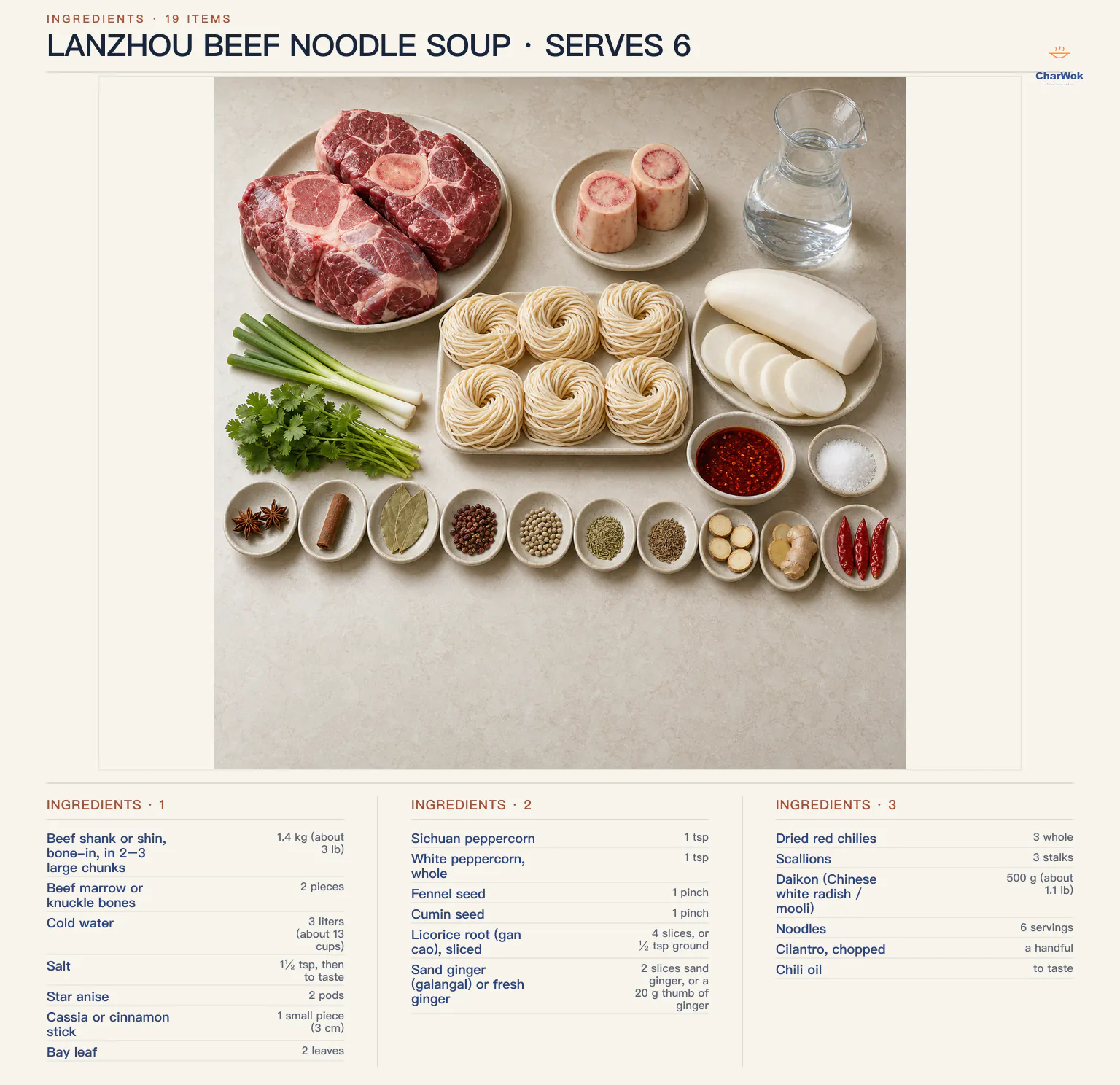
Serves 6. Metric first; cups and pounds noted where they are the household measure.
| Ingredient | Amount | Notes / substitute |
|---|---|---|
| Beef shank or shin, bone-in, in 2–3 large chunks | 1.4 kg (about 3 lb) | Shin or chuck with marbling also works. Avoid lean round. |
| Beef marrow or knuckle bones | 2 pieces | Ask the butcher; soup bones are fine. |
| Cold water | 3 liters (about 13 cups) | Start cold to extract impurities slowly. |
| Salt | 1½ tsp, then to taste | Season at the end, not the start. |
| Star anise | 2 pods | Core spice; do not exceed or it turns medicinal. |
| Cassia or cinnamon stick | 1 small piece (3 cm) | Cassia is more authentic; cinnamon is fine. |
| Bay leaf | 2 leaves | Standard bay. |
| Sichuan peppercorn | 1 tsp | Adds a faint tingle; see the Sichuan pepper guide for sourcing. |
| White peppercorn, whole | 1 tsp | Warmer and cleaner than black for white broth. |
| Fennel seed | 1 pinch | Licorice back-note. |
| Cumin seed | 1 pinch | A northwest echo; keep it to a pinch. |
| Licorice root (gan cao), sliced | 4 slices, or ½ tsp ground | Optional but adds the classic sweet roundness. |
| Sand ginger (galangal) or fresh ginger | 2 slices sand ginger, or a 20 g thumb of ginger | Sand ginger is earthier; ginger is the easy substitute. |
| Dried red chilies | 3 whole | For aromatics only, not heat. Remove seeds if you worry. |
| Scallions | 3 stalks | One to blanch with, two to add whole. |
| Daikon (Chinese white radish / mooli) | 500 g (about 1.1 lb) | Napa or turnip will not give the same sweetness. |
| Noodles | 6 servings | Hand-pulled if you have the day; otherwise fresh alkaline noodles, hand-rolled noodles, or dried. |
| Cilantro, chopped | a handful | The green of the five-color canon. |
| Chili oil | to taste | Homemade Chinese chili oil is worth the half hour. |
Method, with the why built in
- Blanch the meat and bones. Put the shank and bones in a clean pot, cover with cold water, and bring to a full boil. This first boil is the only time you want a rolling boil. The gray foam rising is coagulated blood and albumin; skim it off as it forms. After 5 minutes of boiling, tip everything into a sink of cold water, rinse the bones, and scrub the pot. You now have clean material for a clear stock. Skipping this step is the fastest route to a gray bowl.
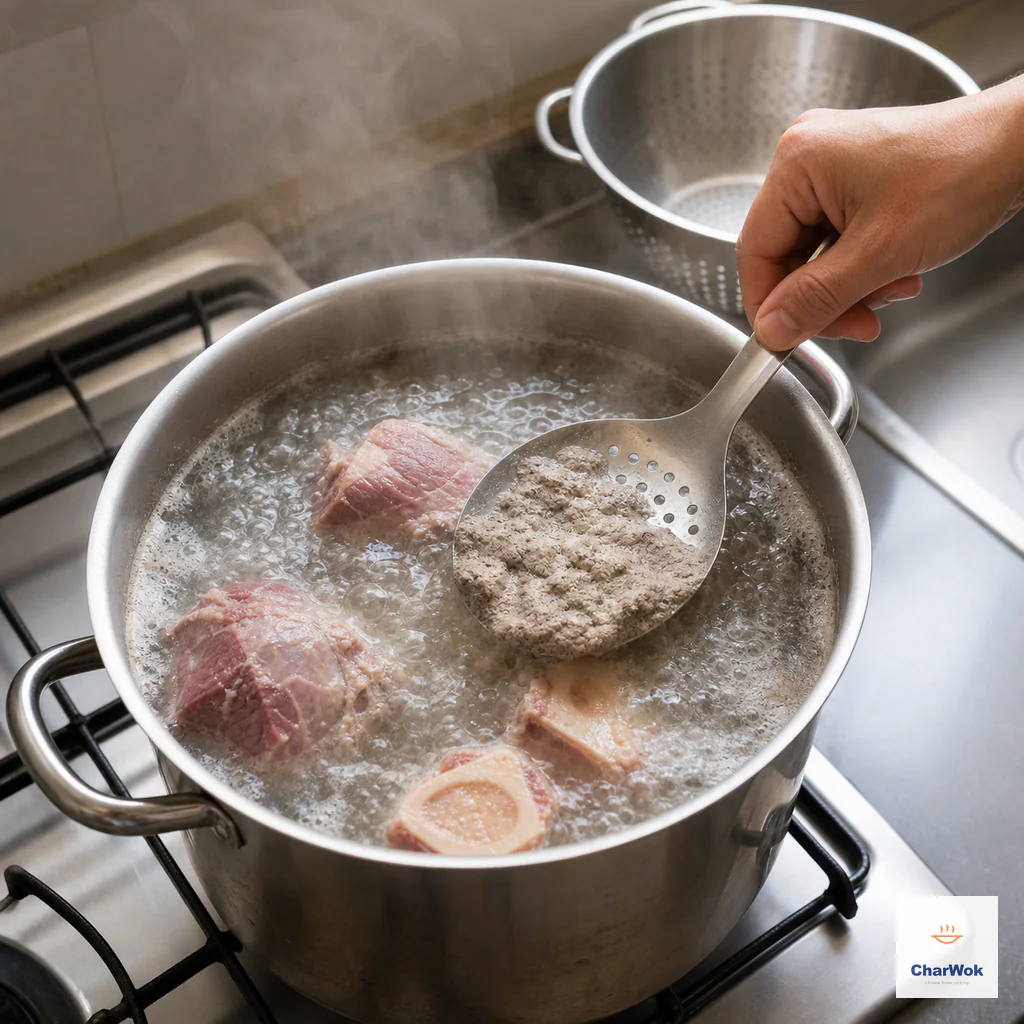
The blanch is the only rolling boil: skim for five minutes, then discard the water, rinse the beef and bones, and scrub the pot.
- Start the real broth cold. Return the rinsed meat and bones to the clean pot, add the 3 liters of cold water, and bring it back to a boil over medium heat. Add one scallion stalk, the ginger or sand ginger, and the spice sachet. The cold start pulls flavor out gently; a hot start seals the meat and gives a thinner stock.
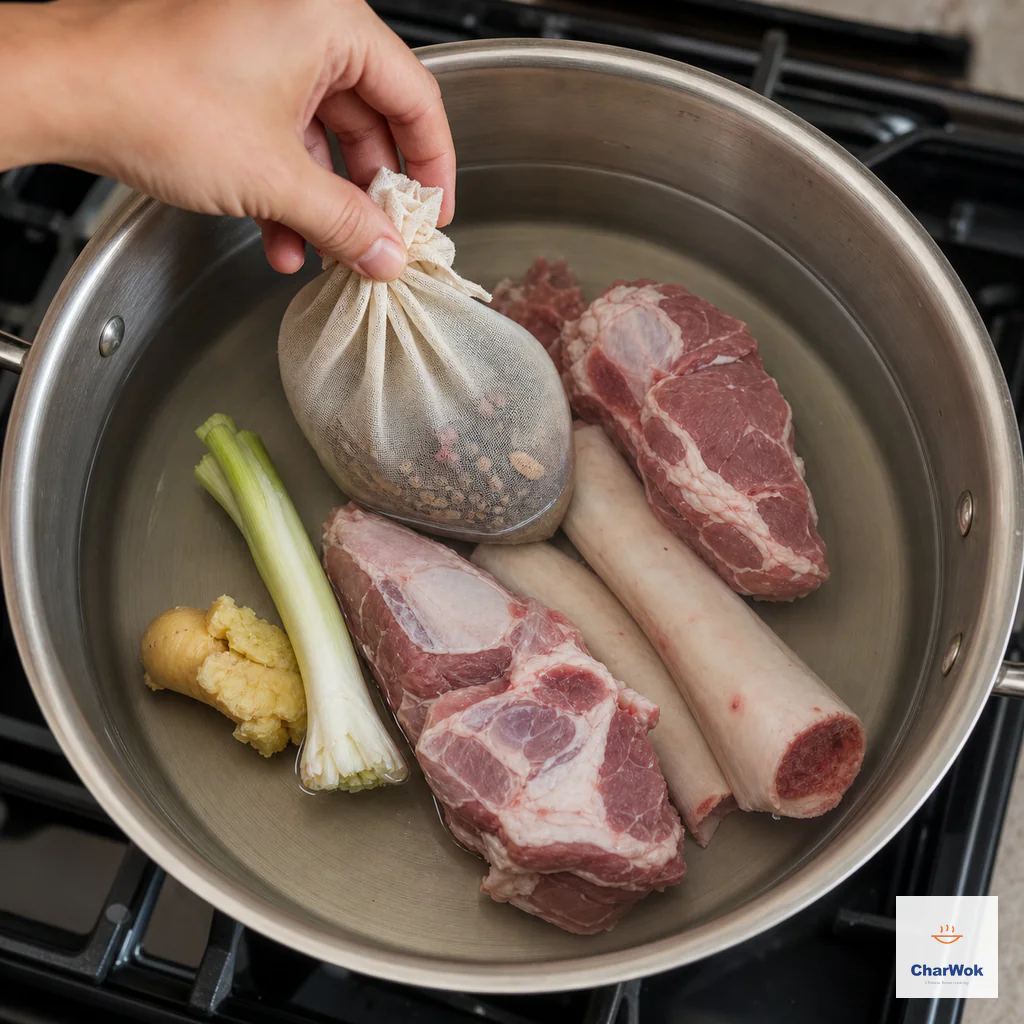
Start the clean broth with cold water and keep every whole spice tied inside a sachet so the flavor stays gentle and the stock easy to strain.
- Drop to the lowest possible simmer. Once it boils, reduce the heat until the surface barely trembles, one bubble breaking every two or three seconds. Cover with the lid cracked. This is the make-or-break setting. A hard boil emulsifies fat and scum and ruins clarity; a true simmer keeps the broth transparent and lets collagen dissolve slowly for body.
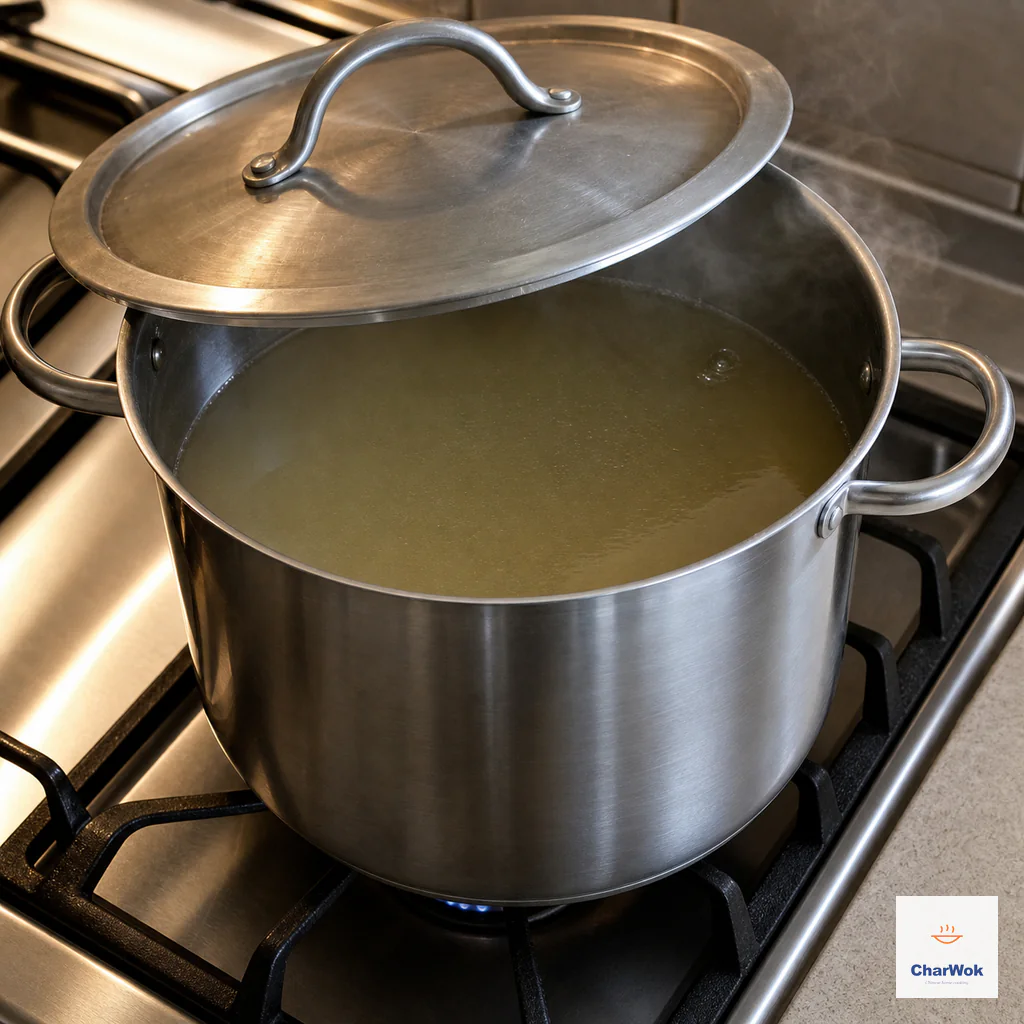
Reduce to the smallest stable flame, crack the lid, and hold the surface at an occasional bubble rather than a boil that would cloud the stock.
- Skim for the first 30 minutes. Stand there with a slotted spoon and lift off any foam or fat that rises. After half an hour the broth will have settled and you can largely leave it alone for the next 2 to 2½ hours.
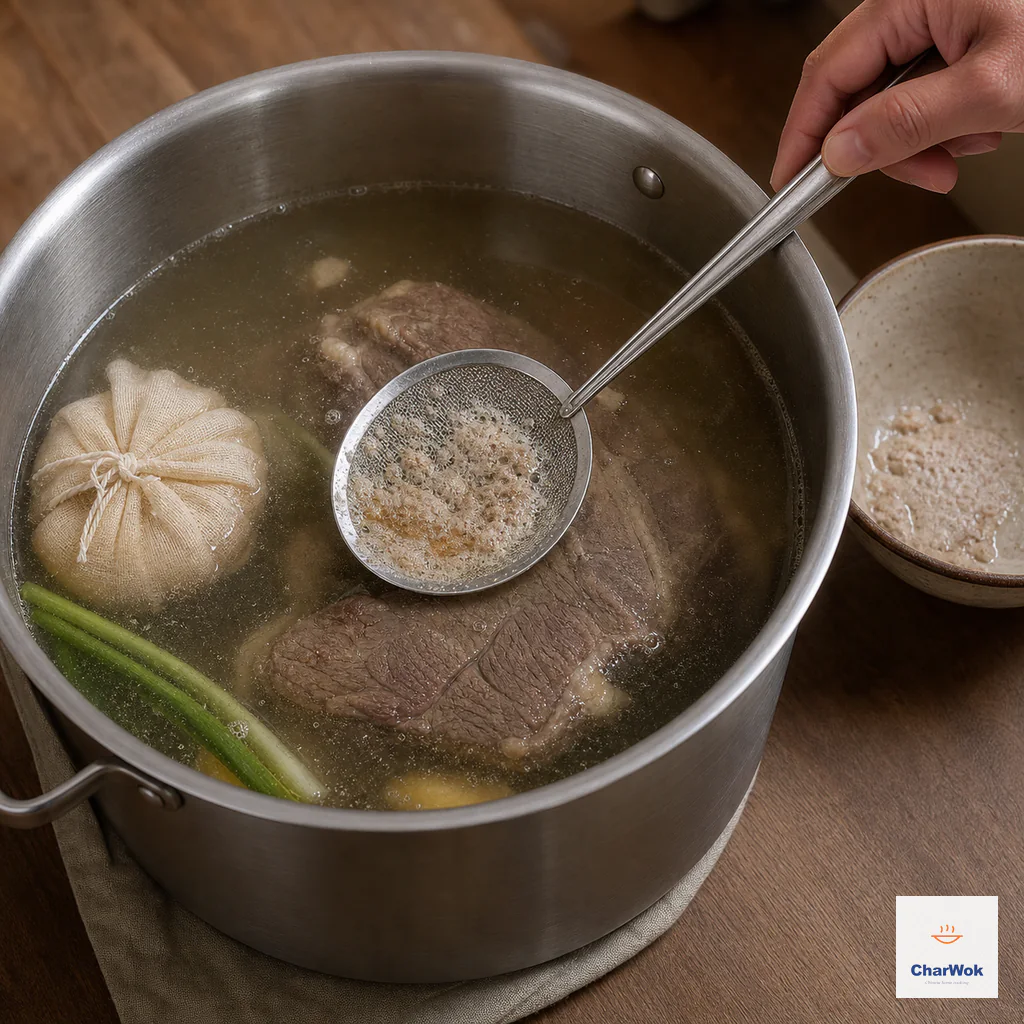
Skim gently during the first 30 minutes without stirring the pot; once the surface settles, leave the broth at its quiet simmer.
- Test and rest the beef. At around 2½ hours, pierce the shank with a skewer. It should slide in with only slight resistance; the meat is done when it is tender but still holds its shape. Lift the beef out, let it cool to room temperature, then refrigerate it. Cold beef slices cleanly; warm beef falls apart into ragged shreds. If you have the patience, chill it overnight.
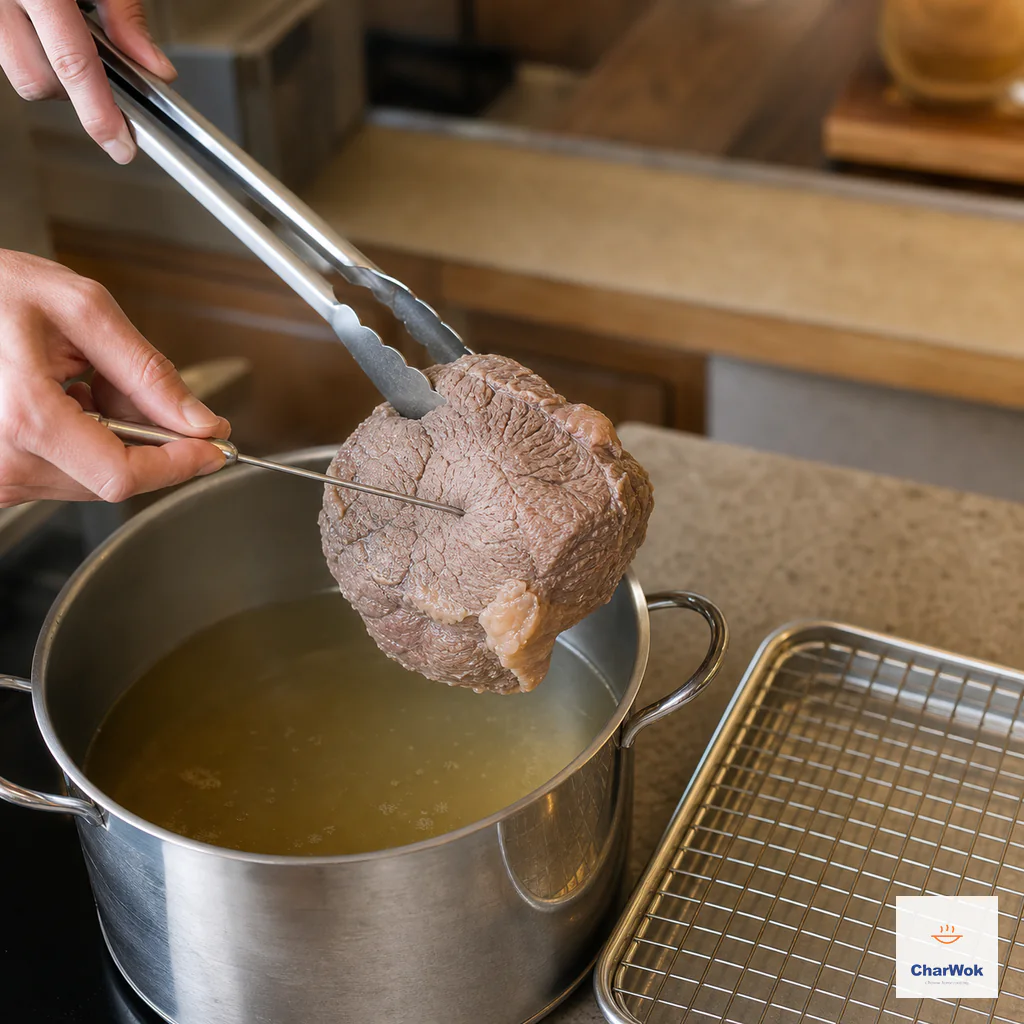
Lift the shank when a skewer enters with slight resistance and the meat still holds together, then cool and chill it before slicing thinly.
- Cook the daikon in the broth. Peel the daikon and cut it into rounds about 5 mm thick. Drop them into the simmering, strained broth and cook 12 to 15 minutes, until a knife meets no resistance. Daikon is in the bowl for sweetness and a soft, almost custardy texture; undercook it and it tastes of raw radish, overcook it and it disintegrates. Lift the spice sachet and bones out now and discard them.
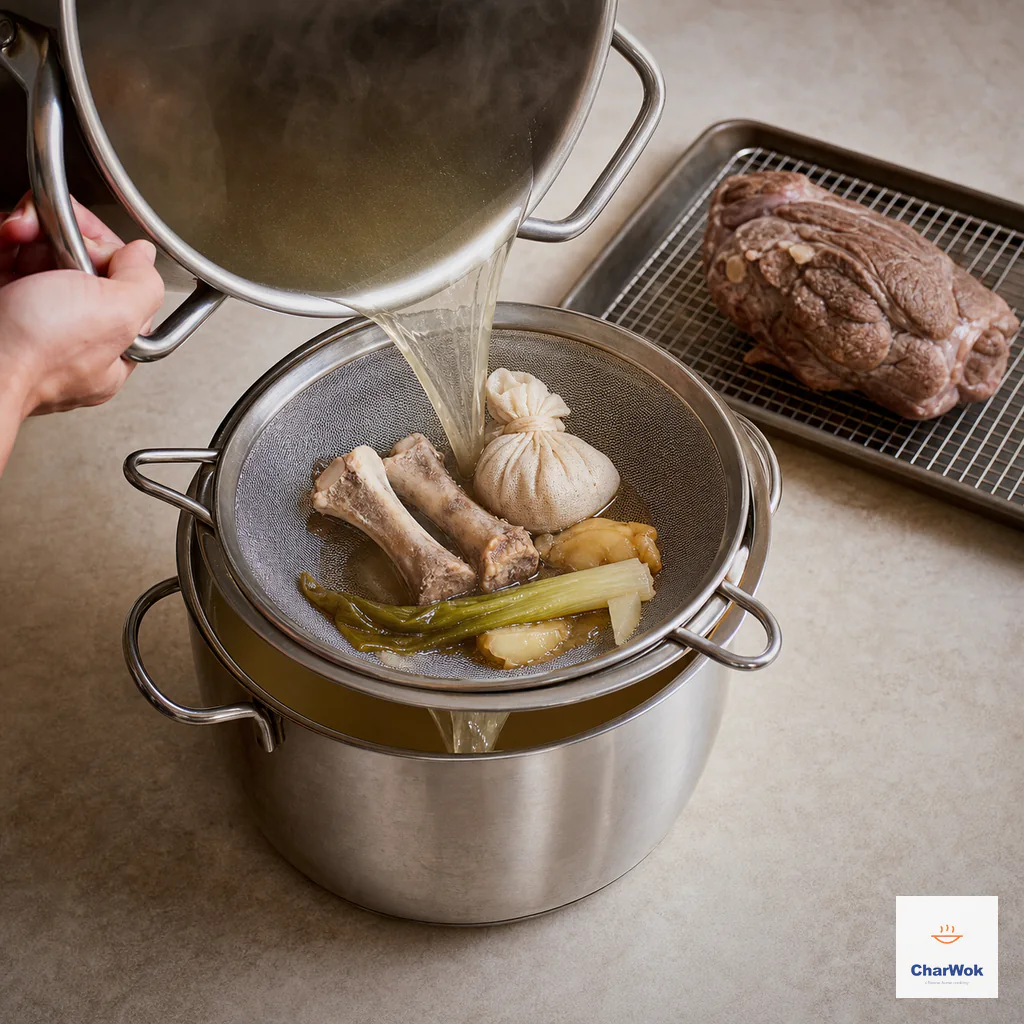
Remove the beef first, then strain out the spent bones and aromatics into a spotless pot without pressing sediment through the mesh.
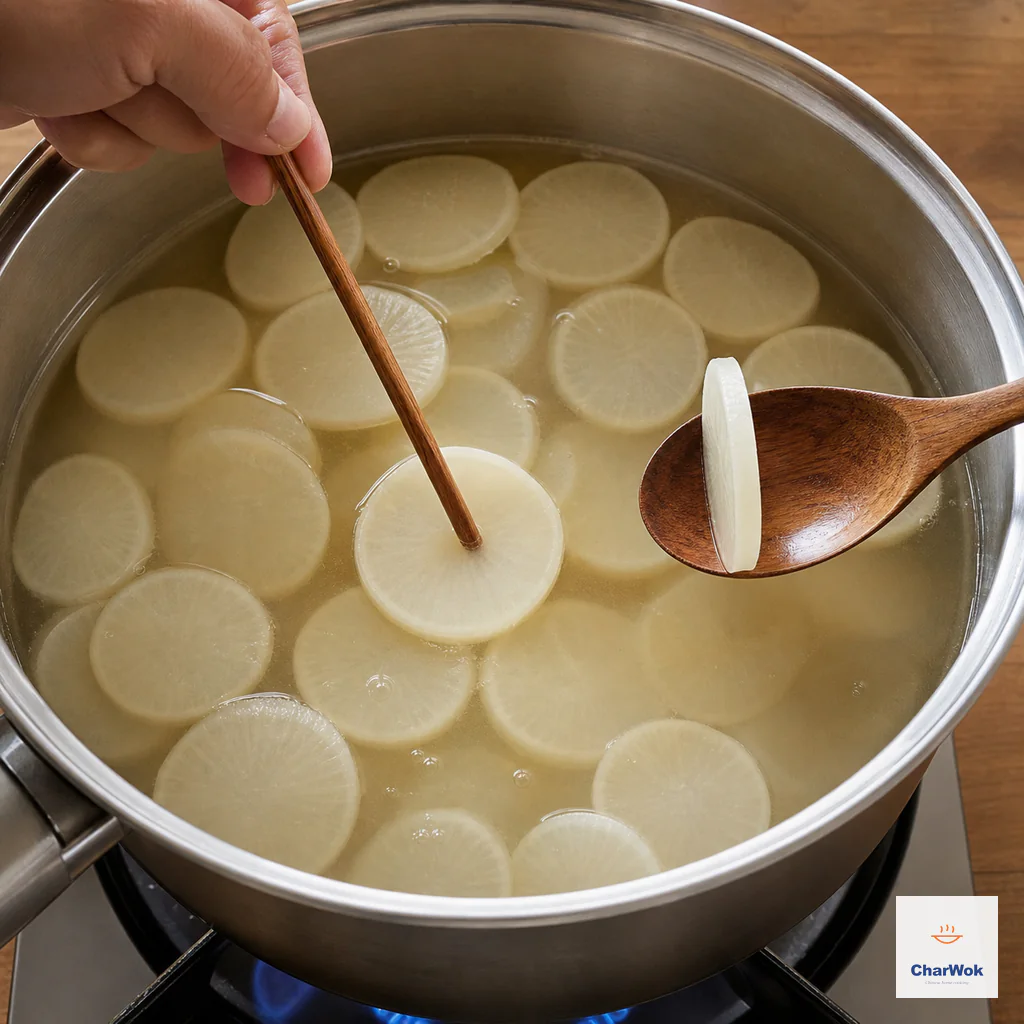
Simmer the thin daikon rounds until a chopstick passes through but each slice still holds its clean circle.
- Cook the noodles separately. Bring a large pot of water to a boil and cook the noodles to one minute less than the package time, then drain and rinse for a few seconds under cold water. Cooking noodles in the broth would cloud it and dump starch into your careful stock. If you are pulling your own, follow a reliable hand-pulled noodle method and cook them in plain water.
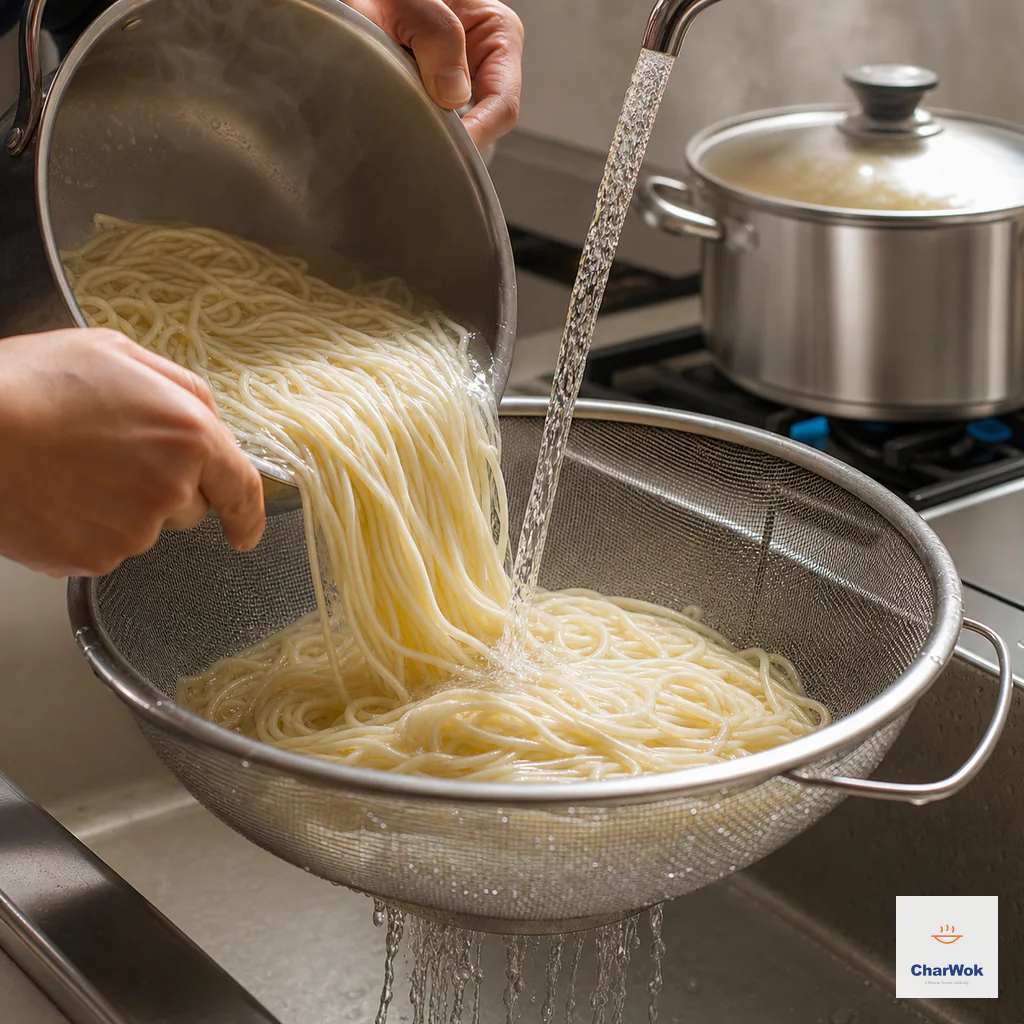
Cook the noodles in abundant plain water, drain one minute early, and rinse only briefly so loose starch never enters the clear broth.
- Build the bowls. Divide the noodles among six bowls. Ladle the screaming-hot broth over them with a few daikon rounds, top with thin slices of the cold beef, and finish with chopped cilantro and a generous spoonful of chili oil. The beef warms through in the broth; do not return it to the pot to re-cook or it will go dry.
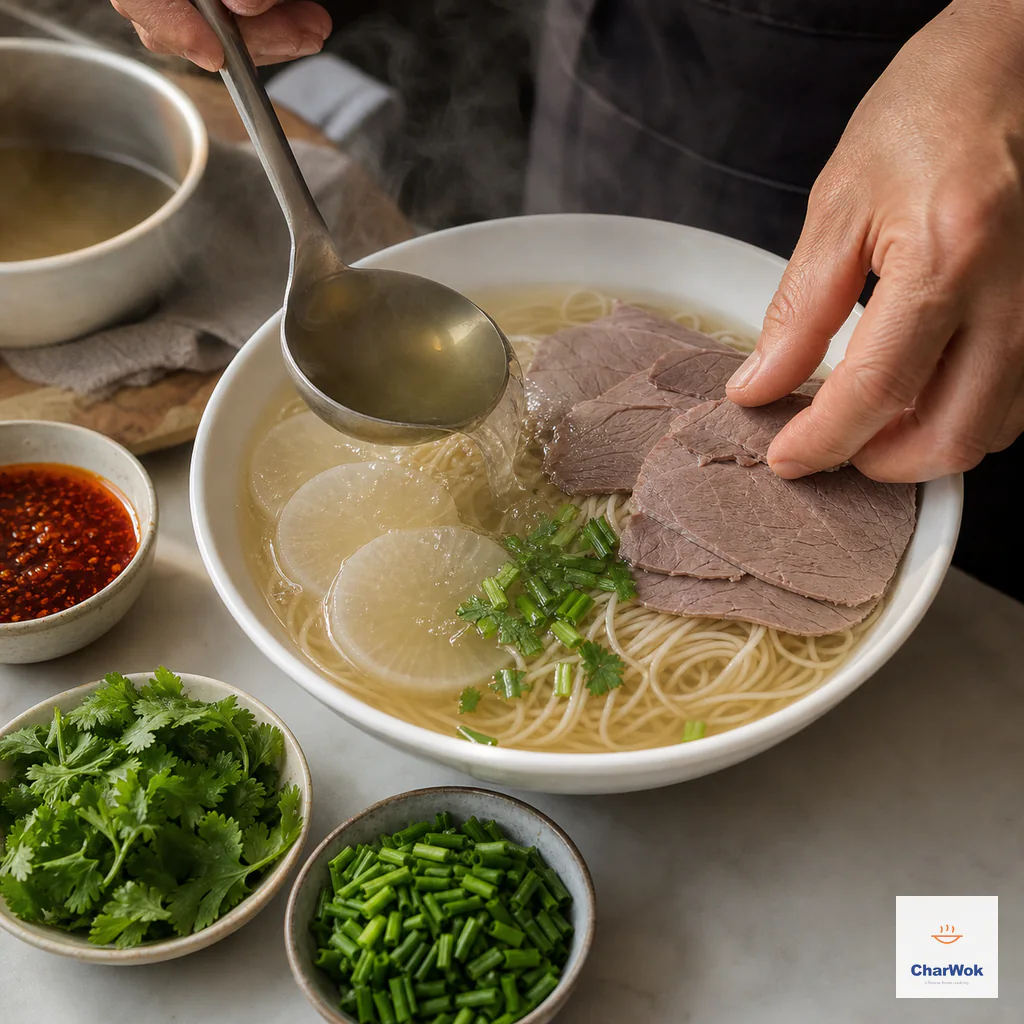
Build each bowl with noodles first, then screaming-hot broth and daikon, chilled thin beef, fresh greens and chili oil so the beef warms without recooking.
When it goes wrong
- Cloudy or gray broth. The simmer was too hot, or you skipped the blanch. Strain through a fine mesh lined with a paper towel, cool it, and lift off the solidified fat. Next time hold a lower heat and skim longer. You cannot un-cloud a stock, but you can keep the next batch clean.
- Broth tastes thin and watery. Either the ratio of water to bone was off, or you did not simmer long enough for the collagen to dissolve. Reduce the strained broth uncovered for 20 minutes to concentrate it. A pinch of salt at the very end will also wake it up; salt added early dulls extraction.
- Beef is dry and stringy. It was either a lean cut, or it overcooked. Use bone-in shank next time and pull it at 2½ hours. You can also rescue tough slices by warming them briefly in a little broth before serving.
- Broth numbs your lips. Too much Sichuan peppercorn, or the sachet sat in too long. Lift spices out at 2 hours max. The numbing quality belongs to Dan Dan noodles and hot and sour glass noodle soup, not here.
- Noodles turn to paste. They were overcooked or sat in hot broth too long before serving. Cook to one minute under, shock under cold water, and assemble bowls at the last second.
- Daikon tastes bitter. It was an old, pithy radish, or it was undercooked. Choose heavy, firm daikon with smooth skin, and cook until genuinely yielding.
Variations and what to serve alongside
The chili oil is non-negotiable for me, and it should be the fragrant, flake-suspended kind rather than a thin hot sauce. A spoonful of black rice vinegar at the table is a regional habit some people love and I can take or leave; try it once and decide for yourself. For a sharper cold-day bowl, swirl in a little toasted sesame oil right before serving.
If you do not want to pull noodles, the broth is just as good with belt-wide biang biang noodles or the quicker scissor-cut noodles, both of which hold up to a hot liquid without going soft. Dried ramen or fresh Chinese egg noodles are honest weeknight substitutes.
Because the broth is light, pair it with something assertive. A plate of cold smashed cucumber in garlic, a vinegary tiger salad, or a stack of pan-fried pork and chive dumplings turn the bowl into a meal. The Cantonese teahouse habit of two soups at one table is worth borrowing, but honestly this bowl stands alone.
Storing and reheating
The broth keeps four days in the fridge and improves overnight as the fat settles and the flavors marry. Freeze it for up to three months; the cooked beef freezes separately, sliced, for up to two. Reheat broth to a full boil, then cool slightly before pouring, so you do not toughen the beef slices. Always cook noodles fresh, never from the day before. Leftover noodles turn gummy and there is no fixing that.
Questions I get asked
Can I make this in a pressure cooker?
Yes, and it cuts the simmer to about 45 minutes at high pressure. The trade-off is clarity: pressure agitation clouds the broth slightly, so strain it twice through a fine sieve and chill it overnight to lift off the fat. Flavor is nearly identical.
Do I have to use beef bones?
Bones add the fat and gelatin that give body and carry the chili oil. Without them you get a thinner, less rounded soup. If you cannot find them, add a 10 g piece of dried kelp and an extra hour of simmering to compensate for missing umami.
Why is my broth bitter?
Usually too much star anise or cassia, or a spice sachet left in past two hours. Whole spices keep extracting; pull them out on time. Burned scum on the pot bottom also turns bitter, so blanch and rinse first.
Is hand-pulled flour the same as bread flour?
Close. Bread flour, around 12 to 13 percent protein, gives the gluten you need to pull long strands without tearing. All-purpose works for hand-rolled and scissor-cut styles but will snap if you try to pull it thin.