I once served this salad twenty minutes too early, and by the time the braised pork came to the table the cucumber had wept a small lake into the bottom of the bowl. That is the single thing that ruins tiger salad, and it is also, conveniently, the only thing you really have to get right. Everything else is knife work and a vinegar bottle.
Tiger salad, lǎo hǔ cài (老虎菜), is a raw vegetable salad from the cold-country kitchens of Dongbei, the three provinces of Northeast China that border Russia and Korea. There is no tiger in it and never has been. The name points to the aggressive, alive quality of the flavor: raw scallion, raw garlic, fresh chili, and black vinegar hit the palate all at once, the kind of bite that clears a foggy head and resets a mouth that has been swimming in braised meat. On a Dongbei table, where the proteins run heavy and the cooking runs deep, this is the dish you reach for between bites to stay hungry.
At a glance: A 5-minute raw salad of cucumber, scallion white, fresh green and red chili, and cilantro, cut to a uniform 5 cm (2-inch) length and tossed at the last second with a 2:1 black-rice-vinegar-to-soy dressing. The make-or-break rule: salt the dressing, never the vegetables, and dress no more than 2 minutes before you sit down. Serves 4.
Two tiger salads, one name
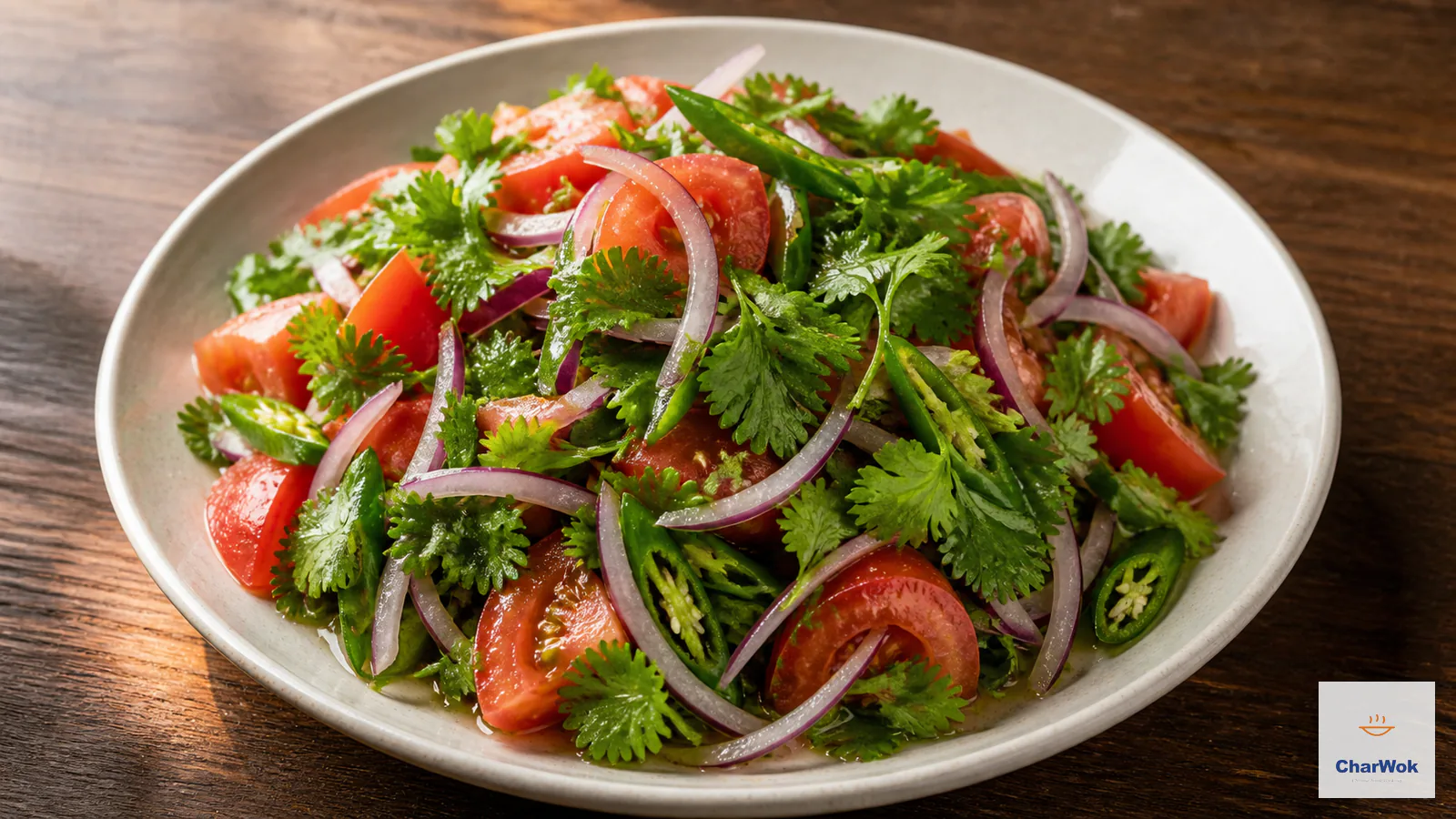
The word lǎo hǔ cài is loosely used across northern and western China for any cold, sharply dressed vegetable plate, and at least two distinct versions are famous. This one, the Dongbei version, is built on cucumber and scallion. The other well-known version is the Xinjiang tiger salad from the far northwest, which leans on tomato and red onion and reads more like a chopped salad you might meet in Central Asia. They share a philosophy, not a recipe.
What separates the Dongbei style is the dressing. Where the Xinjiang version stays bright and acidic with a clean vinaigrette character, the Northeast bowl goes aromatic: black rice vinegar for a smoky, malty depth, toasted sesame oil for richness, and a generous hit of raw minced garlic that lands like a small electric shock. It is closer in spirit to the dressing you would pour over rehydrated wood ear mushrooms or a plate of cool napa cabbage salad than to a Western vinaigrette.
The ingredients, and the ones worth buying right
Ingredients at a glance
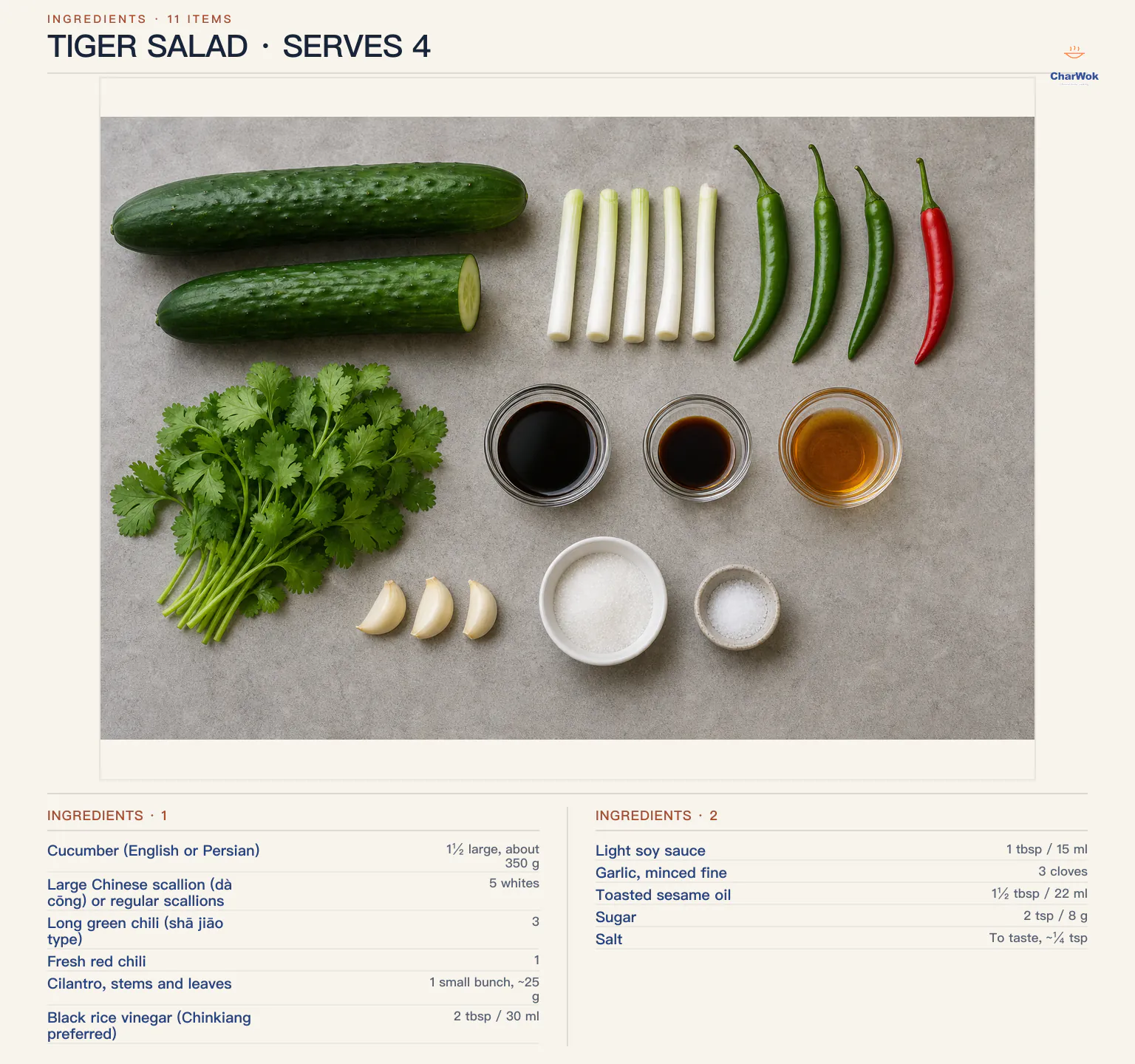
| Ingredient | Amount | Notes / substitute |
|---|---|---|
| Cucumber (English or Persian) | 1½ large, about 350 g | No need to peel or seed. Skip standard waxed slicing cucumbers if you can; their watery core dilutes the dressing. |
| Large Chinese scallion (dà cōng) or regular scallions | 5 whites | Use only the white parts. Dà cōng is milder and sweeter; if unavailable, 5 regular scallion whites work, or substitute the white base of a leek. |
| Long green chili (shā jiāo type) | 3 | Mild to medium heat. Anaheims or young jalapeños are reasonable US stand-ins. |
| Fresh red chili | 1 | Mostly for color. Fresno or red jalapeño. |
| Cilantro, stems and leaves | 1 small bunch, ~25 g | Keep the tender stems; they have more flavor than the leaves and add crunch. |
| Black rice vinegar (Chinkiang preferred) | 2 tbsp / 30 ml | The backbone of the dressing. Do not substitute white distilled vinegar; if you must swap, use a 50/50 mix of black rice vinegar and balsamic. |
| Light soy sauce | 1 tbsp / 15 ml | Use light, not dark. See my notes on light vs. dark soy sauce. |
| Garlic, minced fine | 3 cloves | Mince by hand or microplane; pre-minced jar garlic tastes flat and metallic here. |
| Toasted sesame oil | 1½ tbsp / 22 ml | A larger amount than you might expect. Read why in the section below on sesame oil. |
| Sugar | 2 tsp / 8 g | Round off the acid. Not optional. |
| Salt | To taste, ~¼ tsp | Stirred into the dressing only, never directly onto the cut vegetables. |
A note on the scallion. In Dongbei this salad is properly made with the white portion of dà cōng, the fist-thick Chinese scallion that looks like a leek ran for office. It is sweeter and less sulfuric than the bunching scallions most US markets sell. If you have an Asian grocer nearby, buy the dà cōng; if you do not, regular scallion whites are an honest substitute. What you should not do is use the green tops, which are grassy and weepy and belong in a stir-fry.
Why the cut matters more than the recipe suggests
Most recipes will tell you to slice everything into thin strips of roughly equal length and move on. That instruction is correct but undersells the reason. A raw salad has no heat to fuse flavors and no cooking liquid to carry seasoning. The only thing that distributes dressing evenly through a cold bowl is surface area, and the only thing that makes each mouthful feel balanced is uniformity. Uneven cuts mean some pieces swim in vinegar while others taste like plain cucumber.
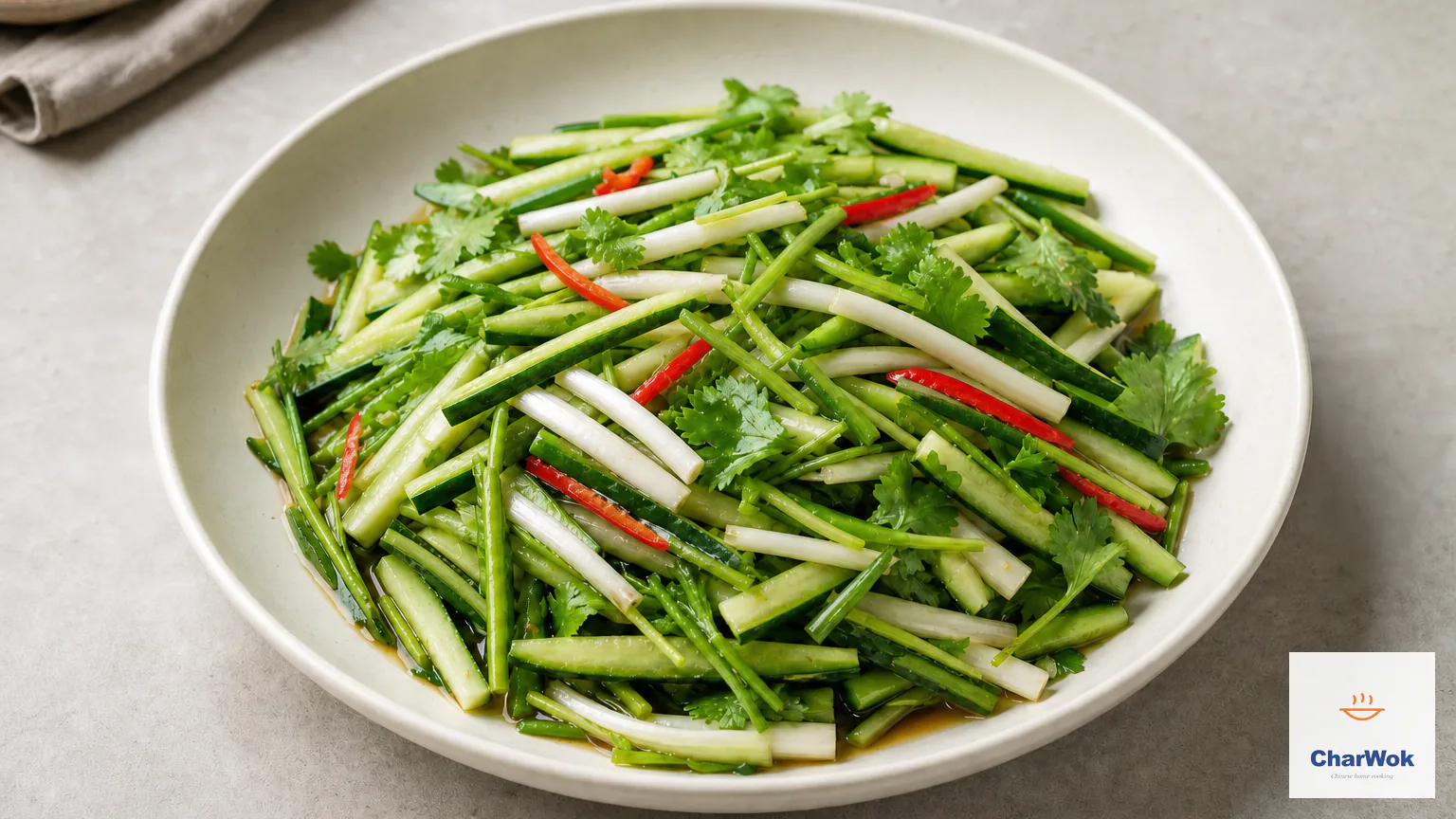
The target is a thin baton about 5 cm (2 inches) long and 3 mm (⅛ inch) wide, across every ingredient. The classic technique is the diagonal-then-stack cut: slice the cucumber on a steep bias into ovals, then cut those ovals lengthwise into thin sticks. Do the same to the scallion whites and the chilies so the geometry matches. Run a knife through the cilantro, stems included, into similar lengths. This is the same length-matching logic behind a proper Di San Xian prep, where potato, eggplant, and pepper are cut to one size so they finish together.
Do not smash the cucumber. I love a good smashed cucumber salad as much as anyone, and the cracked, irregular surfaces are wonderful at grabbing a dressing, but this is a different dish. Smashing turns Dongbei tiger salad into a confused cousin of the three-way cucumber salad. Here you want clean, separate batons that snap between your teeth. The crunch is the point.
Building the dressing
Whisk the black rice vinegar, light soy sauce, minced garlic, toasted sesame oil, sugar, and salt in a small bowl until the sugar is fully dissolved, about 30 seconds. Taste it. The dressing should read tart first, savory second, with a warm sesame roundness behind and a faint sweet finish. If it tastes sharp and one-dimensional, it is usually short on sugar or oil, not salt. Add a pinch more sugar before you reach for the salt shaker.
The 2-to-1 vinegar-to-soy ratio is the heart of the flavor, and the larger-than-usual sesame oil pour is deliberate. Cold dishes need more fat than hot ones, because without heat there is nothing to volatilize the aromatics and carry them to your nose. The sesame oil does that carrying. It is also why the dressing looks darker and glossier than you might expect from a salad vinaigrette.
You can make the dressing hours ahead and hold it covered at room temperature. The garlic will mellow slightly, which most people prefer. Do not refrigerate it; cold sesame oil seizes and goes cloudy, and the flavor flattens.
Step by step
- Cut everything to match. Batons roughly 5 cm (2 in) long and 3 mm (⅛ in) wide for the cucumber, scallion whites, and chilies; cilantro in similar lengths, stems and all. Uniformity here is what makes the salad feel professional rather than tossed together.
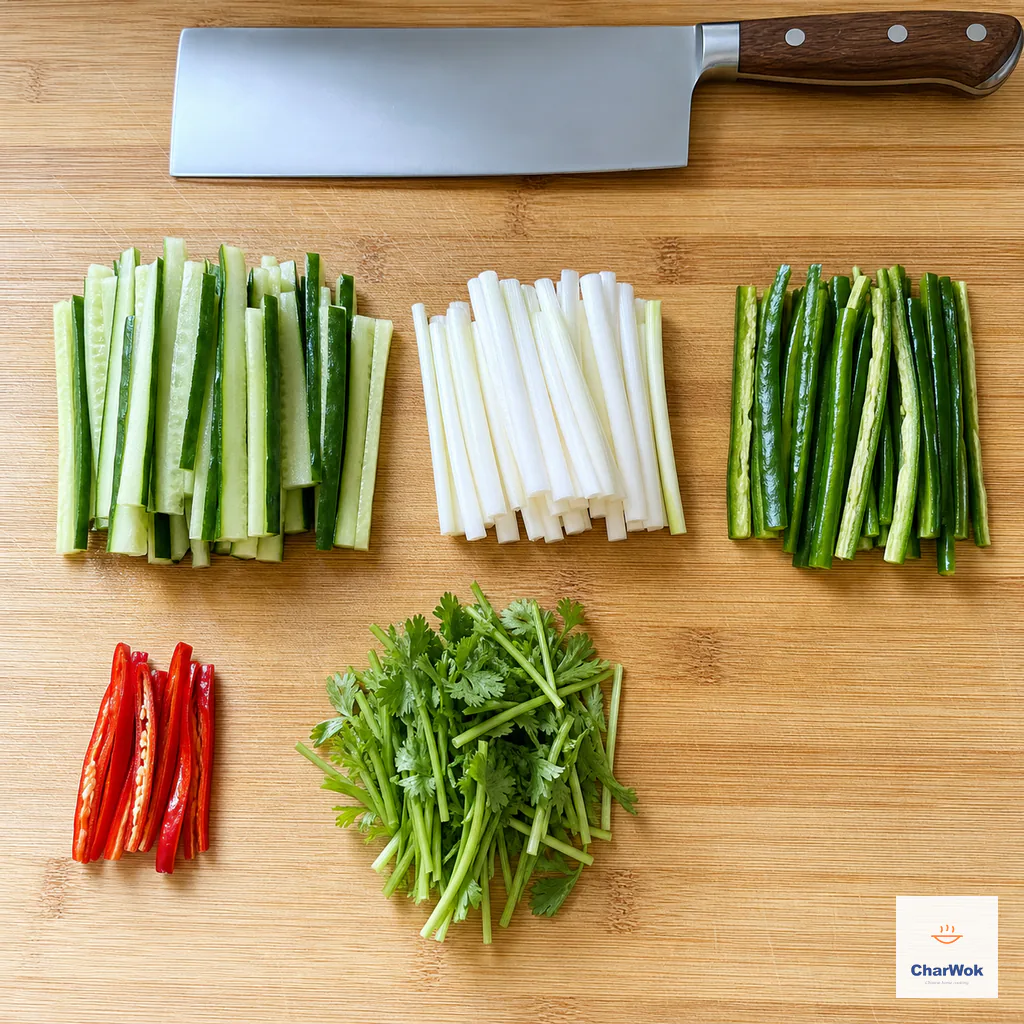
Cut the cucumber, scallion whites, chilies, and cilantro to roughly the same 5 cm length and 3 mm width so every bite stays balanced and crisp
- Build the dressing in a separate bowl. Black rice vinegar, light soy sauce, minced garlic, toasted sesame oil, sugar, salt. Whisk until the sugar dissolves fully. Taste and correct: usually it needs a touch more sugar, rarely more salt.
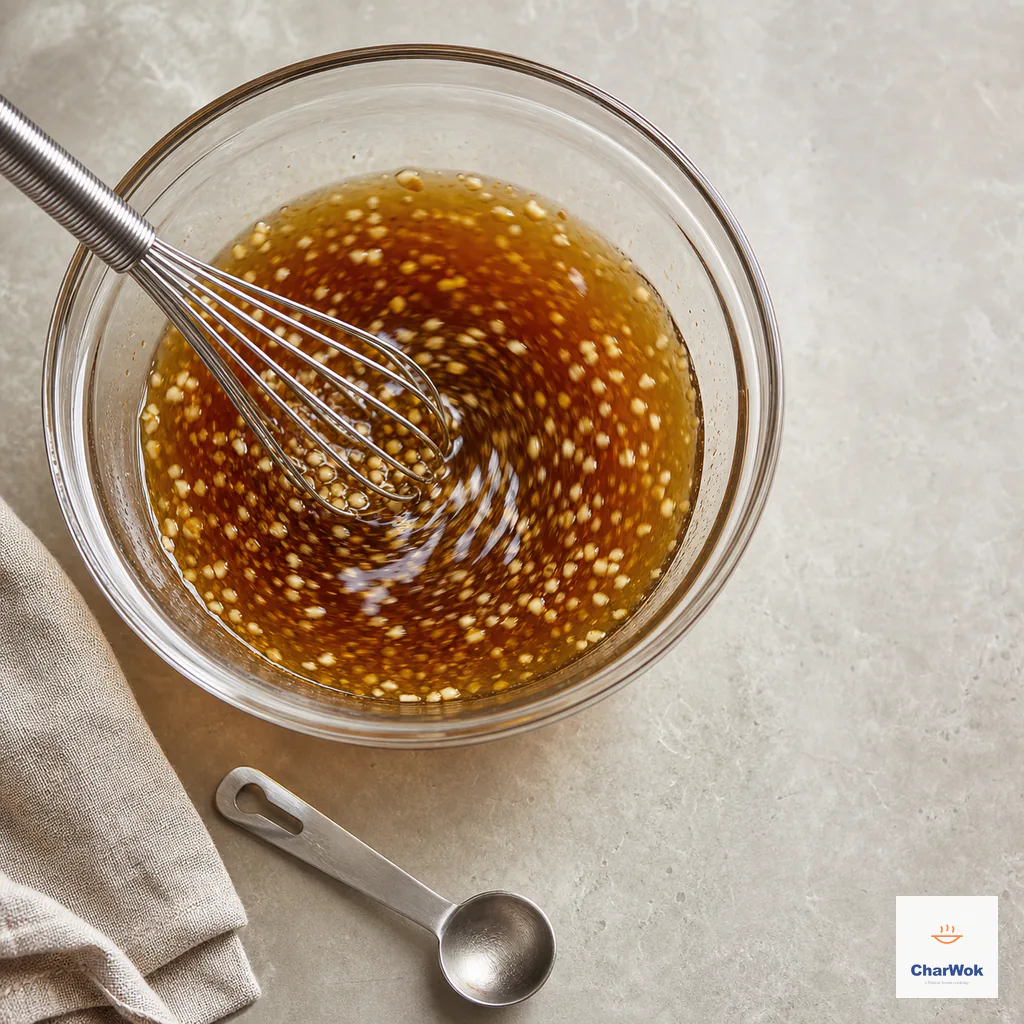
Whisk the black rice vinegar, light soy, garlic, toasted sesame oil, sugar, and salt until no sugar crystals remain, then taste and correct
- Pile the vegetables into a wide serving bowl. Keep them dry. Do not salt them, do not rinse the cucumber after cutting, and do not let the bowl sit in a warm kitchen for an hour. If you must prep early, cover and refrigerate the cut vegetables uncovered so they do not steam.
- Dress no more than 1 to 2 minutes before serving. Pour the dressing over, then toss vigorously with chopsticks or tongs for a full 20 to 30 seconds. The vegetables should be glossy, not drowning. There will be a small pool of liquid at the bottom; that is correct.
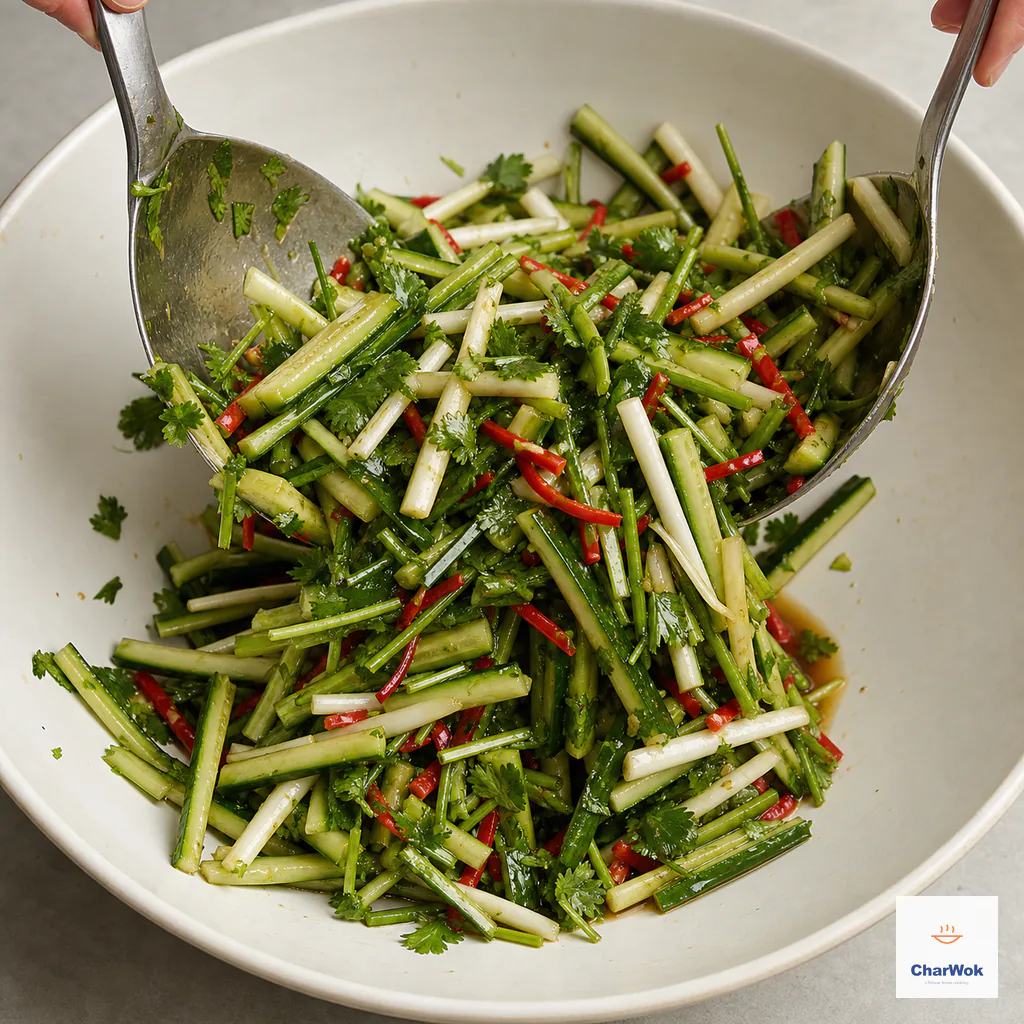
Dress only 1 to 2 minutes before serving and toss vigorously for 20 to 30 seconds; the vegetables should look glossy, never drowned or wilted
- Serve immediately. This dish does not improve with time. If you want a heat lift, finish with a spoonful of chili oil right at the table.
When good salads go wrong
The bowl fills with water and the salad goes limp. This is the number-one failure and it has one cause: time. Salt pulls water out of cut cucumber and chili cells by osmosis, and within ten minutes the dressing thins and the vegetables collapse. There is no rescue once it has happened. The only fix is prevention: dress at the last second. If you are bringing this to a potluck, carry the vegetables and the dressing in separate containers and combine them in front of your guests.
The salad tastes flat or one-note. Almost always a sugar or sesame oil problem. Black rice vinegar is assertive and slightly smoky; without enough sugar to round it and enough oil to carry it, the dressing reads as just sour. Correct the dressing before you pour it. A flat salad can also mean your vinegar has been open in the cupboard for two years; black rice vinegar loses its aromatic top notes over time.
The garlic is harsh and burning. Raw garlic gets angrier the longer it sits minced. If your garlic was bruised or sprouting, the dressing will taste hot and bitter. Use fresh, firm cloves, and if you are sensitive, soak the minced garlic in the vinegar for five minutes before adding the other ingredients; the acid mellows the bite.
The chili dominates everything. Two things help. First, remove the seeds and ribs from the chilies, where most of the capsaicin lives. Second, use the long, light-green shā jiāo type rather than a fiery serrano if heat is a worry. The chili is supposed to be aromatic, not punishing.
Variations worth keeping
Add wood ear mushrooms. A handful of rehydrated, blanched wood ear mushrooms folded in at the end gives the salad a slippery, crunchy contrast that is very common in Dongbei home versions. It turns a side into something closer to a main.
Thin glass noodles. Soak mung bean vermicelli, cut into short lengths, and toss them in. They drink the dressing and stretch the salad to feed more people.
Smoky version. Char the green chilies over a flame until the skin blisters, then peel and slice. This borrows from tiger skin pepper technique and adds a roasted depth that plays beautifully with the black vinegar.
What to serve it with
Tiger salad exists to cut through richness, so pair it with the dishes that need cutting. Next to a glossy, sweet-savory plate of red-cooked pork belly it does exactly what a pickle does next to a fatty brisket. It is equally welcome beside the dark, syrupy glaze of three cup chicken, the seared pepper bite of black pepper beef, or the sticky-sweet crust of sweet and sour meatballs. If you are cooking a northern-leaning meal, try it alongside the cumin-and-chili intensity of cumin lamb stir-fry; the cool vinegar tames the dry spice in a way rice alone cannot.
For a full summer spread, drop this into a rotation drawn from a collection of Chinese summer recipes, where cold dishes carry the meal and the wok stays off as much as possible. Add steamed rice and a simple soup and you have a complete table.
Storage
Once dressed, this salad does not store. Eat it in the first ten minutes. If you have leftovers, drain the liquid and use the vegetables as a condiment over cold noodles the next day; the texture will be softer but the flavor still bright. Undressed cut vegetables keep in the fridge, covered, for about a day before they start to dry out. The dressing keeps for three to four days in a sealed jar at room temperature; give it a whisk before using.
Frequently asked questions
Why is it called tiger salad if there is no meat? The name describes the fierce, lively flavor from raw scallion, garlic, and chili, not the ingredients. Many Chinese dish names work this way.
Can I use regular cucumbers from the supermarket? Yes, but pick English or Persian types with fewer seeds and less water. Standard waxed cucumbers release too much liquid and thin the dressing.
Is this salad spicy? Only mildly. With the seeds removed and long green chilies used, it reads as aromatic warmth. Add chili oil at the table if you want real heat.
Can I make it ahead for a party? Prep the vegetables and mix the dressing in advance, but keep them separate. Combine no more than two minutes before serving, or the salad will weep and go limp.
What can I substitute for black rice vinegar? Nothing is exact. The closest swap is half balsamic and half rice vinegar, which mimics the malty depth and color without being identical.