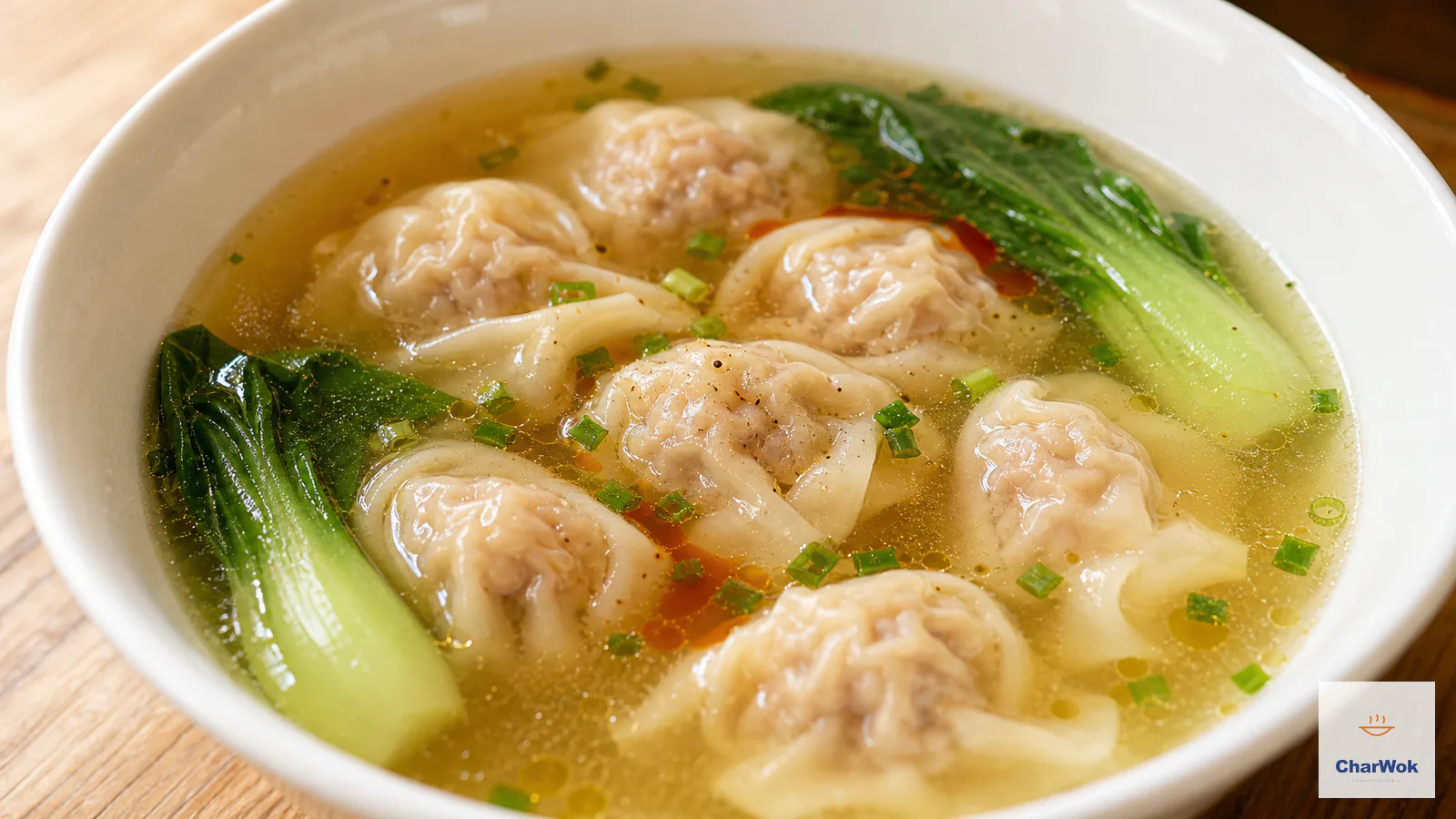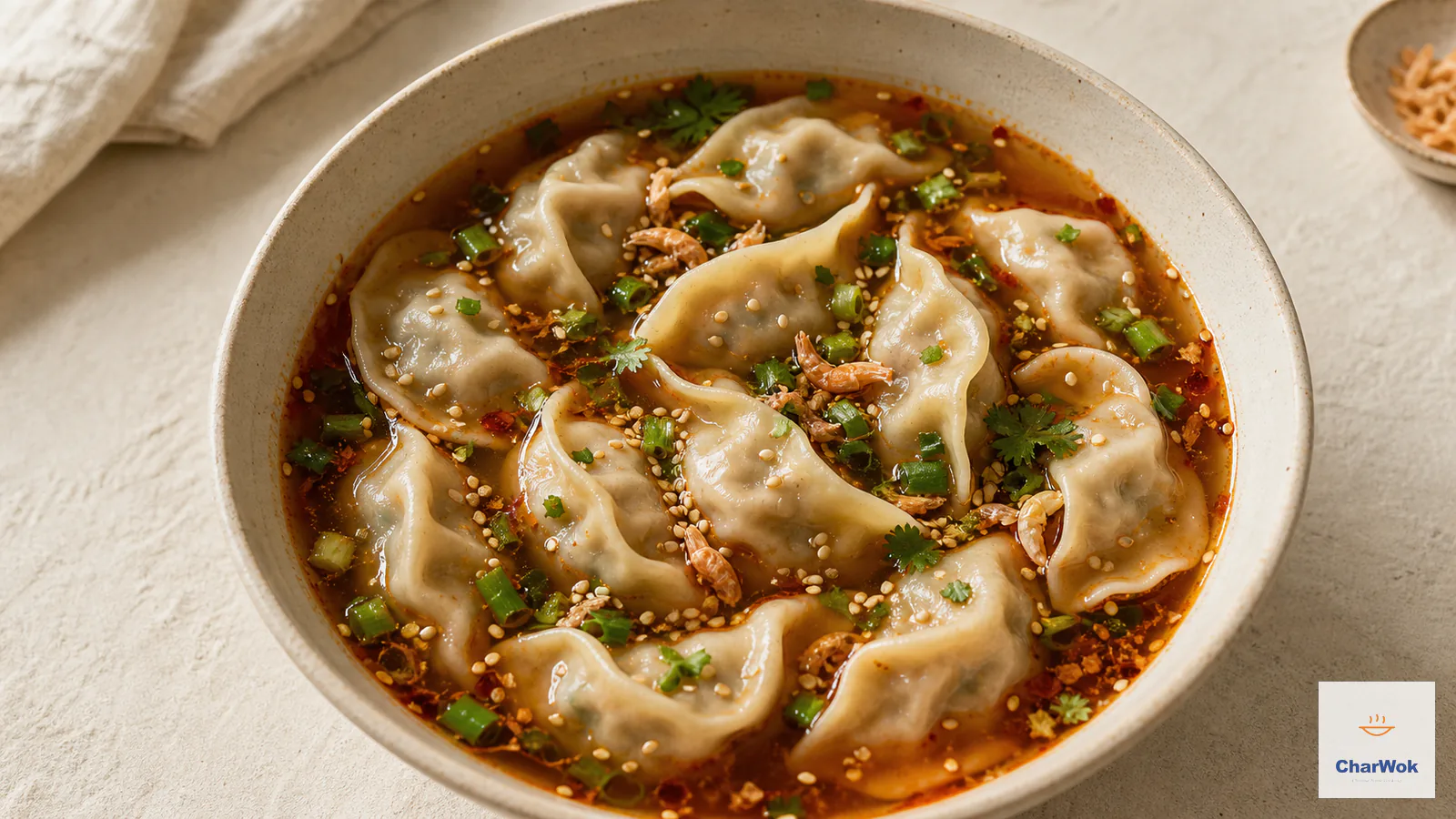
酸汤水饺 (suan tang shui jiao, "hot-and-sour soup dumplings") is built around boiled beef dumplings, but the real subject is the liquid they swim in: a tangy, spicy, fragrant broth made with quick-spiced black vinegar. Skip the broth and you have a perfectly good dumpling. Balance the vinegar, chili oil, and starchy cooking water, and the bowl becomes much more than the sum of its parts.
The pain point most home cooks hit is the dumplings themselves. The wrapper tears, the filling leaks, or the beef comes out dry. The useful controls are dough hydration, fat content, and the cold-water additions that calm the boil. Those cues improve texture, but they do not prove the ground-beef filling is safely cooked; the final check is a measured center temperature.
At a glance: Hot-and-sour soup dumplings are beef-and-chive jiaozi served in a broth of spiced black vinegar, chili oil, soy, and starchy cooking water. Use a dough at roughly 53% hydration (160 ml water to 300 g flour), ground beef with enough fat to stay juicy, and three cold-water additions to manage the boil. Then check several of the largest dumplings: the center of the filling must reach 71°C / 160°F.
What this dish is, and where it comes from
Suan tang shui jiao is a Shaanxi specialty, from the wheat-belt northwest of China where vinegar is treated with the reverence southern cooks reserve for soy sauce. The local palate runs hot and sour, and the genius move here is to take an everyday boiled dumpling (the same one you'd see folded a dozen ways in our general jiaozi guide) and drop it into a brothy bowl built on that hot-sour axis. Think of it as the dumpling equivalent of hot and sour soup or the tingly liquid in chili-oil wontons: the carb is the vehicle, the broth is the point.
One thing that throws first-timers: the "soup" is not a long-simmered stock. It is hot dumpling-cooking water (starchy, slightly cloudy) spiked with the spiced vinegar and seasonings at the bottom of the bowl. The starch in that water is what lets the oil and vinegar cling to the dumplings instead of separating into a greasy slick. So don't dump the boil water; you need it.
The dough: why 53% hydration, and why you rest it
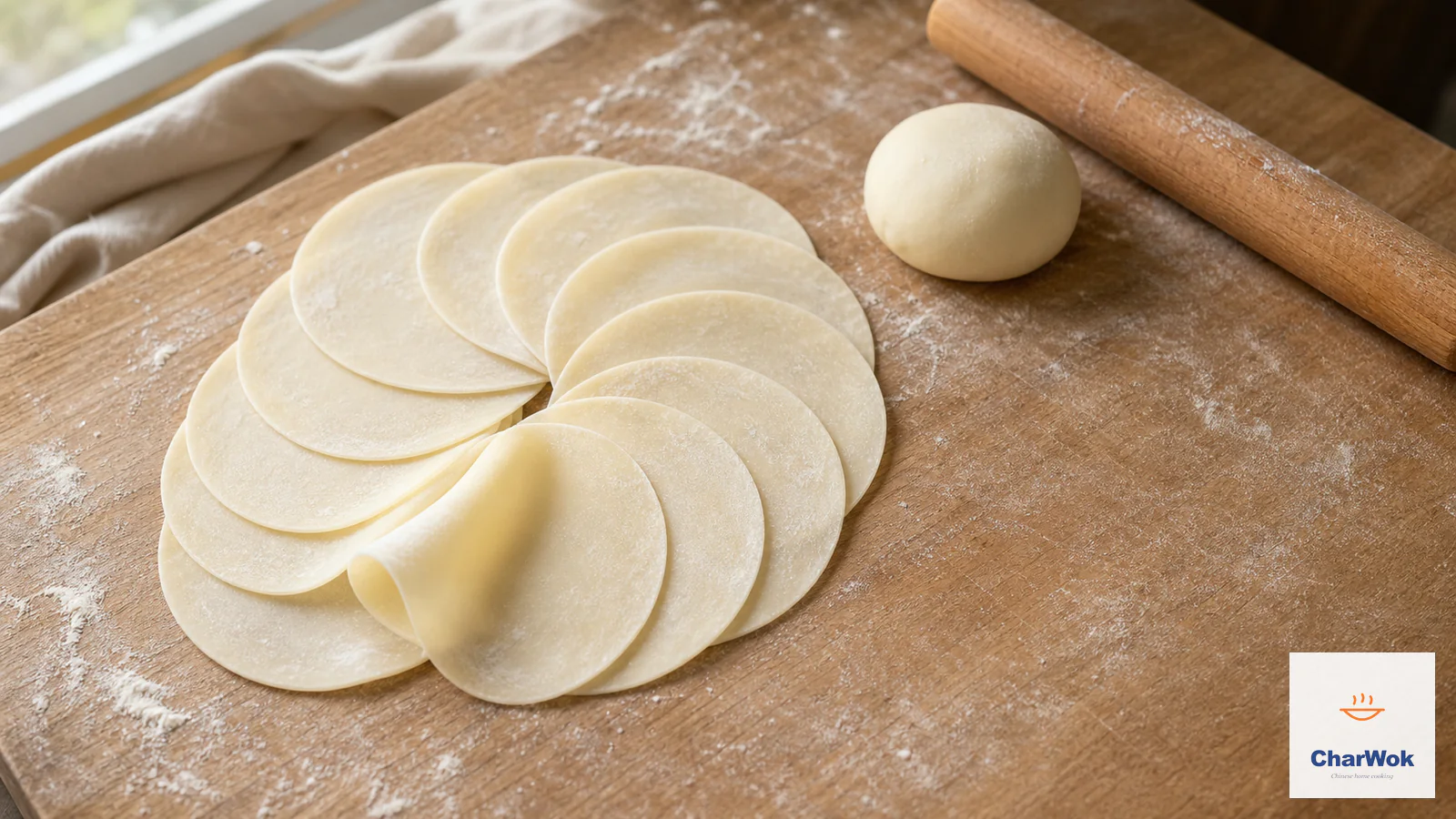
Dumpling dough is just flour, water, and a pinch of salt. Recipes disagree on the liquid amount because flour absorption changes by brand and measuring method, so weighing is more repeatable. Three hundred grams of all-purpose flour with 160 ml of water lands around 53% hydration: firm enough to roll thin, but soft enough to pleat and seal without springing open. For wrapper technique, resting, rolling, and the pasta-machine shortcut, see the guide to making dumpling wrappers from scratch.
The step people skip and then regret is the rest. After the first short knead the dough feels lumpy and resists stretching. That is the gluten, tight and angry. Cover it and walk away for 30 to 60 minutes. The gluten relaxes, the flour fully hydrates, and the second knead takes it smooth in under a minute. A dough that wasn't rested will shrink back as you roll and produce thick, chewy wrappers. A rested dough rolls out almost paper-thin with no argument.
Filling: how to keep ground beef from turning into a hockey puck
Beef is the hard filling. Pork carries its own fat and forgives you; beef leans out and turns dense and cottony if you mistreat it. Two things save it, and both matter.
First, fat. Buy ground beef labeled 80/20 or grind your own from a fatty cut like short rib or chuck eye. Extra-lean beef is the reason so many home dumplings taste like cardboard. If your supermarket only stocks lean, add a tablespoon of neutral oil to the mix. It isn't a perfect fix, but it beats dry. This is the same principle behind a good dumpling filling in general: the fat is where the juiciness lives.
Second, beat in the liquid. The old northern technique called da xian'r (打馅儿, "beating the filling") means stirring the meat in one direction while you trickle in water or stock a little at a time, stopping only when the meat has drunk every drop and looks sticky and slightly lighter in color. You are essentially making a meat emulsion. The salt-soluble myosin in the beef unravels and traps the water, so it stays inside the dumpling during boiling instead of leaking out. Stir in both directions and you break that network. Pick a direction at the start and commit to it. By the time you're done, the mixture should look glossy and fall in a slow ribbon off the spoon.
Seasoning is light on purpose: scallion, ginger, a half-teaspoon of ground Sichuan pepper (or five-spice powder if you prefer warmer notes), a teaspoon of Shaoxing rice wine, and salt. The broth will carry the aggressive seasoning; the filling should taste clean and beefy. Fold in the chopped Chinese chives and a teaspoon of sesame oil last, right before assembling. The oil coats the chives and slows them from weeding water into the filling. (This is the same reason the chive filling in chive pockets gets a protective slick of oil.)
Keep the raw filling cold and contained. Refrigerate it whenever wrapping pauses. After hands, utensils, or a plate touch raw beef, wash them before handling cooked dumplings, serving bowls, or garnishes; transfer the finished dumplings with a clean utensil to a clean plate.
Ingredients
Ingredients at a glance
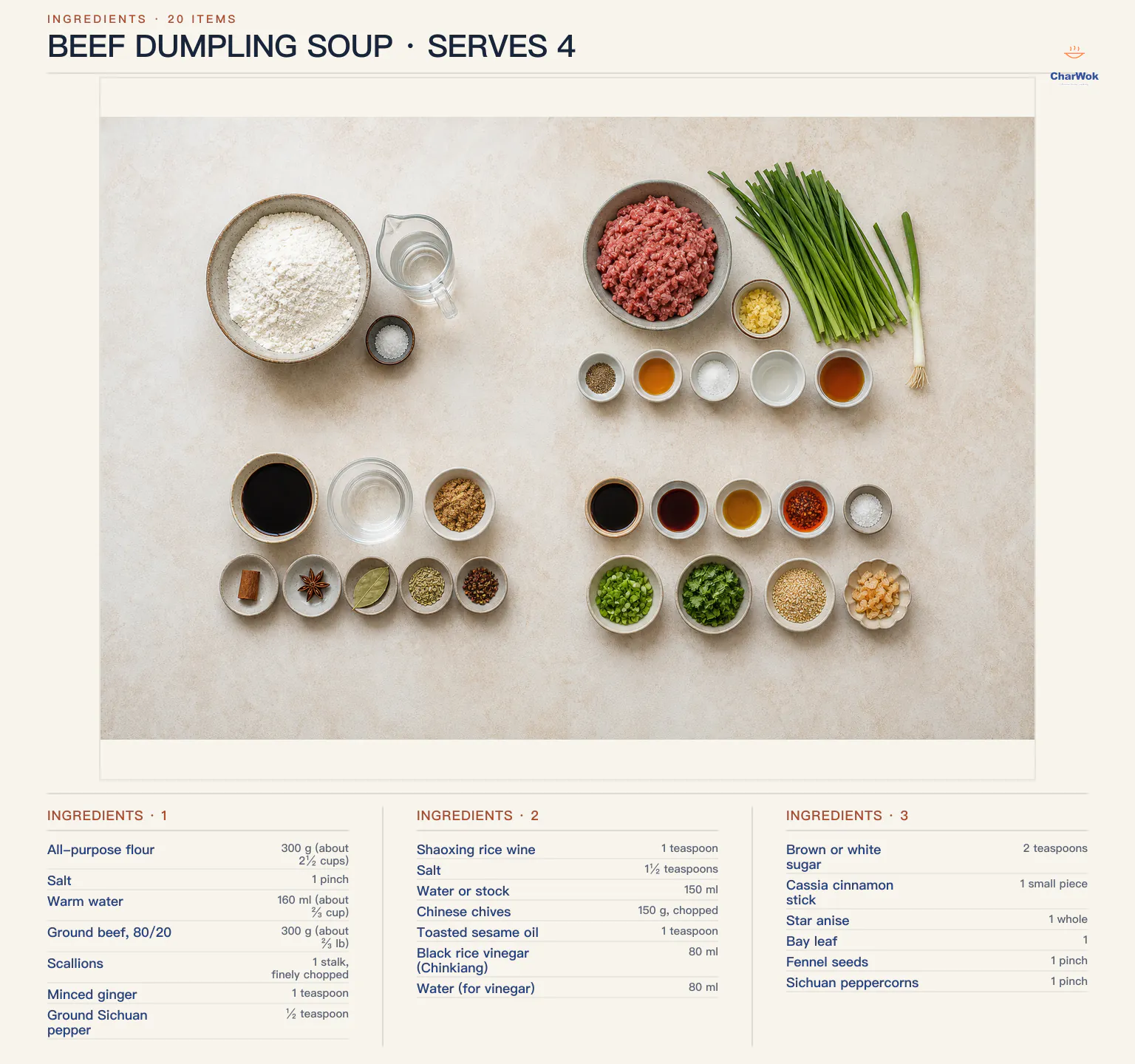
| Ingredient | Amount | Notes / substitute |
|---|---|---|
| All-purpose flour | 300 g (about 2½ cups) | Plus extra for dusting. A US AP flour around 10–11% protein is ideal. |
| Salt | 1 pinch | For the dough. |
| Warm water | 160 ml (about ⅔ cup) | Aim for ~53% hydration; adjust 1–2 tsp if the dough feels wet or stiff. |
| Ground beef, 80/20 | 300 g (about ⅔ lb) | Fatter is better. Grind your own short rib if you can. |
| Scallions | 1 stalk, finely chopped | Use 2 if the stalk is thin. |
| Minced ginger | 1 teaspoon | Fresh, microplaned fine. |
| Ground Sichuan pepper | ½ teaspoon | Swap for ½ tsp five-spice if you dislike the numbing note. |
| Shaoxing rice wine | 1 teaspoon | Dry sherry works in a pinch. |
| Salt | 1½ teaspoons | For the filling. |
| Water or stock | 150 ml | Beaten into the filling. |
| Chinese chives | 150 g, chopped | Sub napa cabbage (salted and squeezed) or regular chives. |
| Toasted sesame oil | 1 teaspoon | Folded in last to coat the chives. |
| Black rice vinegar (Chinkiang) | 80 ml | The sour backbone. Balsamic is a rough substitute but sweeter. |
| Water (for vinegar) | 80 ml | Dilutes the vinegar for simmering. |
| Brown or white sugar | 2 teaspoons | Rounds the vinegar's edge. |
| Cassia cinnamon stick | 1 small piece | Chinese cinnamon, not true Ceylon. |
| Star anise | 1 whole | |
| Bay leaf | 1 | |
| Fennel seeds | 1 pinch | |
| Sichuan peppercorns | 1 pinch | Whole, for the vinegar steep. |
Method
- Mix and rest the dough. Combine the flour, the pinch of salt, and 160 ml water. Knead briefly; it will look rough. Cover and rest 30–60 minutes, then knead until smooth. The rest is non-negotiable; tight gluten will not roll thin.
- Steep the spiced vinegar. Put the black rice vinegar, water, sugar, cinnamon, star anise, bay leaf, fennel seeds, and Sichuan peppercorns in a small saucepan. Cover, bring to a simmer, and hold 5 minutes. Strain out the spices and keep the liquid warm. Do this now so the flavors are set by the time you assemble. (Curious why black rice vinegar and not white? It's maltier and rounder; see the vinegar guide.)
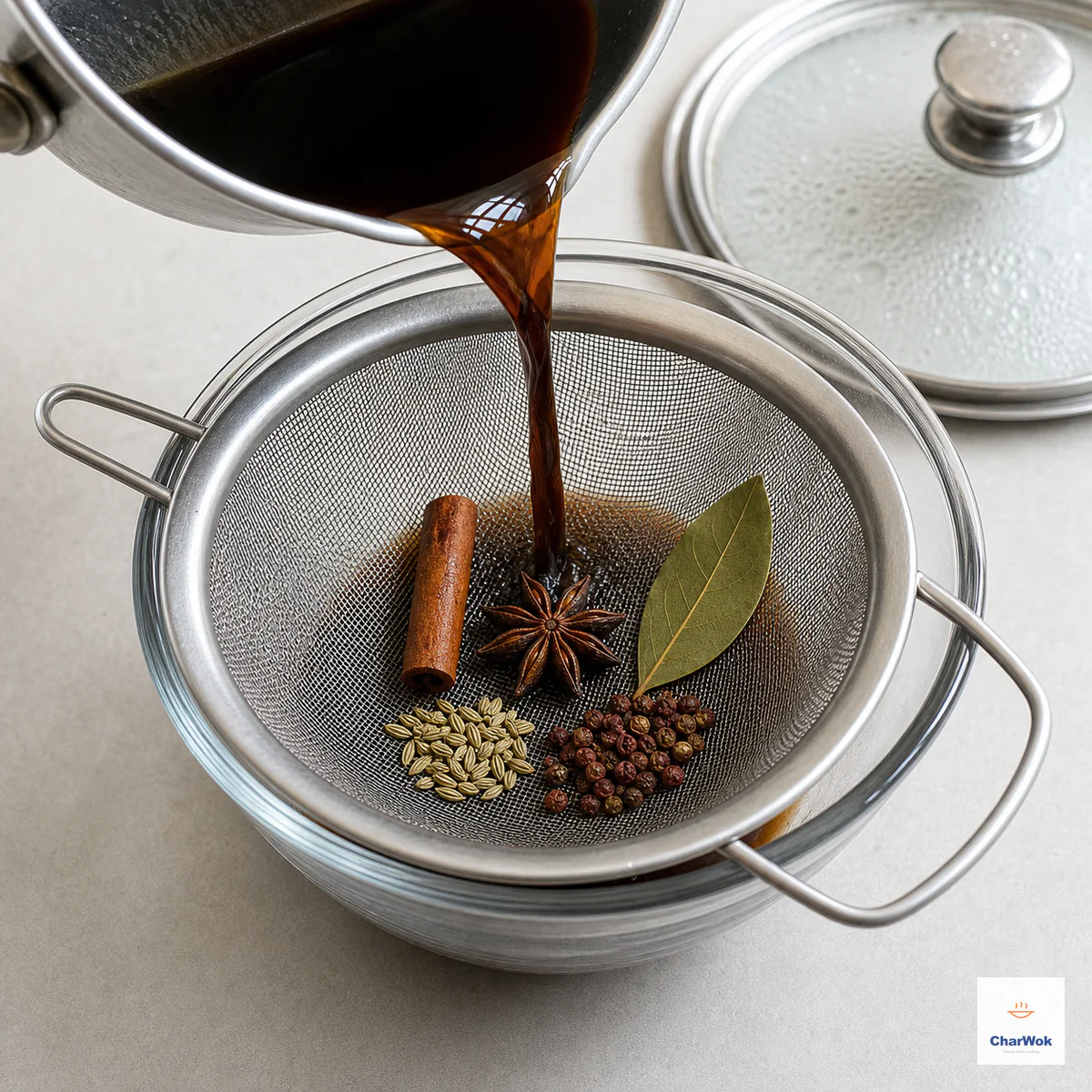
Keep the saucepan covered for the 5-minute simmer, then strain out every whole spice and keep the vinegar warm.
- Beat the filling. In a bowl, combine the beef, scallion, ginger, ground Sichuan pepper, Shaoxing wine, and salt. Stirring firmly in one direction only, trickle in the 150 ml water/stock a few tablespoons at a time, waiting until each addition is absorbed before adding more. Stop when the meat looks glossy and sticky. Fold in the chives and sesame oil last.
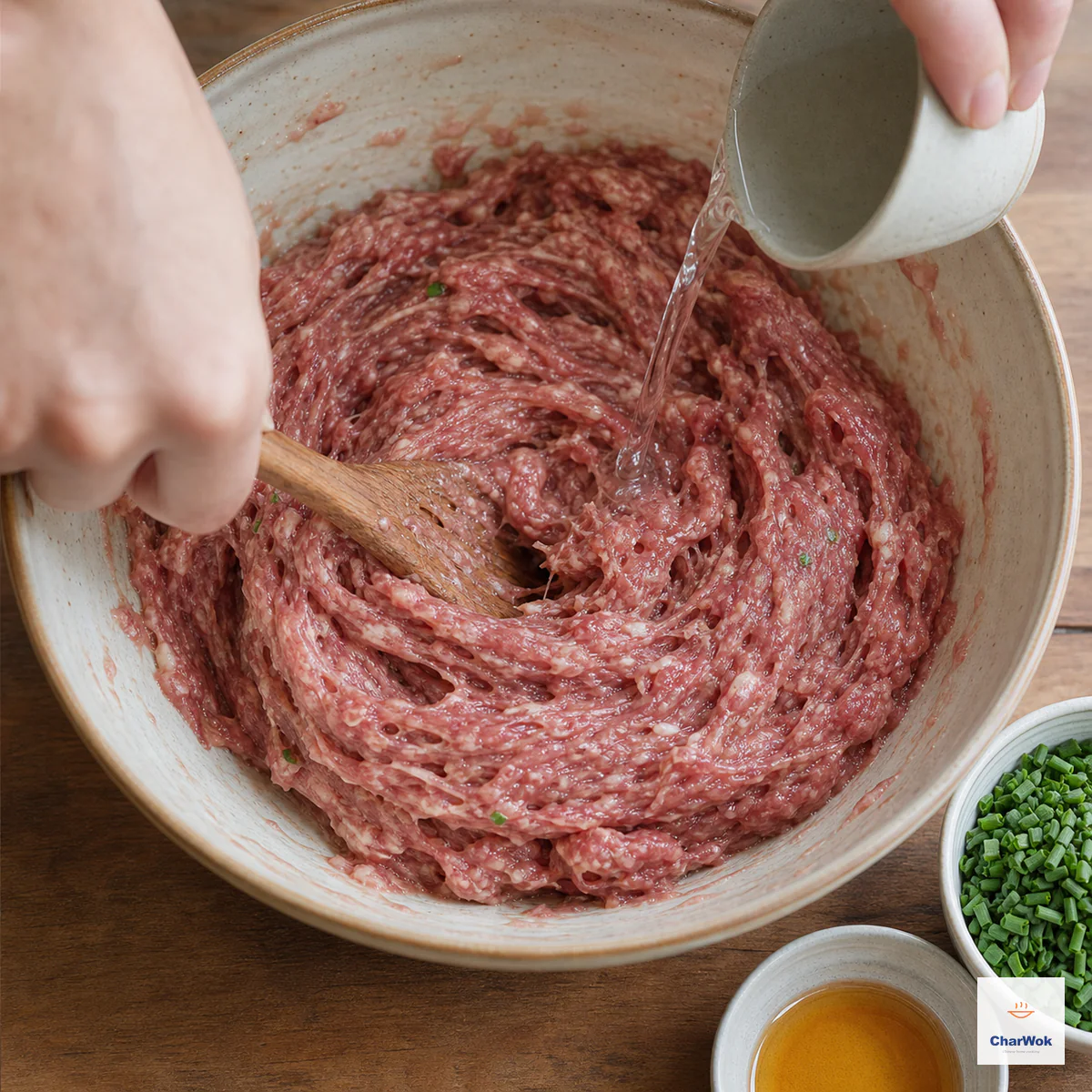
Add the 150 ml water or stock in small batches, stirring one way until each addition disappears; fold in the chives and sesame oil last.
- Roll the wrappers. Roll the rested dough into a log about 2.5 cm (1 inch) thick and cut it into roughly 40 pieces. Flatten each piece with your palm, then roll each into a thin round, working the edges thinner than the center so the pleat doesn't get bulky. Keep rolled wrappers and the cut pieces covered with a damp cloth so they don't dry out. For folding options beyond a simple half-moon, the dumpling folding guide walks through the core pleats and their variations.
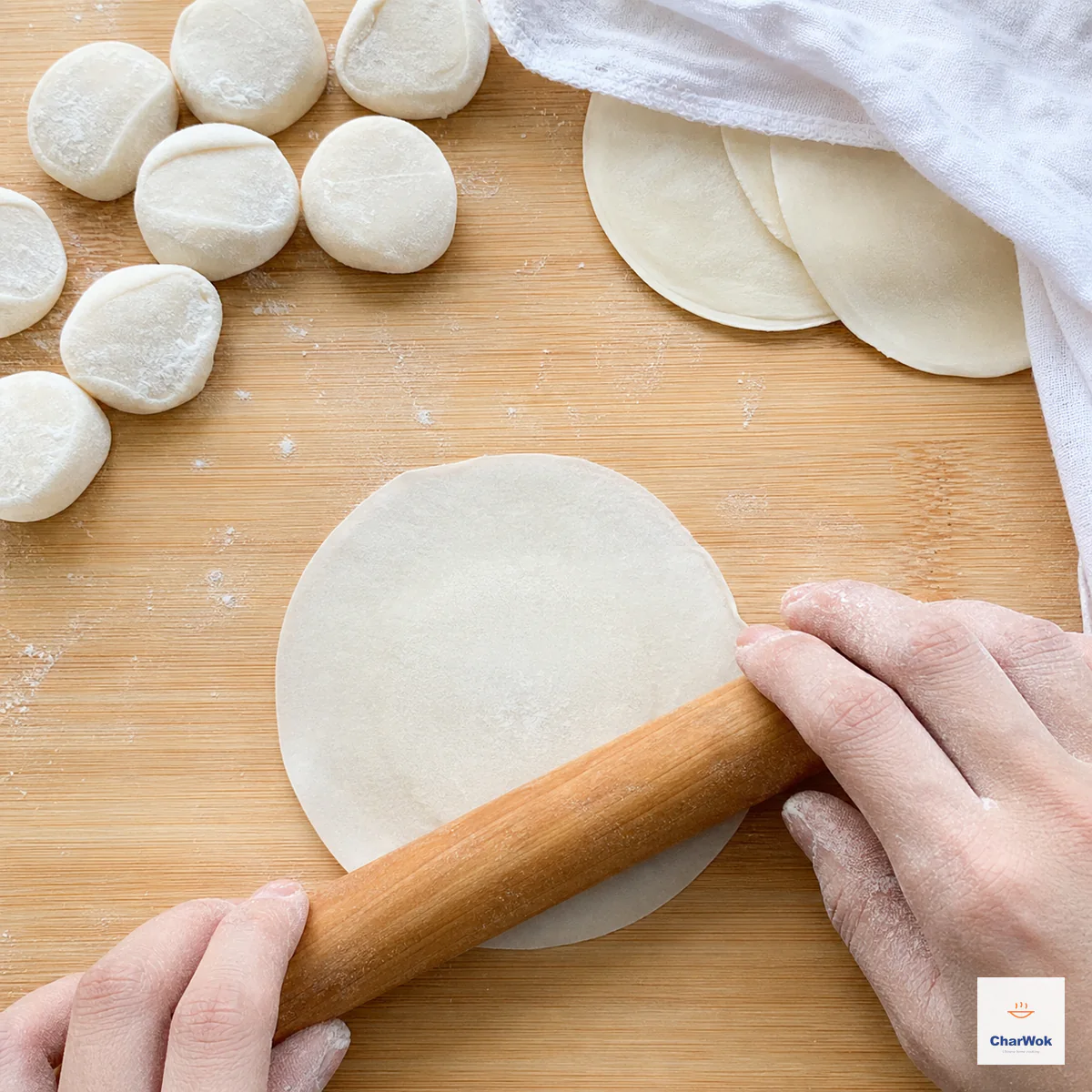
Roll each wrapper to about 8 cm with a sturdy center and thin edges, and keep both dough pieces and finished rounds under a damp cloth.
- Fill and seal. Put a scant tablespoon of filling in the center of a wrapper, fold, and press the edges airtight. How you pleat is up to you (a flat half-moon, a crescent, a standing pleat), as long as there are no gaps. The same logic applies whether you're making these, pork-and-cabbage dumplings, or the pan-fried pork-and-chive version.
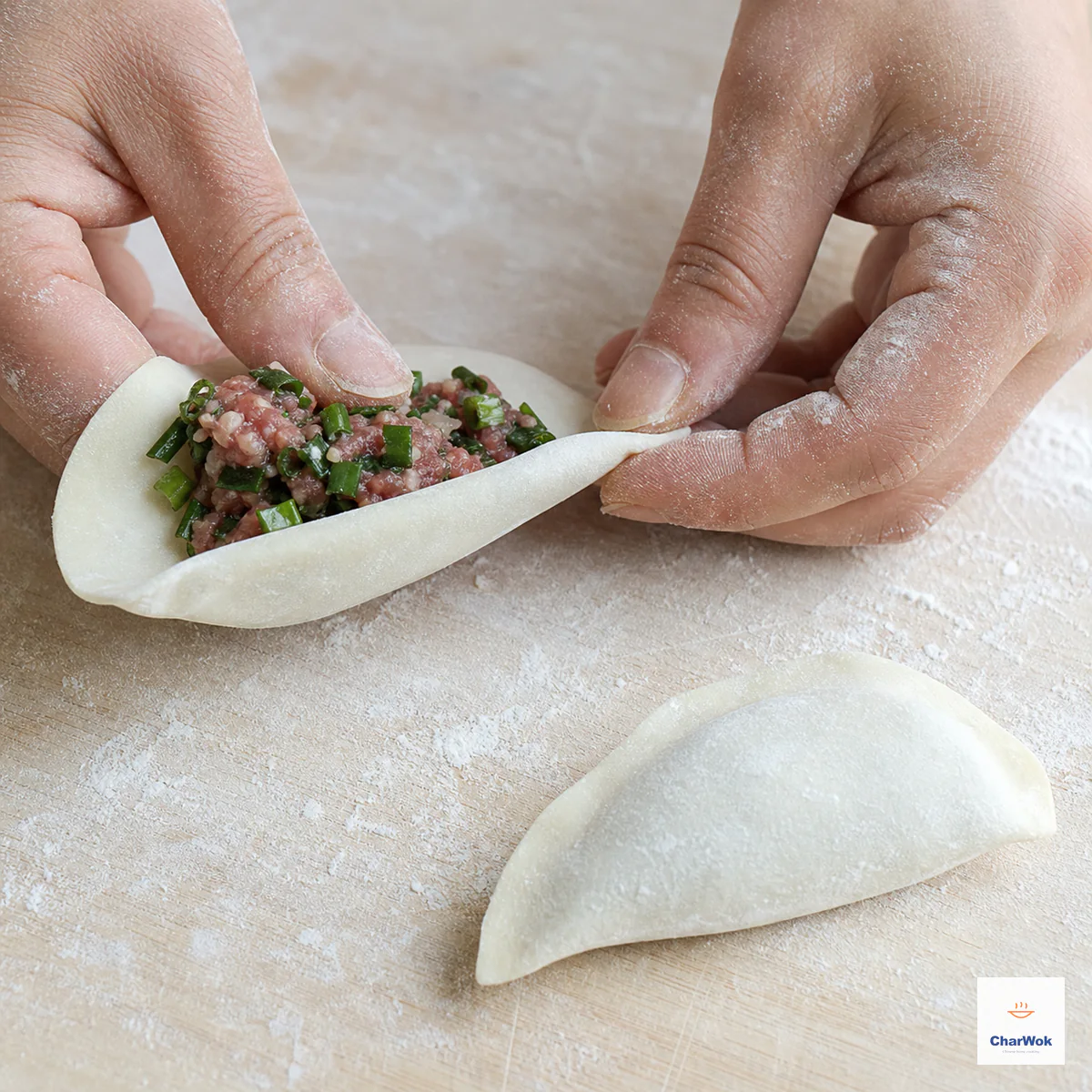
Use a modest spoonful of filling and press the entire seam airtight; the shape may vary, but no gap can remain.
- Boil and check the dumplings. Bring a large pot of water to a rolling boil, leaving enough headroom to prevent boil-over. Slide in half the dumplings (about 20) and stir gently with the back of a spoon to lift them off the bottom. Cover loosely. Each time the water returns to a boil, uncover and slowly pour about 120 ml cold water down the inside of the pot; repeat for three additions total. Floating, plumping, and a slightly translucent wrapper mean it is time to check, not that the beef is automatically safe. Lift out two or three of the largest dumplings, then insert a clean thin-tip instant-read thermometer through the side into the center of the filling. Each one must reach 71°C / 160°F, the USDA minimum for ground meat. Return any under-temperature dumplings to the pot and recheck after another minute with a cleaned probe. The three-addition technique is explained further in how to cook dumplings.
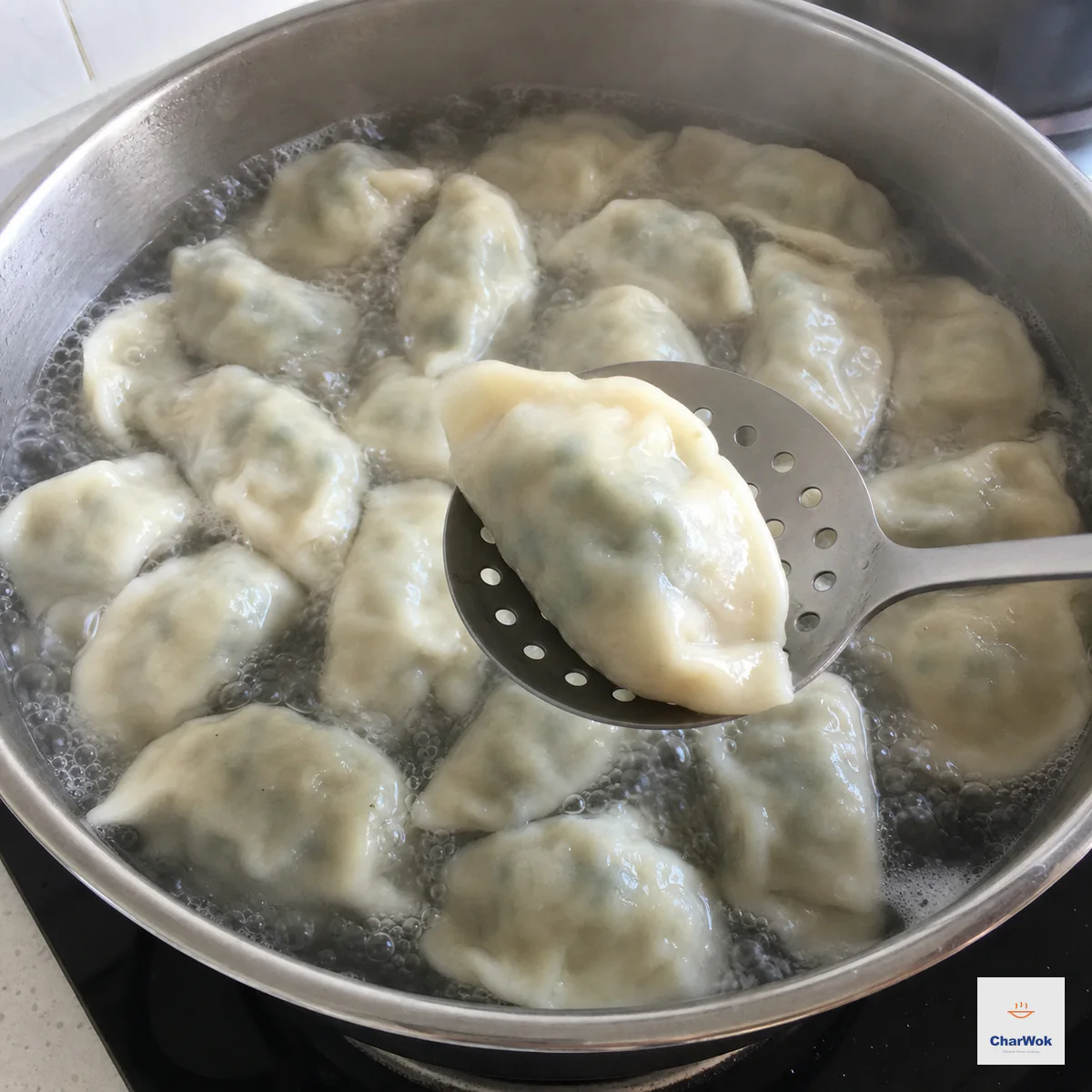
Floating, plumping, and translucent wrappers mean it is time to check: test two or three of the largest filling centers and serve only when every checked dumpling reaches 71°C / 160°F.
- Build the bowls. While the dumplings boil, put 1–2 tablespoons of the spiced vinegar plus the soy sauce, sesame oil, chili oil, salt, scallion, cilantro, sesame seeds, and dried shrimp into each serving bowl. Use a slotted spoon to transfer the hot dumplings in, then ladle over a generous scoop of the starchy boiling water. Stir gently and eat immediately, while the broth is still fiery and the wrappers are at peak tenderness.
When things go wrong (and they will, at first)
The wrappers shrink back as you roll. The dough hasn't rested, or it has dried out. Re-cover and rest another 20 minutes. If it's dry and cracking, knead in a few drops of water and rest again.
Wrappers tear while boiling. Usually two causes: you rolled them unevenly (a thick center is fine, paper-thin spots are not), or you overfilled. A level tablespoon is plenty for a home-rolled wrapper. Torn dumplings still taste fine; fish them out, eat them, and roll the rest a touch thicker.
The filling leaks into the pot. The seal wasn't airtight, or you stirred the dumplings too aggressively right after they went in. Press from the center outward to push air out before sealing, and only nudge them off the bottom with the back of a spoon, never a vigorous stir.
The beef is dense and dry. Either the grind was too lean, you skipped the beating-in step, or you stirred in both directions and broke the emulsion. Next time buy fattier beef and commit to one direction.
The broth tastes thin or one-note. You under-salted, or you didn't use the starchy boil water. The cloudiness from that water is doing real work: it carries the oil and vinegar as an emulsion rather than letting them separate. If it's still flat, add another splash of spiced vinegar and a little more chili oil directly to the bowl.
The vinegar is too aggressive. Black rice vinegar is strong. Start with one tablespoon per bowl, taste, and add more only as needed. If the broth is already too sharp, dilute it with more hot cooking water instead of trying to bury the acidity under sugar.
Variations, pairings, and dipping options
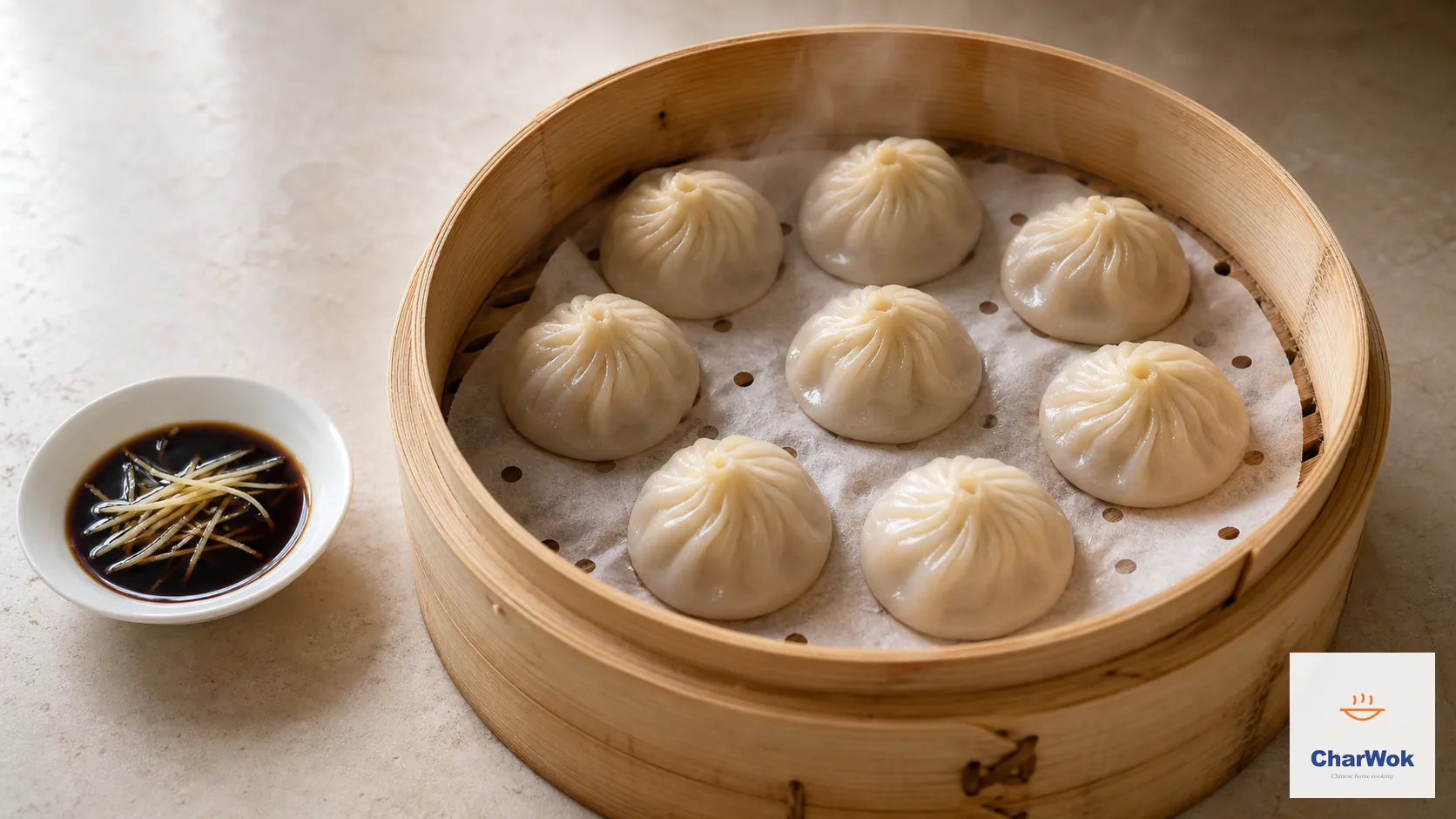
The beef-and-chive filling is traditional, but the suan tang format is forgiving. Lamb with cumin is a natural northwest move. A pork-and-shrimp filling gets you closer to the richness of xiao long bao territory. Vegetarians can swap the beef for firm tofu and mushrooms; just don't skip the chives, they're the backbone of the aroma.
If the soupy bowl isn't your thing, boil the dumplings plain and serve them with one of the six classic dumpling dipping sauces. A simple black-vinegar-and-chili-oil dip is essentially the broth's flavor in concentrated form. For a heartier meal, a side of egg drop soup or a quick stir-fried green rounds it out, the same way you'd build a plate around wonton soup.
Storing and reheating
Freeze raw dumplings promptly on a flour-dusted or parchment-lined tray so they do not touch, then bag them airtight once solid. Cook them straight from frozen without thawing. Extra cold-water additions or extra minutes are only timing guides: check two or three of the largest dumplings from each batch and do not serve until every checked center reaches 71°C / 160°F.
For cooked leftovers, separate the dumplings and broth into shallow containers and refrigerate within 2 hours, or within 1 hour when the room is hotter than 32°C / 90°F. Eat within 3–4 days and reheat the centers and broth to 74°C / 165°F. The USDA leftovers guidance explains those limits. Keep the spiced vinegar covered and refrigerated rather than leaving it at room temperature.
Frequently asked questions
Can I use store-bought dumpling wrappers instead of making dough?
Yes. Store-bought wrappers are thinner and less elastic, so fill them lightly and wet the edges to seal. The spiced broth carries the flavor even when the wrappers are plain.
How do I know beef dumplings are safely cooked?
Floating, plumping, and a translucent wrapper are timing cues only. Remove two or three of the largest dumplings from each batch and insert a clean thin-tip thermometer through the side into the center of the filling. Every checked dumpling must reach 71°C / 160°F; return any cooler ones to the pot and recheck after another minute.
Why add cold water three times while boiling the dumplings?
Each addition briefly calms the boil so the wrapper is less likely to burst while the filling heats. It is a texture and boil-control technique, not a doneness test; still verify the ground-beef filling at 71°C / 160°F.
What can I substitute for black rice vinegar?
Balsamic vinegar works but is sweeter, so sharpen it with a little white vinegar. Malt vinegar is closer in depth. Plain rice vinegar alone is too mild for this broth.
How do I freeze and cook these dumplings later?
Freeze them raw on a floured or parchment-lined tray, then transfer them to an airtight bag. Boil straight from frozen without thawing; use floating only as the cue to begin checking, and verify several of the largest centers at 71°C / 160°F before serving.
How spicy is beef dumpling soup?
It is mildly warming as written. Chili oil is added per bowl, so each person can start with a teaspoon and add more at the table.
Can I make the dough in a stand mixer?
Yes. Use the dough hook on low until the dough comes together, then rest it and finish kneading briefly. The machine replaces the initial hand work, but the 30–60 minute rest is still necessary.