I have made zongzi badly more times than I care to admit. The first batch I ever tied had rice squeezing out of every seam, and by the time the pot stopped simmering I had a greasy porridge glued to half a dozen bamboo leaves. Zongzi, the sticky-rice dumpling wrapped in leaves and boiled for hours, is one of those dishes where the recipe is short and the technique is long. The rice is forgiving, the wrapping is not.
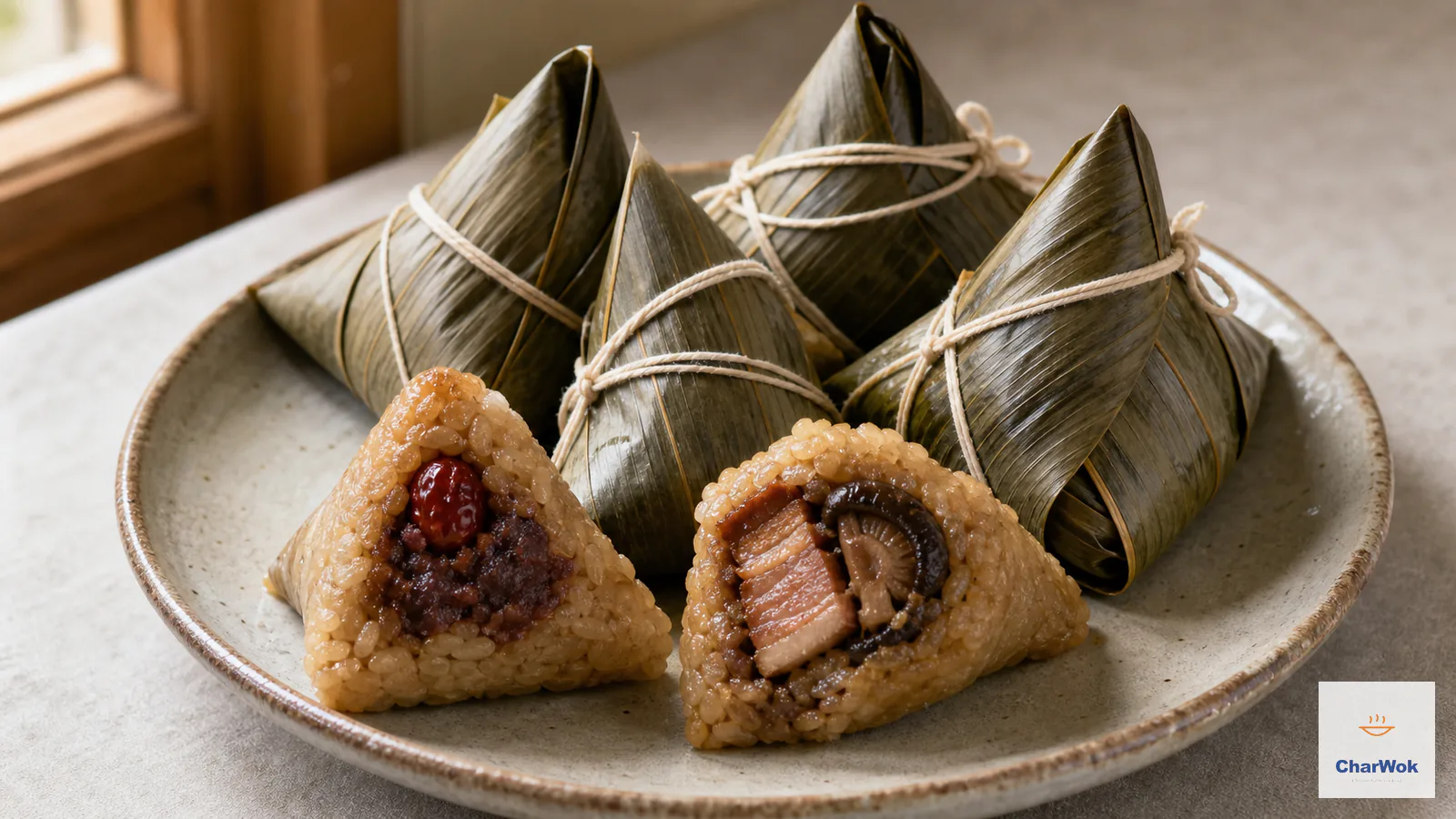
The version most people recognize is the northern sweet style: a triangle of glutinous rice, a jujube date, a slick of sweet red bean paste, all perfumed by the bamboo or reed leaf it was cooked in. The savory southern and Shanghai style goes bigger: a four-cornered pyramid stuffed with marinated pork belly, dried shiitake, and sometimes a salted egg yolk. I make both every Dragon Boat Festival, and over the years I've settled on a few decisions worth stating plainly: soak the rice overnight, not for a few hours; marinate the pork the night before so the seasoning actually penetrates; and tie the string tight enough to hold the leaf shut but loose enough that the rice can expand. Get those three things right and the rest is patience.
What you're actually making
Zongzi are eaten across the Chinese-speaking world to mark the Dragon Boat Festival, which falls on the fifth day of the fifth lunar month. The story everyone learns as a child is about Qu Yuan, the poet-statesman who drowned himself in the Miluo River; villagers threw rice wrapped in leaves into the water so the fish would eat that instead of his body. Whether or not you credit the legend, the dish itself is much older than the festival, and every region has its own grammar. The two we're cooking here are the most teachable: a sweet triangle and a savory pyramid. Master the folding logic of each and you can branch into Cantonese, Teochew, or the jianshui (lye-water) alkaline zongzi without panic.
At a glance. 600 g glutinous rice yields 12 dumplings. Soak rice, leaves, and (for savory) dried mushrooms overnight. Marinate the pork overnight too. Sweet zongzi are triangular and need one wide leaf; savory zongzi are four-cornered pyramids built from a cross of two leaves, with a third and fourth leaf folding in to close the open sides. Cook them in a deep pot weighted with a plate, in plenty of water, for about two and a half hours — and the one rule you cannot bend is that the dumplings stay under water the whole time.
The leaves, the string, and the rice
Dried bamboo leaves are the standard in northern and many southern kitchens; reed leaves are the classic in parts of the north and give a cleaner, grassier scent. Either works, and I won't pretend to have a strong preference. What matters is that you soak them overnight in water with a weight on top so they stay submerged, then blanch them in boiling water for a minute and wipe each leaf with a clean cloth before wrapping. A stiff leaf will crack along the spine the moment you fold it, and a cracked leaf means a leak.
The rice is glutinous rice (also called sweet rice), the same short-grain sticky rice you'd use for lo mai fan stir-fried sticky rice, lo mai gai lotus-leaf chicken rice parcels, or fan tuan breakfast rice rolls. It is not the same as jasmine rice, and it cannot be par-cooked regular rice. Soak it overnight in plenty of cold water, 8 hours minimum and 12 is better. Under-soaked rice stays chalky in the center no matter how long you boil, which is the failure mode nobody warns you about.
Ingredients
Quantities below make 12 dumplings of one style. If you want to split the batch, six sweet and six savory, halve each column and buy a little extra pork. I've kept the two fillings separate so you can pick one and run.
Sweet zongzi (12 dumplings)
Ingredients at a glance
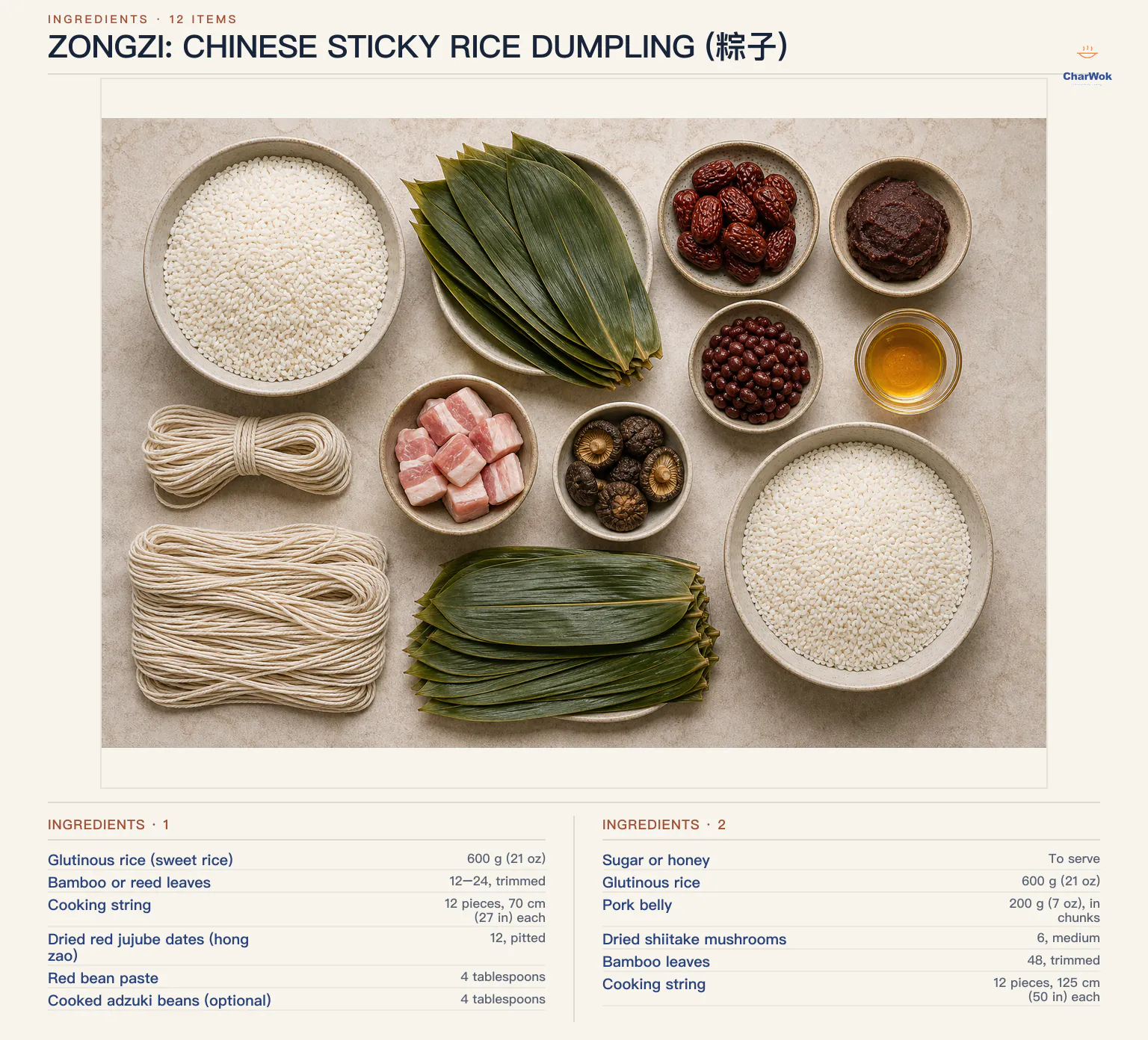
| Ingredient | Amount | Notes / substitute |
|---|---|---|
| Glutinous rice (sweet rice) | 600 g (21 oz) | Short-grain sticky rice, not jasmine. Soak overnight. |
| Bamboo or reed leaves | 12–24, trimmed | 1 wide leaf per dumpling, or 2 narrow leaves overlapped. Buy extra; some split. |
| Cooking string | 12 pieces, 70 cm (27 in) each | Cotton kitchen twine. Never nylon; it melts. |
| Dried red jujube dates (hong zao) | 12, pitted | Soft pitted dates from a Chinese grocer. Medjool is too wet and sweet. |
| Red bean paste | 4 tablespoons | Use the smooth cooked paste. See the homemade red bean paste guide. |
| Cooked adzuki beans (optional) | 4 tablespoons | Whole beans for texture. Skip if your paste is already chunky. |
| Sugar or honey | To serve | Optional, for dipping. |
Savory zongzi (12 dumplings)
| Ingredient | Amount | Notes / substitute |
|---|---|---|
| Glutinous rice | 600 g (21 oz) | Soaked overnight, drained. |
| Pork belly | 200 g (7 oz), in chunks | Skin-on, cut into roughly 2 cm cubes. See marinate below. |
| Dried shiitake mushrooms | 6, medium | Soak overnight, squeeze dry, halve. The shiitake guide covers sizing. |
| Bamboo leaves | 48, trimmed | 4 per dumpling for the pyramid wrap. |
| Cooking string | 12 pieces, 125 cm (50 in) each | Longer than the sweet version, because you wrap two directions. |
For the pork marinade, combine and toss with the belly cubes the night before:
- 2 tablespoons light soy sauce and 1 tablespoon dark soy sauce (dark is for color; if you're unsure which is which, the light vs. dark soy sauce breakdown sorts it out)
- 1 tablespoon Shaoxing rice wine
- 1/4 teaspoon five-spice powder
- A pinch each of white pepper, salt, and sugar
- 1 teaspoon minced ginger
The soy-and-wine marinade is close kin to the one that flavors red-cooked pork belly; you want the meat seasoned all the way through, not just on the surface, which is why an overnight rest matters. A few cooks like to fold in a half salted-duck-egg yolk per dumpling, a Cantonese touch and a good one.
The method
- Soak everything overnight. Rice, leaves, and dried mushrooms go into separate bowls of cold water, each weighted down so nothing floats. Marinate the pork in the fridge. This is the step people try to shortcut and regret: the rice has to be fully hydrated or the center of the dumpling stays hard.
- Prep the leaves. Drain them, blanch in boiling water for 60 seconds, then lay them flat on a towel and wipe both sides. Snip the hard stem end and the ragged tip so each leaf is a clean oval. Flex a leaf with your fingers before you commit to it; if it snaps, it is not ready.
- Fold the sweet triangle. Start with a single wide leaf, or lay two narrow ones down with about a third of their width overlapping so they read as one sheet. Curl it around three fingers of your non-dominant hand, smooth (shiny) face inward, and pinch the spine into a sharp crease where the leaf meets itself; that crease is what holds the corner, so press it firmly. You now have a tapered pocket, point downward. Tuck a pitted date into the very point first; it acts as a plug, keeping loose grains from squeezing out the bottom. Spoon in a shallow layer of rice, then a small dollop of red bean paste with a few whole adzuki beans pressed into it, then fill the rest of the pocket with rice, heaped a little above the rim. To close: bring the two side edges in over the mound, then bend the upper portion of the leaf down so it tents over the filling. Coil whatever leaf trails off the top around the package and cinch it with string. The tension you want: the bundle keeps its shape when you set it down, but a thumbnail pressed into it still leaves a dent. That slack is room for the rice to swell.
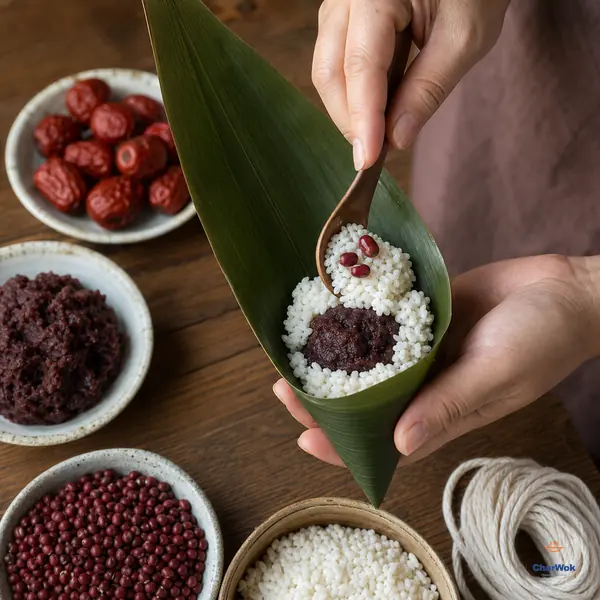
Fold one wide leaf, or two overlapped narrow leaves, into a narrow cone with no hole at the point. Add the pitted date first, then rice, a spoonful of red bean paste, more rice and a few whole adzuki beans; place the rice lightly so it still has room to expand before the leaf is sealed.
- Fold the savory pyramid. Lay two leaves down one on top of the other, rotated so they cross at roughly ninety degrees. The overlap should sit centered, leaving four pointed ends sticking out like compass points. Lift the whole cross and let the center sag into a shallow cup between your hands. Build the filling inside that cup: a base of rice, the marinated pork chunk and a mushroom half pushed into it, then more rice scraped flat across the top so it sits flush with the leaf edges. Now bring the two nearer pointed ends up and over the filling so they meet at the middle; that closes the front and back. The left and right ends are still open, so take a third leaf, drape it across one of those gaps and fold it over to shut that side, and do the same with a fourth leaf on the opposite gap. Finally, wrap the string around the bundle on the diagonal that runs across those last two leaves (perpendicular to the direction they were folded in), so each wrap of twine presses a fold down rather than pulling it open. This is the fiddly wrap; the first one always looks lumpy.
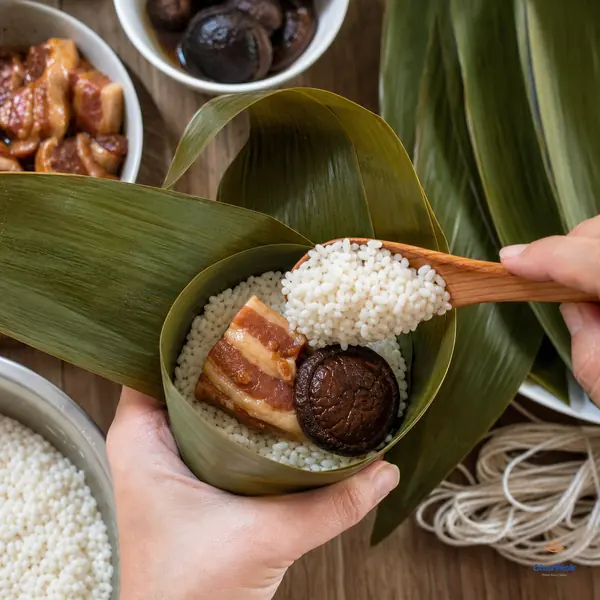
Cross two softened leaves and fold their centre into a wide cone. Lay down rice, centre one marinated pork-belly chunk and one rehydrated shiitake, then cover them completely with more rice and level the top before the remaining leaves close the four-sided dumpling.
- Cook them long and low, in deep water. Use a deep, fairly narrow pot and crowd the dumplings in so they prop each other up rather than drifting around. Add enough water to sit well above the bundle; give yourself a 5 cm (2 in) cushion, because the level falls as steam escapes. Lay a heavy heatproof plate over the top before you turn on the heat; it weights the bundles so they don't ride up. Bring it to a rolling boil, then ease back to a gentle, steady bubble and hold it there for two and a half hours. Set a timer for the halfway mark and again near the end, and replenish with water from a freshly boiled kettle whenever the line drops close to the top dumpling. The reason for all this babysitting is simple: any part that pokes above the waterline cooks by steam instead of by immersion, and comes out dry and underdone.
- Rest before eating. Lift them out and let them sit 10 minutes. The rice finishes absorbing water in that rest and firms up enough to hold its shape when you unwrap. Serve sweet zongzi warm, at room temperature, or even cold (they hold up chilled, which is how a lot of people grew up eating them as a snack), with sugar or honey for dipping. Serve savory zongzi warm.
When things go wrong
Most zongzi failures are one of four things, and three of them are fixable.
- Hard, chalky center. The rice was under-soaked, or the dumpling wasn't fully under water during the boil. There's no rescue for an under-soaked batch; re-boiling won't fix it. Next time, soak a full 8–12 hours and keep the water level topped up.
- Rice leaking out of the seam. The string was too loose, or you overfilled the cone. A little grain escaping is fine; a blowout means the wrap was sloppy. Pack the dumplings tightly in the pot next time so they brace each other, and leave a thumbnail's width of headroom in the cone for the rice to expand.
- Leaf tore while folding. The leaf wasn't softened enough. Blanch longer and keep the leaves you haven't folded yet under a damp cloth so they don't dry out mid-session.
- Savory filling tastes bland. The pork wasn't marinated long enough, or you cut the chunks too big for the seasoning to reach the middle. Cut to 2 cm cubes and give it a full overnight marinate. You can also toss the drained raw rice in a tablespoon of the marinade liquid before wrapping so the rice itself carries flavor.
I'll own the leak problem. My first savory batch looked like a slow-motion explosion. The fix that worked for me was packing the pot snugly and weighting the top plate, not obsessing over tighter string. A dumpling braced on all sides by its neighbors simply has nowhere to bulge.
Variations worth making
Once the wrap is reliable, the filling is wide open. A few I keep coming back to:
- Cantonese style. Add half a salted egg yolk and a piece of Chinese sausage (lap cheong) to the savory filling. The yolk turns golden and fudgy after the long boil.
- Alkaline (jianshui) zongzi. Soak the rice in water laced with lye water, wrap plain, and boil. The dumpling comes out amber and slightly translucent, eaten dipped in sugar — a cousin of the jianshui sweet lotus root with sticky rice.
- Eight-treasure sweet. Swap the single date and bean paste for a mix of candied winter melon, lotus seed, jujube, and a dab of the filling used in eight treasure rice. Festive and a little fussy, but worth it once a year.
Storage and reheating
Cooked zongzi keep well, still wrapped in their leaves and sealed in a bag: plan on three days maximum in the refrigerator, or a couple of months if you freeze them. To reheat, thaw the dumpling first, then drop it, leaf and all, into a pot of boiling water and let it barely simmer for three to five minutes, just long enough to heat it through to the middle. A microwave will do in a hurry but tends to dry out the corners; if you must, wrap the whole thing (leaf included) in a damp paper towel and heat it in short one-minute bursts. The texture is best the day they're made, and honestly the savory ones are nearly as good reheated as fresh.
Frequently asked questions
Can I skip the overnight soak? Not really. A 4-hour hot-water soak will get you partway there, but the center of the dumpling will still be firmer than the outside. Glutinous rice needs a full 8–12 hours in cold water to hydrate evenly.
Can I use a pressure cooker? Yes, and it cuts the cook to about 45 minutes at high pressure with a natural release. Keep the dumplings under water and put a plate on top, same as the stovetop method. The texture is slightly softer than a long simmer but very close.
Do I have to use pork belly? No. Chicken thigh works, and the seasoned pork you'd use for pearl meatballs is a fine substitute if you want a leaner, more uniform filling. Belly gives the best mouthfeel because the fat bastes the rice from inside during the boil.
Why a heavy plate on top? The dumplings want to float, and a floating dumpling cooks above the waterline and turns out half raw. The plate pins them down and keeps the boil even.
The handful of decisions that decide whether zongzi come out right are unglamorous: soak long, marinate long, keep them under water, tie firm but not strangling. Get those right and even an ugly wrap tastes exactly like it should.