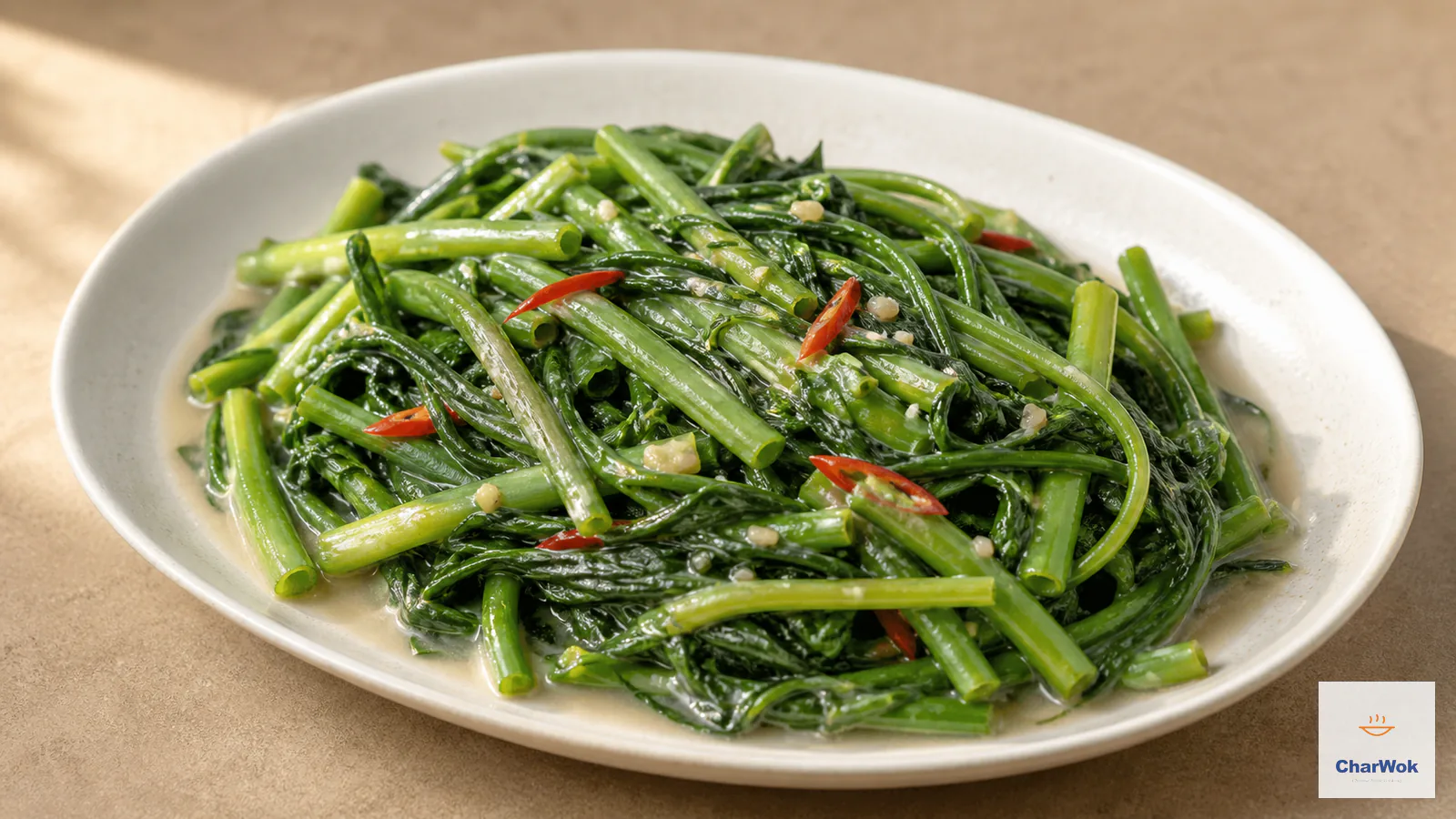
Order water spinach in a good Cantonese restaurant and you get stems that snap between your teeth, leaves that still hold their green, and a slick of sauce that tastes faintly of cheese and wine. Cook the same bunch at home and nine times out of ten you get a dark, watery, stringy tangle. The gap between those two outcomes is not about the recipe. It is about the heat, and about a single ingredient most home cooks skip: white fermented tofu.
This is Jiao Fu Tong Cai (椒腐通菜), the Cantonese stir-fry of water spinach with fermented bean curd and fresh chili. Once you understand why each step exists, it comes together in about a minute and forgives a wok that is not quite restaurant-hot.
At a glance: Split the bunch into stems and leaves and cook them in that order, twenty seconds apart. Build the sauce in a bowl first — two cubes of white fermented tofu mashed with one tablespoon of Shaoxing wine — so the pan never idles. Max heat the whole time; if your burner is modest, add the spinach in two smaller batches. Total time over the flame: under a minute.
What you are cooking, and why it behaves the way it does
Water spinach (also sold as ong choy, morning glory, or kangkong) is a semi-aquatic green with hollow, tube-like stems and long pointed leaves. The hollow core is the whole personality of the vegetable: it stays crisp under high heat precisely because there is air and water trapped inside it, so it takes longer to go limp than a solid stem of the same thickness. That same hollow structure is also why it collapses into mush the instant you crowd the pan: the stem walls are thin, and once they overcook there is nothing left to bite into.
The flavor sits between real spinach and sweet basil: lightly mineral, slightly sweet, no oxalic harshness. It pairs naturally with pungent aromatics, which is why garlic, chili, and fermented tofu keep showing up with it across Cantonese and Southeast Asian kitchens.
The case for fermented tofu
If you have only ever eaten fermented tofu (furu, 腐乳) cold on plain congee, it is easy to underestimate it as a cooking ingredient. Cubes of soy curd cured in salt, rice wine, and sometimes chili or red yeast ferment until they turn soft, funky, and cheese-like. Two things happen when you cook with it. First, it supplies a deep, savory backbone you cannot get from soy sauce alone, because the fermentation has already broken the proteins down into free amino acids. Second, it thickens the pan sauce slightly and helps it cling to the slick stems instead of pooling at the bottom of the plate.
For this dish you want the plain white variety, sold in glass jars in most Asian markets. The red version (stained with red yeast rice) is saltier and more assertive, better suited to long braises like spiced beef shank. If white is all you cannot find, use one cube of the red instead of two and taste before adding any extra salt.
Ingredients
Ingredients at a glance
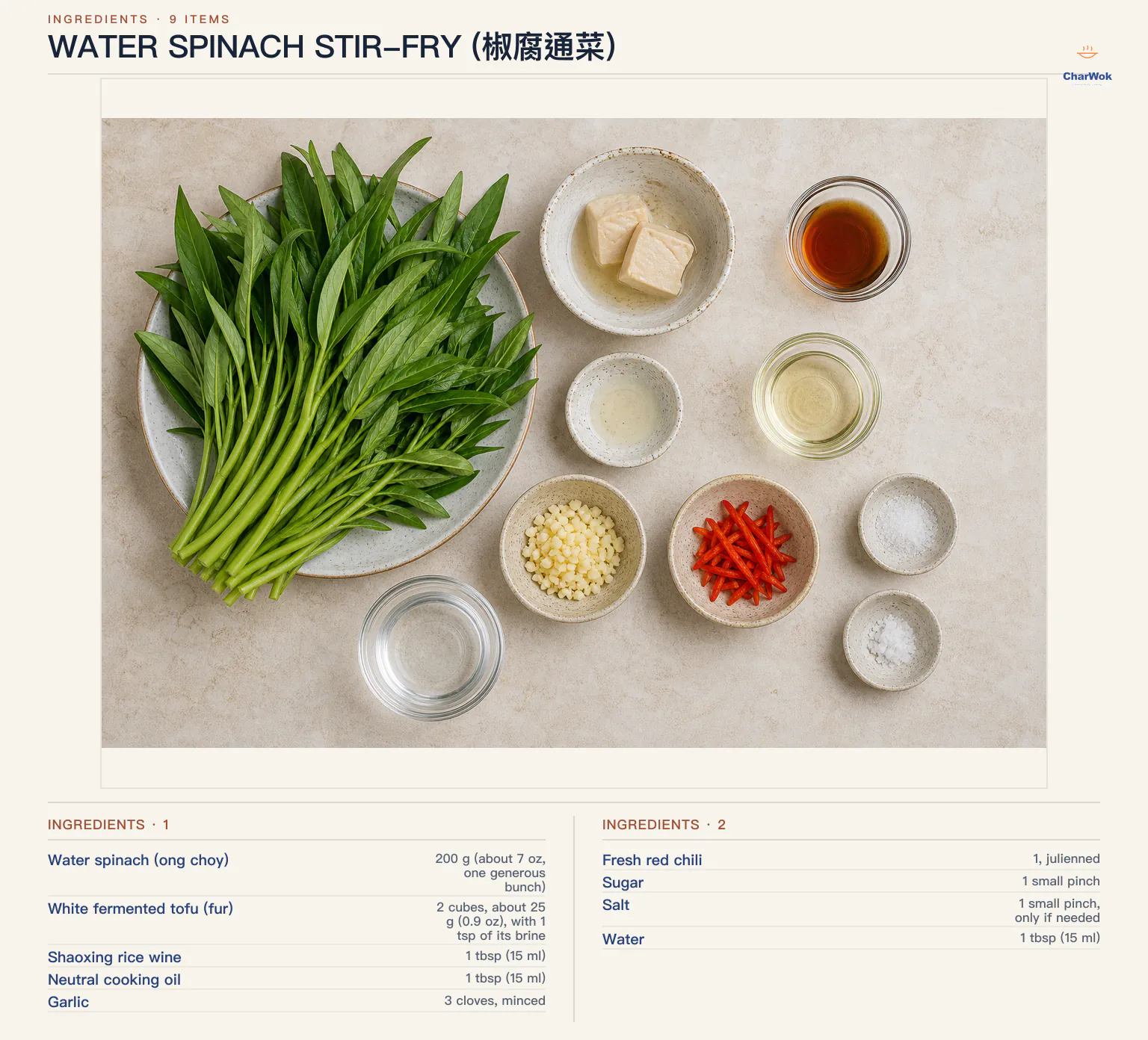
Serves 2 as a side. The spinach cooks down a lot, so do not be alarmed by the volume of raw greens.
| Ingredient | Amount | Notes / substitute |
|---|---|---|
| Water spinach (ong choy) | 200 g (about 7 oz, one generous bunch) | Look for firm, unblemished hollow stems. Choy sum works if you cannot find it. |
| White fermented tofu (fur) | 2 cubes, about 25 g (0.9 oz), with 1 tsp of its brine | Red fermented tofu: use 1 cube. Miso thinned with rice wine is a passable shortcut, not a true substitute. |
| Shaoxing rice wine | 1 tbsp (15 ml) | Dry sherry or Shaoxing-style cooking wine. Avoid salted "cooking wine" if you can. |
| Neutral cooking oil | 1 tbsp (15 ml) | Peanut, canola, or grapeseed. Something with a high smoke point. |
| Garlic | 3 cloves, minced | Smashed and chopped coarse is better than a fine paste here. |
| Fresh red chili | 1, julienned | Use a mild red chile (Fresno or long red) for color and a whisper of heat. Skip or use bell pepper for zero heat. |
| Sugar | 1 small pinch | Balances the saltiness of the furu; do not make it sweet. |
| Salt | 1 small pinch, only if needed | Fermented tofu is already very salty. Taste first. |
| Water | 1 tbsp (15 ml) | To create steam that flashes the leaves. |
Before the heat goes on
Mise en place is not optional for a one-minute stir-fry. Once the spinach hits the wok you will not have time to mince garlic or hunt for the wine bottle.
- Wash in plenty of water. Drop the whole bunch into a sink or large bowl of cold water and swish it. Grit and sand settle in the hollow stems and only float out when there is room for them to drop. Lift the greens out, change the water, and repeat once. Rinsing under a running tap alone is not enough.
- Test the stem ends. Snap the bottom half-inch of a stem. If it bends without breaking, the lower portion is overgrown and woody, so trim those ends off; otherwise they will end up as chewy strings on the plate. Tender young bunches need no trimming.
- Cut into sections and separate. Slice the stems and leaves into 8–10 cm (3–4 inch) lengths. Then sort them into two piles: stems in one, leaves in the other. They go into the wok at different times because the stems need roughly twenty seconds of head start; if you add them together the leaves die before the stems soften.
- Build the sauce in a small bowl. Drop the two furu cubes (scoop up a teaspoon of the brine they sit in) into a bowl with the Shaoxing wine, the pinch of sugar, and the pinch of salt. Mash with the back of a spoon until you have a smooth, pourable paste about the consistency of heavy cream. The wine is doing two jobs here: loosening the furu into a sauce, and carrying the aromatics onto the stems. Thin it with another splash of wine if it looks stiff.
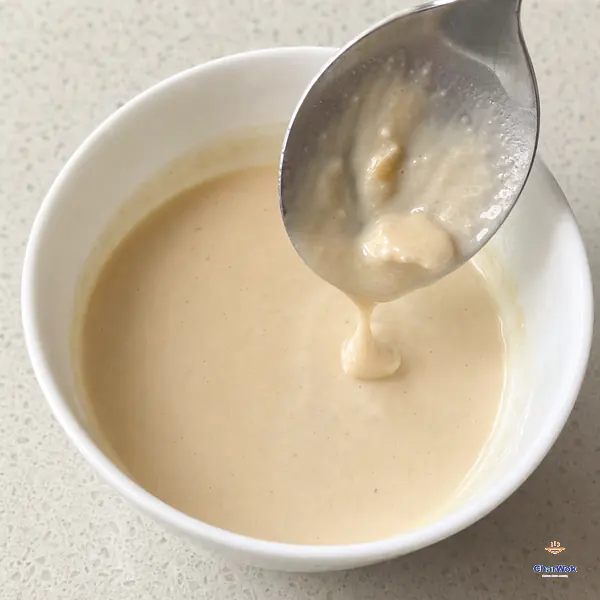
Mash both white furu cubes with their brine, Shaoxing wine, sugar and salt until almost completely smooth. The sauce should fall from the spoon in a short continuous ribbon like light cream; crush any firm pieces before it reaches the wok.
- Mince the garlic, slice the chili. Coarse is fine. You want visible flecks of garlic in the finished dish, not a paste that burns in seconds.
The stir-fry itself
- Heat the wok until it is genuinely hot. A flat-bottom or round carbon-steel wok over your biggest burner, empty, for a minute or two. Flick in a drop of water; it should skitter across the surface and vanish in a second, not sit there sizzling gently. If your burner is on the weak side, this is the moment to be patient: every extra minute of preheating buys you crispness later.
- Add the oil, then the aromatics, together. Pour in the oil, swirl to coat, and immediately add the garlic and chili. Do not let the oil smoke on its own first; you want the garlic to hit warm oil, not scorching oil. Toss for five to ten seconds, just until the garlic smells sweet and small rapid bubbles fizz around the pieces. Garlic goes from golden to bitter in about three seconds, so stay at the stove.
- Pour in the sauce and let it sizzle. Add the mashed furu mixture. It will spit and immediately smell winey and savory. Stir for a few seconds so the sauce toasts slightly; this brief contact with the hot metal mellows the raw alcohol note.
- Stems first. Add the stem pile and toss vigorously for about 20 seconds. The stems should just start to brighten in color and lose their raw stiffness. If your heat is low, push them up the sides of the wok to make contact with the hot metal.
- Leaves and the tablespoon of water. Add the leaves, then splash in the tablespoon of water right away and keep the wok moving. The water flashes into steam, and that steam is what wilts the leaves evenly without needing them to sit in oil. Covering for ten seconds is a fair trick on a weak burner; on a strong one it is unnecessary.
- Stop the moment the leaves collapse. From the second the leaves go in, the dish has maybe 20–30 seconds left. The instant the leaves are wilted but still vivid green, tip everything onto a plate. Residual heat will keep cooking them, so err on the side of slightly under.
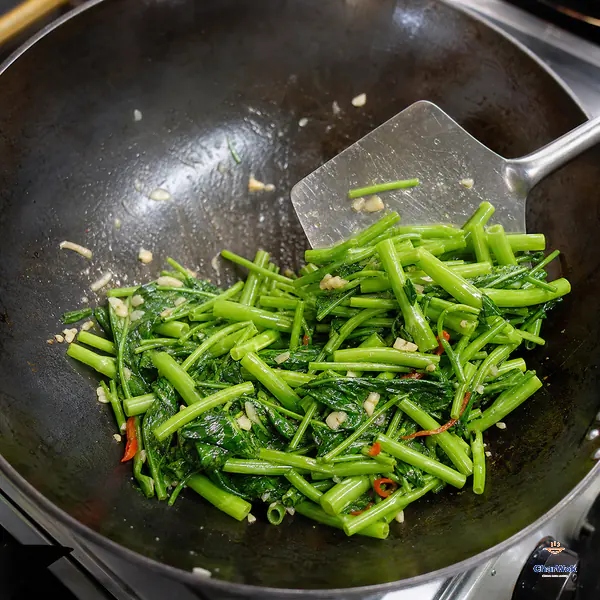
Stop as soon as the leaves collapse from upright to gently drooping while staying vivid green and the hollow stems remain bright and plump. Push the greens out immediately; the nearly dry wok confirms they steamed quickly instead of simmering into dark, watery vegetables.
When things go wrong
A few failures come up over and over with this dish. Each one has a clear cause.
- The stems are still stringy after cooking. Two possibilities. Either the bunch was old and the lower stems were woody (you cannot cook your way out of woody fiber, so trim harder next time), or the heat was too low and the stems steamed instead of seared. On a weak burner, cook half the bunch at a time so the wok stays hot.
- The leaves are dark and slimy. You cooked them too long, or crowded the pan so they braised in their own water rather than frying. Next time, fewer greens in the wok at once and pull the dish off the heat ten seconds earlier. Once they go dark olive there is no rescue.
- The dish tastes aggressively salty. Almost certainly the furu. Different brands vary wildly in salt; taste your mashed sauce before adding any extra salt, and if you are using red fermented tofu, start with one cube.
- A pool of brown liquid collects on the plate. You did not get the wok hot enough, or the spinach was still wet when it went in. Drain the washed greens well, and remember that final tablespoon of water is for steam, not a sauce base; add only that much.
- The garlic turned bitter and dark. The oil was too hot when the garlic went in, or you walked away. Add garlic to oil that has barely begun to shimmer, and keep it moving.
Variations and the same idea on other greens
The furu-and-chili treatment is a method, not a recipe tied to one vegetable. Once it is in your hands it works on most quick-cooking Asian greens, with one adjustment: harder greens need a brief blanch first so the stir-fry time stays short.
- Spinach and choy sum: swap in directly, no blanch. Spinach needs even less time over the heat than water spinach.
- Bok choy and gai lan (Chinese broccoli): drop the stems into boiling water for 30 seconds, shock in cold water, drain, then stir-fry as written. Blanching sets the color and gives thick stems a head start the wok alone cannot provide on a home burner.
- Fermented black bean version: replace the furu with a teaspoon of mashed fermented black beans and a splash of soy sauce. Earthier, less cheesy, equally good.
- No fermented tofu at all: a clean garlic-and-oyster-sauce version still works; treat it like a quick oyster-sauce lettuce with chili.
What to serve it with
This is a side built to cut through rich main dishes. A plate of it next to red-cooked pork belly or scallion-oil chicken, with steamed jasmine rice to catch the sauce, is a balanced Cantonese-style meal. For a faster weeknight version, pair it with tomato egg stir-fry and rice and you have dinner in twenty minutes. You can also fold leftovers into egg fried rice the next day; chop the stems small first.
Storage and reheating
Honestly: cook the amount you will eat. Water spinach does not reheat well. The stems hold up overnight in the fridge, but the leaves turn olive and weepy, and the furu sauce goes flat. If you must save leftovers, cool them uncovered, refrigerate in a sealed container for up to a day, and reheat hard and fast in a dry pan, never the microwave, which turns the whole thing to mush. The better move is to wash and prep the greens in advance and keep them in a bag with a damp paper towel, then do the one-minute stir-fry fresh when you sit down.
Frequently asked questions
A few things readers ask about this dish, answered short.
- Can I use regular spinach instead? Yes. Regular spinach cooks even faster, so cut the leaves' time in the wok roughly in half and skip the tablespoon of water: its moisture will steam the pan on its own.
- Why separate the stems and leaves? The hollow stems need about twenty extra seconds to soften. Add them together and the leaves overcook into slime while you wait for the stems.
- Is the dish vegetarian? As written, yes, fully plant-based. Check the label on your furu to be sure no alcohol content is an issue for your needs, and use a vegetarian rice wine if you are strict.
- My wok is not very hot. Will this still work? Yes, with two changes: cook half the bunch at a time so the pan stays hot, and cover the wok for ten seconds after the water goes in to trap steam on a weaker burner.
- Can I make it without fermented tofu? You can, but it becomes a different dish. Swap in oyster sauce or mashed fermented black beans for a similar savory kick.
Cook this once with attention to heat and timing and you will not need the recipe again. The whole technique, from splitting stems and leaves to building the sauce in a bowl first to pulling the dish in under a minute, applies to nearly every quick vegetable stir-fry in the Cantonese playbook.