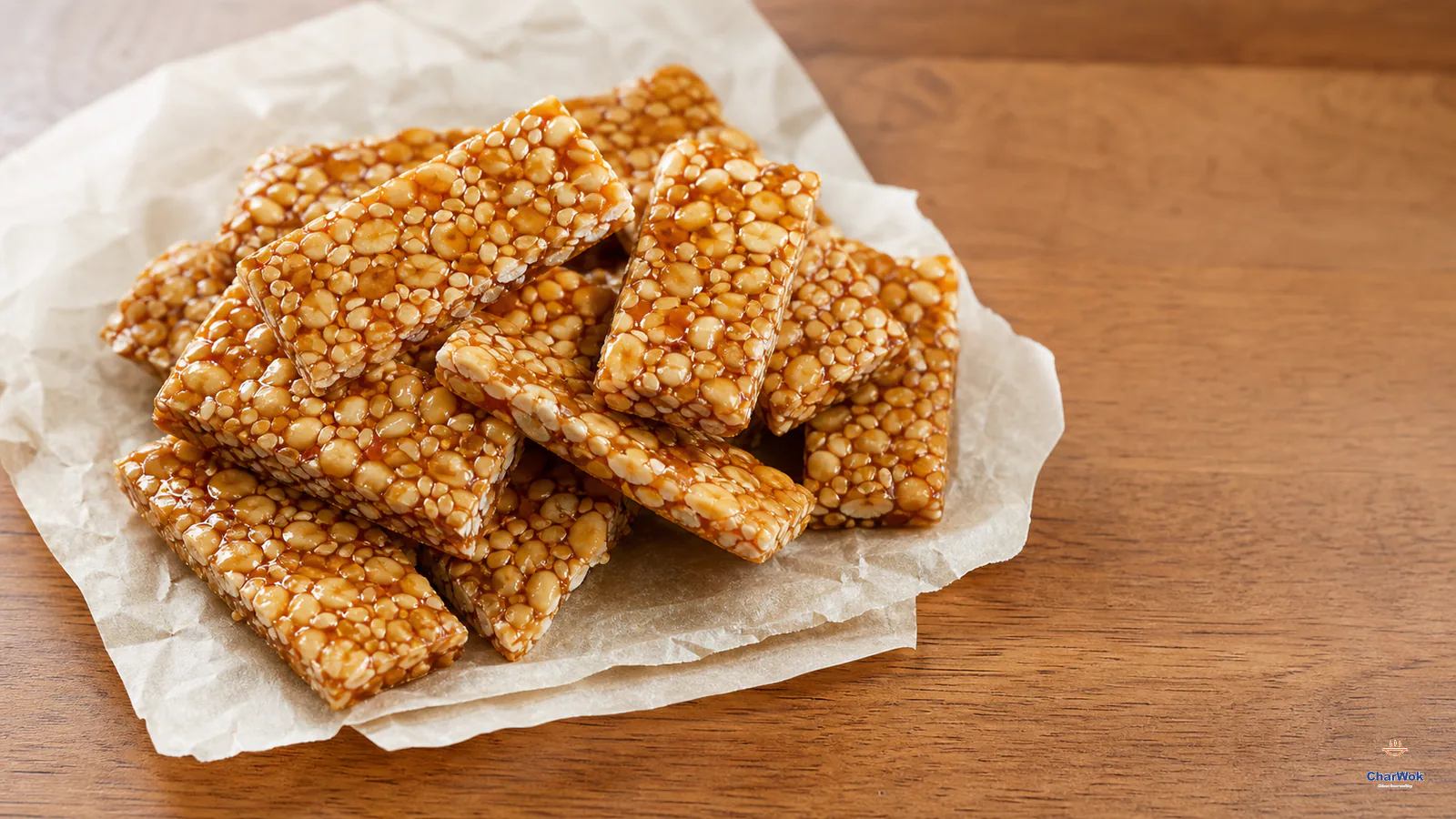
Peanut and sesame brittle is one of those sweets that looks primitive and then ruins you for the bagged version. Two handfuls of nuts, a pan of melting sugar, ten minutes of close attention, and you have something that shatters with a clean snap and tastes deeply, brown-roasted and nutty in a way commercial brittle never quite manages. The catch is the sugar. Every home cook I have taught this to has burned the first batch, and most have glued the second batch to the baking paper. I have done both, more than once, and the fixes are simpler than people think.
This is a Lunar New Year sweet across much of northern China, where it goes by hua sheng zhi ma tang (花生芝麻糖). Families make it by the tin in the weeks before the holiday, the same season you would roll sticky rice cake or steam eight treasure rice. It keeps for a month, travels well, and is almost impossible to stop eating once the tin is open. That combination is exactly why it became a gift sweet rather than an everyday one.
At a glance. Four ingredients, one pan, roughly 25 minutes of work. The ratio that matters is the nut-to-sugar weight: keep nuts and sesame at a total of 300 g against 250 g sugar and the brittle will never taste cloying. Pull the sugar when it reads 150–155 °C (300–310 °F) on a thermometer, or when a dropped thread holds a hard snap in cold water. Shape and score while it is still hot; once the temperature falls past about 80 °C the block is set.
What this candy actually is
Chinese nut brittle is a dry caramel bound around toasted nuts and seeds. There is no corn syrup, no baking soda, no egg white foam like in Western nut brittle or fortune cookies. The structure comes entirely from how far you cook the sugar: stop too early and you get a chewy, sticky slab that pulls out fillings; push too far and you get bitter, glassy shards. The window between those two failures is real but generous once you know the cues.
The traditional version uses raw cane sugar and a little lard or peanut oil. My default uses butter, because most American home kitchens have it and it adds a toffee note that rounds off the burned edge sugar alone can carry. If you want a fully vegan or more traditional slab, neutral peanut oil works just as well; swap the 30 g of butter for 25 g of oil, since oil is 100% fat and butter is roughly 80%.
Ingredients
Peanut and sesame brittle ingredients at a glance
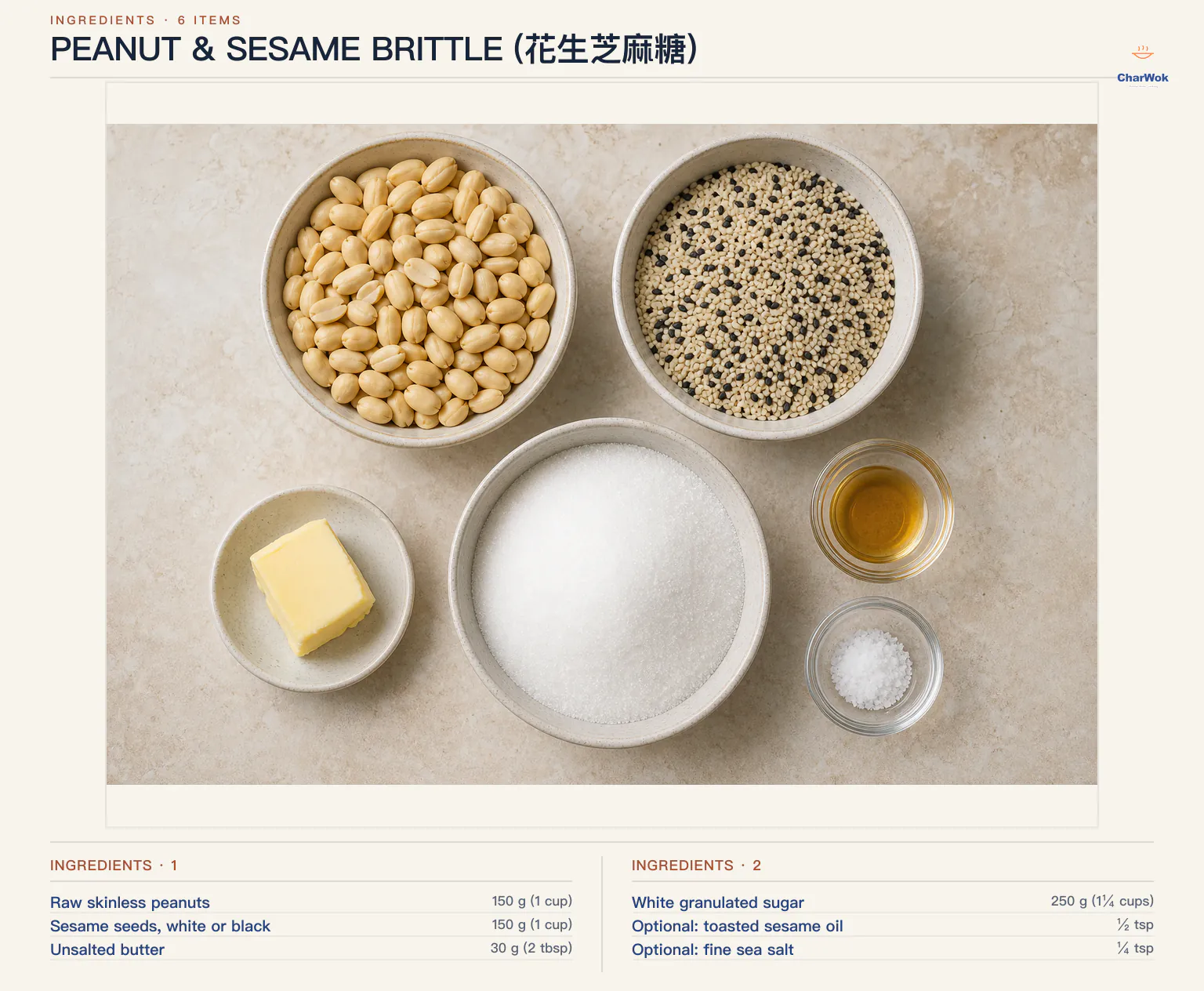
| Ingredient | Amount | Notes / substitute |
|---|---|---|
| Raw skinless peanuts | 150 g (1 cup) | Halves work better than whole for even chopping. Skins left on will tint the brittle reddish and taste slightly bitter. Toasted, salted cocktail peanuts will work in a pinch but cut the salt elsewhere; there is no salt elsewhere in this recipe, so unsalted is safer. |
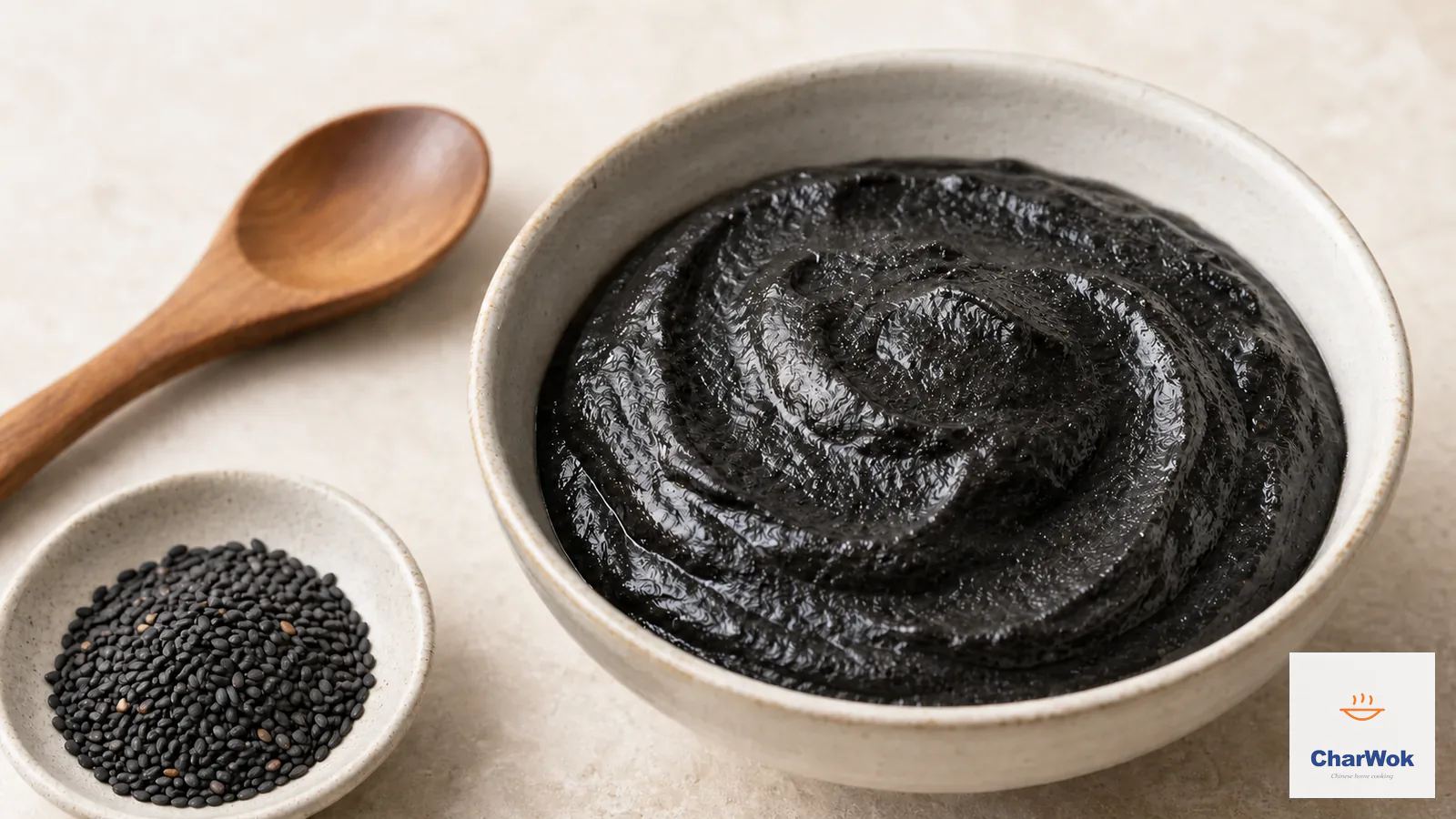
| Sesame seeds, white or black | 150 g (1 cup) | White gives a milder, classic look; black is more dramatic and a little more bitter, closer to the filling inside black sesame tang yuan. Toasting is mandatory either way; raw sesame tastes flat and slightly grassy. |
| Unsalted butter | 30 g (2 tbsp) | Adds dairy richness and helps the sugar melt evenly without crystallizing. Substitute 25 g neutral peanut oil for a vegan or dairy-free slab. |
| White granulated sugar | 250 g (1¼ cups) | Plain white sugar caramelizes cleanly and lets the nut flavor lead. Raw cane sugar gives a darker, molasses-tinged bar but darkens faster, so pull it 5 °C sooner. Do not use brown sugar; it will scorch before it melts fully. |
| Optional: toasted sesame oil | ½ tsp | Stirred in off the heat, it boosts aroma without adding fat that would soften the set. Skip if you want a strictly hard snap. |
| Optional: fine sea salt | ¼ tsp | A small pinch folded in at the end turns this from a kid sweet into an adult one. Recommended. |
On butter versus oil: butter contains about 18% water, which steams off in the first minute and helps the sugar melt without seizing. Oil skips that step, so you may need to nudge the pan off the heat for a few seconds if the sugar looks grainy. Neither is wrong; butter is friendlier the first time.
The method, step by step
Before you turn on the stove, get everything ready. Line a chopping board or the back of a sheet pan with one sheet of baking paper and set a second sheet on top within arm's reach. Have a rolling pin, a sharp knife or bench scraper, and an oven mitt laid out. From the moment the sugar is done you have roughly two minutes, and the most common failure is hunting for the paper while the candy sets in the pan. If you have a warming oven, keep the board and the bowl of toasted nuts in there at about 80 °C (175 °F); a reader taught me this trick and it buys you another minute of working time.
- Toast the peanuts, then chop them coarse. Put the peanuts in a dry pan over low heat and shake or stir constantly. They are done when the skins (if any remain) slip and the nuts are a shade darker, fragrant, and warm to the nose, about 4–5 minutes. Tip them onto a plate to cool. Once cool enough to handle, break any whole peanuts in half and give the lot a rough chop; aim for pieces the size of dry lentils, not dust. Small pieces matter: the smaller the nuts, the less molten sugar you need to fill the gaps, and the less sugary the finished bar tastes.
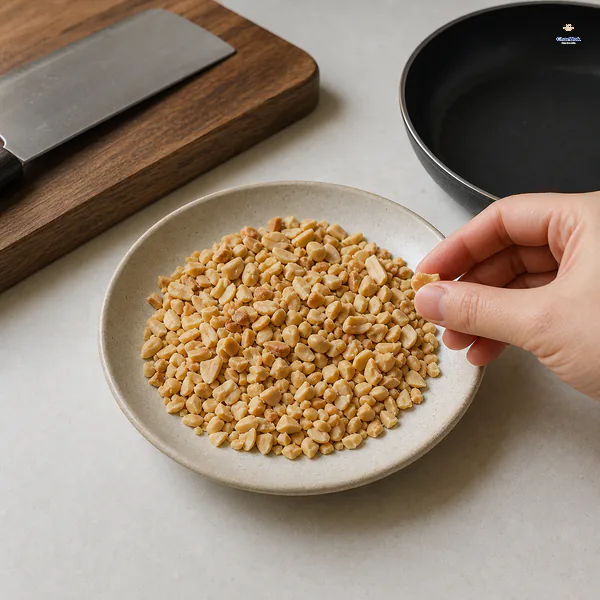
Toast the peanuts in a dry pan over low heat for 4 to 5 minutes, cool them, then chop to dry-lentil-size pieces rather than dust.
- Toast the sesame separately. Wipe out the pan, return it to low heat, and add the sesame. Sesame scorches faster than peanuts because the seeds are tiny and contact the hot surface directly. Keep them moving and pull them the instant they darken a half shade and smell nutty, about 2–3 minutes for white sesame, a minute less for black (you are watching for aroma more than color with black seeds). Pour onto a separate plate. Combining the nuts and seeds in one bowl now saves a step later.
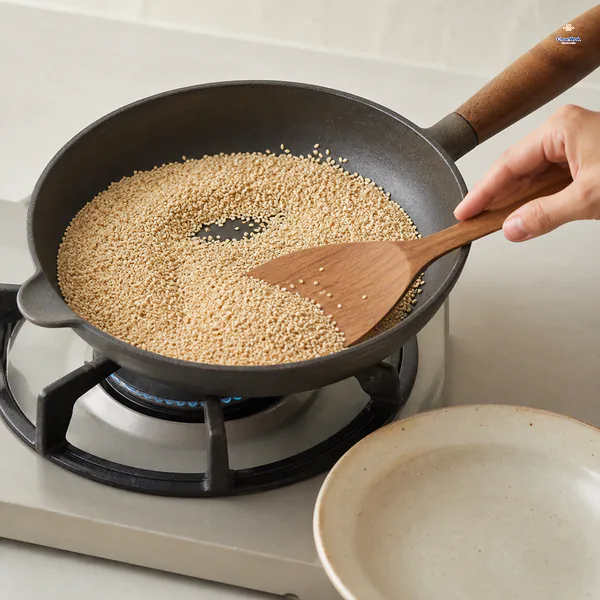
Toast the white sesame separately over low heat for 2 to 3 minutes, keeping every seed moving and stopping as soon as it smells nutty.
- Melt butter and sugar together over low heat. Use a heavy-bottomed nonstick or well-seasoned pan, low heat, and patience. Add the butter first; when it is mostly melted, pour in the sugar and stir just enough to wet every grain. Then stop stirring so much. Constant stirring causes the sugar to crystallize into a grainy mass; occasional, gentle nudging lets it melt evenly. The mixture will look clumpy and opaque for several minutes, then suddenly loosen into a smooth, bubbling amber syrup. This phase takes me about 8–10 minutes.
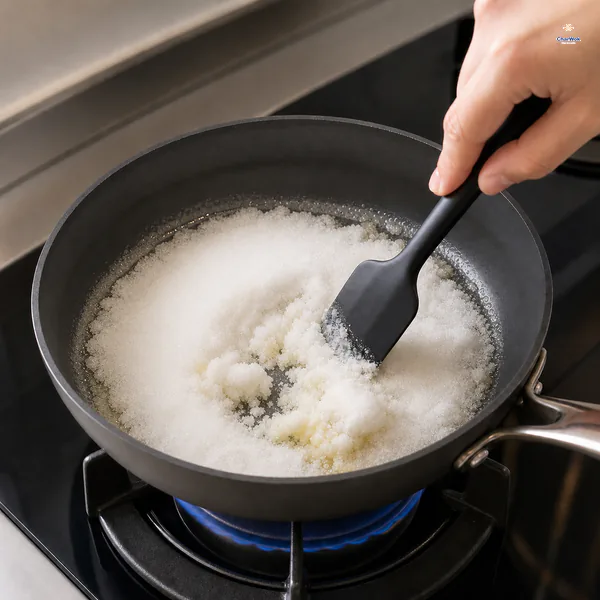
Melt the butter first, wet the sugar with only a little stirring, then use occasional gentle nudges as the opaque clumps loosen into bubbling amber syrup.
- Cook to the hard-crack stage. This is the make-or-break moment. You are aiming for 150–155 °C (300–310 °F) on a sugar thermometer. If you do not have one, drop half a teaspoon of the syrup into a glass of cold water; at the right stage it forms brittle threads that snap cleanly between your fingers rather than bending. Visually, the syrup should be a deep amber, like weak tea, glossy and pourable. Pull the pan off the heat the instant you reach this stage; the residual heat will keep cooking it, so moving fast also means stopping the cook.
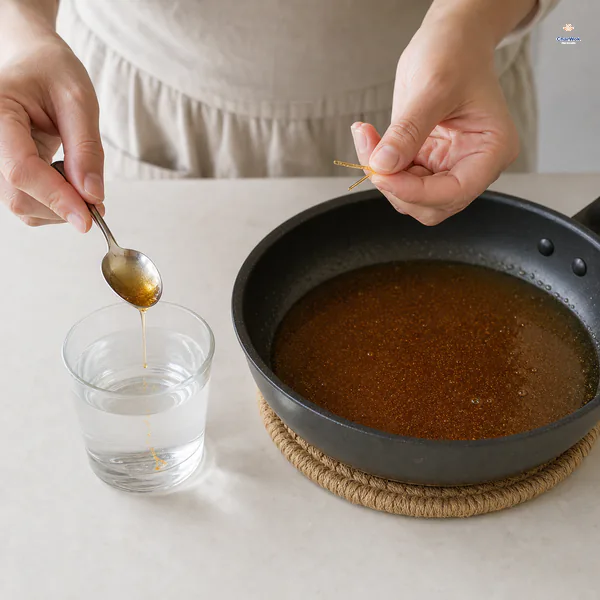
Stop at 150 to 155 degrees Celsius, or when a drop in cold water forms brittle threads that snap instead of bend; remove the glossy deep-amber syrup from the heat immediately.
- Fold in the nuts and seeds, fast. Pour the toasted peanuts and sesame into the syrup and stir with a heatproof spatula to coat every piece. Work quickly because the sugar begins setting the moment it cools. If you added the optional salt or sesame oil, do it now. The mix will look thick and slightly resistant; that is correct. Do not return it to the heat, which would push the sugar past hard-crack into bitter territory.
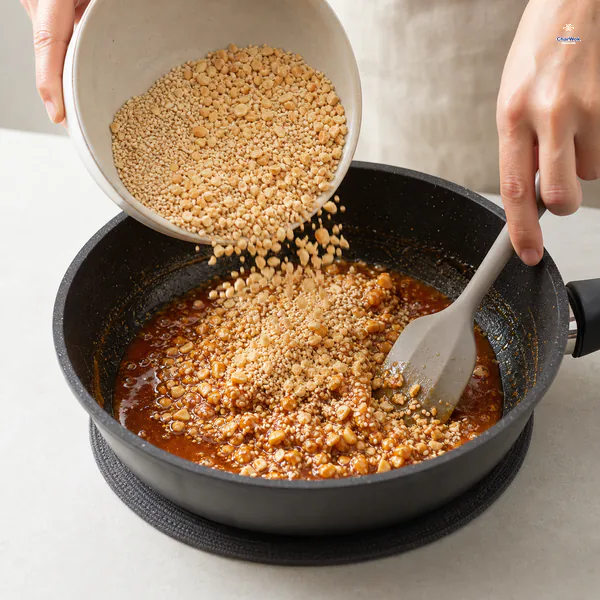
Off the heat, add the warm peanuts and sesame and fold quickly until every piece is coated; add the optional salt or sesame oil now and do not return the pan to the burner.
- Tip onto the paper and flatten immediately. Scrape the hot mass onto your prepared baking paper, drop the second sheet on top, and roll it out to an even slab about 5 mm (¼ inch) thick. Roll from the center outward so the edges do not end up thinner than the middle; thin edges cool first and will shatter when you cut. Peel back the top paper while the slab is still warm and pliable.
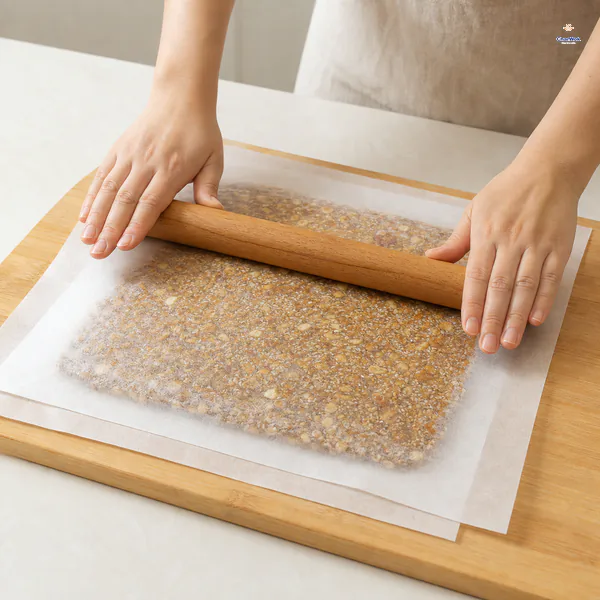
Scrape the hot mixture onto parchment, cover it with the second sheet and roll from the center outward to an even slab about 5 millimeters thick.
- Score, then snap. Use a sharp knife or bench scraper to cut the warm slab into rectangles or diamonds. Press straight down; do not saw. If the slab cracks along its own lines, that is fine and even desirable. If it firms up before you finish, return it to a 120 °C (250 °F) oven for two minutes to soften. Let the pieces cool completely at room temperature before storing; warm brittle will weep sugar and stick together.
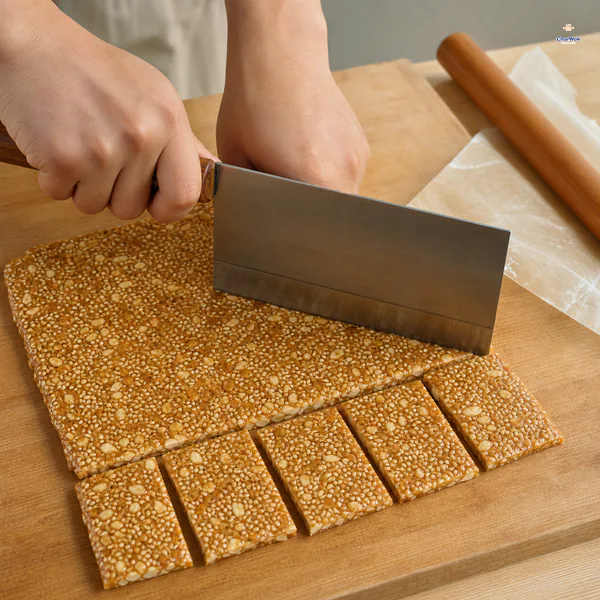
Peel off the top parchment while the slab is warm, press straight down with a knife or bench scraper to cut it, then cool the pieces completely before storing.
When it goes wrong, and how to recover
| Problem | What caused it | How to fix it |
|---|---|---|
| Sugar stuck hard to the baking paper | Paper was not parchment/silicone, or slab cooled fully before you tried to peel | Use genuine parchment or a silicone mat. If already stuck, slide the whole thing onto a baking sheet and into a 120 °C (250 °F) oven for 3 minutes; the warmth softens the bond so the paper peels cleanly. |
| Brittle is chewy and sticks to your teeth | Sugar cooked only to soft-crack, roughly 130 °C, not hard-crack | Next time cook 20 °C higher and trust the cold-water thread test. Salvage this batch as a sticky topping for ice cream; do not try to recook it. |
| Brittle tastes burnt and bitter | Sugar pushed past 165 °C, or cooked too dark to chase a deeper color | Nothing salvages burnt sugar; bin it and start over. The amber color arrives before the bitterness; pull at deep amber, not brown. |
| Sugar seized into a grainy clump | Stirred too aggressively while melting, or a wet spoon introduced water crystals | Keep stirring minimal and use a bone-dry spatula. A seized clump can sometimes be rescued by adding a teaspoon of water and gently re-melting over very low heat, but the texture will be duller. |
| Slab set in the pan before you could pour | Pan off heat too long, or nuts were cold from the fridge | Keep toasted nuts warm (a low oven is ideal). If the mass seizes in the pan, set the pan back over very low heat for 10–15 seconds just to loosen, then pour at once. |
| Nuts taste raw or grassy | Under-toasted, or sesame skipped entirely | Toasting is not optional. The Maillard reaction is where the flavor comes from. Re-toast longer next time; sesame in particular needs to smell nutty before it leaves the pan. |
| Edges crumbled to dust, center too thick | Uneven rolling | Roll from the center outward and check thickness with a ruler the first few times. Aim for a uniform 5 mm. |
| Brittle went sticky and soft in storage | Humidity got in, or stored while still warm | Store only fully cooled pieces in an airtight container with a silica packet or a few raw rice grains to absorb moisture. A cool, dark cupboard is better than the counter. |
One failure worth naming directly: the first time I made this I trusted the color of the syrup and pulled it a full minute too late. The brittle looked beautiful and tasted like char. Sugar does not warn you twice. The color change from amber to brown happens in seconds, so once you are within 10 °C of your target, do not leave the stove.
Variations and other nuts to try
Peanuts and sesame are the classic pairing because peanuts give bulk and body while sesame delivers aroma. Once you trust the method, the sugar syrup is a carrier for almost any toasted nut or seed. Keep the total nut-and-seed weight at 300 g against the 250 g sugar and the set will behave the same way.
- Walnut and sesame. Half peanuts, half walnuts. Toastier and slightly more elegant; the brittleness of walnut matches the candy's snap.
- Cashew brittle. All cashews, no sesame, with a pinch of cardamom folded in at the end. Closer to an Indian trail sweet.
- Spiced peanut bar. Add ½ tsp ground Sichuan pepper and a thin sliver of dried tangerine peel for a northern Chinese New Year version. The numbing note is subtle and grown-up.
- Seed-only brittle. Sunflower and pumpkin seeds instead of nuts, for a nut-free classroom-friendly version. Toast them carefully; seeds scorch as fast as sesame.
For serving, the brittle is good on its own with strong tea, but it also crushes beautifully over a bowl of ginger milk curd or a scoop of plain ice cream. Around the holidays I pack it in small cellophane bags alongside almond cookies and a few mango pancakes; the mix of textures keeps a gift box interesting.
Storage and reheating
Fully cooled brittle keeps for a month in an airtight container in a cool, dark cupboard. Do not refrigerate; the humidity in a fridge will turn the surface sticky within a day. If the pieces do soften from ambient humidity, spread them on a baking sheet and warm in a 120 °C (250 °F) oven for 5 minutes, then cool completely on the counter; they will re-crisp. The brittle also freezes well for up to three months, double-wrapped, though it rarely lasts long enough to need freezing.
A note on sugar choices: the granulated white sugar called for here is the same type you would use to make a clear syrup for pear simmered in rock sugar or to sweeten bubble tea, but it behaves differently than the large crystals of rock sugar, which melt slowly and are better for slow-simmered dishes than for caramel work. For brittle, fine white granulated is the right call.
A few questions I get asked
Readers ask the same handful of things whenever this candy comes up. The quick answers:
- Do I need a candy thermometer? No, but it removes the guesswork on your first batch. The cold-water thread test works fine if you are confident. If you make candy more than once a year, buy one.
- Can I halve the recipe? Yes, and the timing is the same. Do not double it in one pan; the sugar layer gets too deep and cooks unevenly. Make two batches instead.
- Is black or white sesame better? White is milder and more traditional for gifts; black looks striking and tastes slightly more bitter. Either is correct, and a mix of both is lovely.
- Why did my sugar stick to the paper? Almost always the wrong paper or a slab that cooled too long before peeling. Warm it gently in the oven and the paper lifts off.
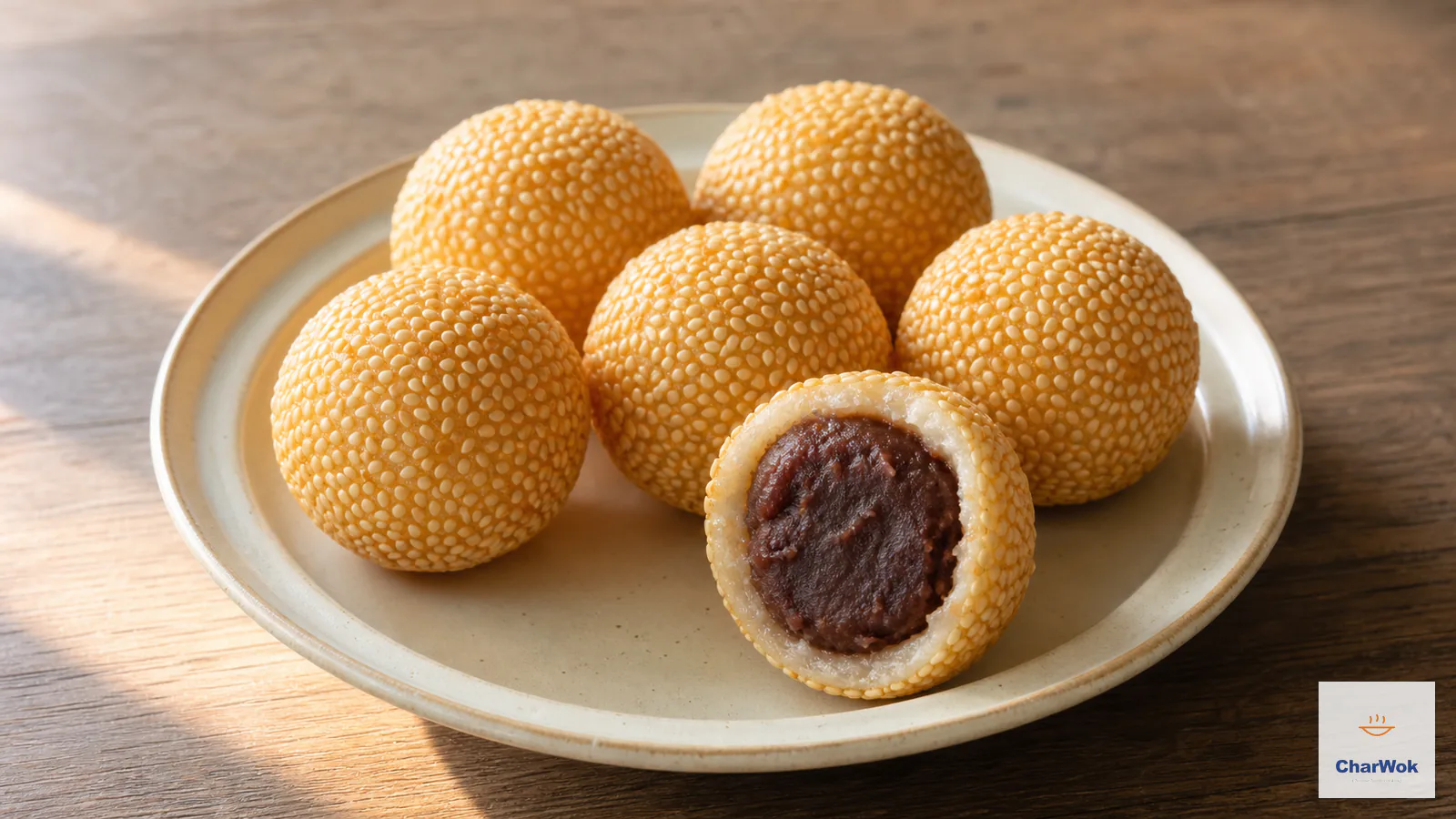
If you want a softer, chewier bar rather than a snapping one, that is a different candy; cook the sugar only to soft-crack (about 135 °C / 275 °F) and accept that it will pull. A chewy sesame bar is its own tradition, closer in spirit to the soft fillings inside sesame balls or sweet red bean soup accompaniments than to a true brittle. Both are good; know which one you are aiming for before you turn on the heat.