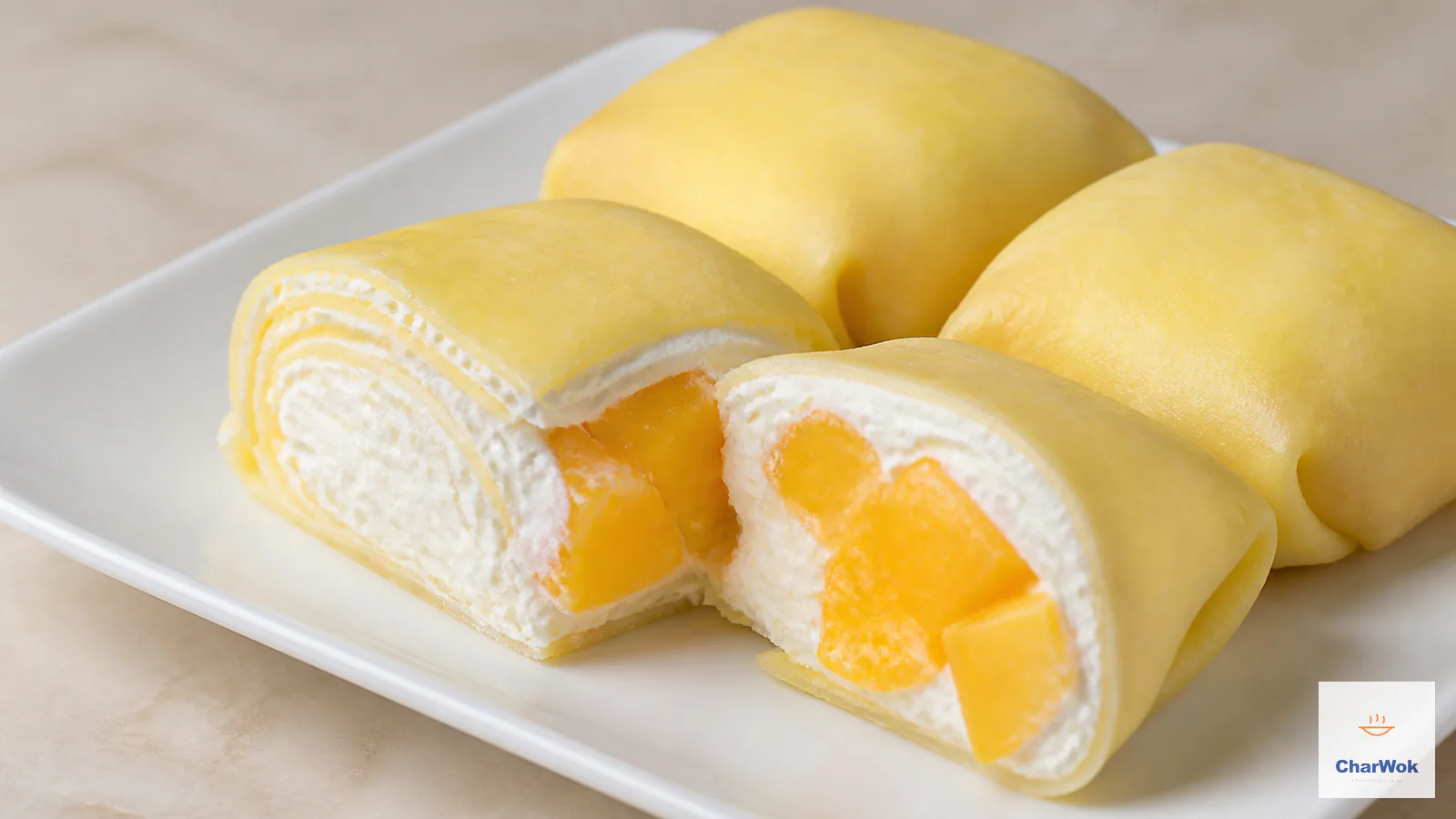
A Hong Kong mango pancake looks like a soft yellow pillow, and that is exactly what it is: a thin, barely-cooked crepe folded around a fist of whipped cream and a fat slab of ripe mango. One bite and the crepe tears, the cream pushes out, the mango juice runs down your wrist. It is the kind of dessert that makes you forget you are eating something "simple."
The hard part is not the ingredients. Flour, milk, eggs, cream, mango. The hard part is restraint. The crepe has to stay pale and stretchy, not browned and crisp. The cream has to be cold and just barely sweet, or it weeps and turns the pancake soggy overnight. And the mango has to be the right variety, cut the right way, or you get stringy fibers poking through a wrapper that took you forty minutes to make.
I have ruined more batches of these than I care to admit. The first time I tried them I cooked the crepes like French crepes, golden on both sides, and they cracked the moment I tried to fold them. The lesson is the whole dish: a mango pancake crepe is closer to a Cantonese har gow wrapper in spirit than to a breakfast pancake. Soft. Elastic. Cooked on one side only.
At a glance: One-side-only crepes cooked low and slow until they look dry on top, cooled smooth-side-down, then wrapped around cold heavy cream whipped to stiff peaks and a chunk of ripe mango. Rest the wrapped pancakes in the fridge at least 30 minutes so the cream firms up and the crepe relaxes. Twelve pancakes from about 320 g (11 oz) of batter. The single biggest mistake is overcooking the crepe.
What this dessert actually is
Mango pancakes belong to the Cantonese dessert shop, the kind of place in Hong Kong and Guangzhou that sells mango sago pomelo, durian puddings, and chilled sweet soups. They sit in a refrigerated case, stacked, each wrapped in cling film so you can see the pale yellow skin and the dimple where the four folds meet. You order one and eat it cold with a plastic fork, often after a dim sum meal.
They are not old. Unlike mooncakes or tang yuan, mango pancakes are a modern Hong Kong invention, born from the same era and impulse as bubble tea: take a Western technique (the crepe, the whipped cream) and bend it around a Southeast Asian fruit that southern China fell in love with. The result is Chinese only in the sense that it was made for a Chinese palate, in a Chinese kitchen, by people who understood how a wrapper should behave.
The Chinese name is 芒果班戟, ban ji being a phonetic borrowing of "pancake." If you want a deeper sense of how Cantonese kitchens borrow and adapt, the whole dim sum canon works the same way: recognizable shells, local fillings, eaten with tea.
The flour question, and why cornstarch matters
The crepe batter uses all-purpose flour plus a good slug of cornstarch (or custard powder). The cornstarch does two jobs. First, it weakens the gluten network so the cooked crepe bends instead of snapping. Pure-flour crepes are tender but they tear when you fold them around a pile of cream. Cut the flour with cornstarch and you get something closer to a dumpling wrapper: stretchy, forgiving, almost chewy. Second, cornstarch gelatinizes when the batter hits the pan, which is what gives the cooked crepe that slightly translucent, glossy look on the cooked side.
Custard powder (Bird's is the common brand) is cornstarch with food coloring and vanilla flavoring added. It is what gives Hong Kong shop pancakes that sunny yellow. If you cannot find it, plain cornstarch gives you a paler, more honest crepe, and the mango carries the yellow anyway. Do not substitute cake flour for the cornstarch; it will not give you the stretch.
Ingredients
Mango pancake ingredients at a glance
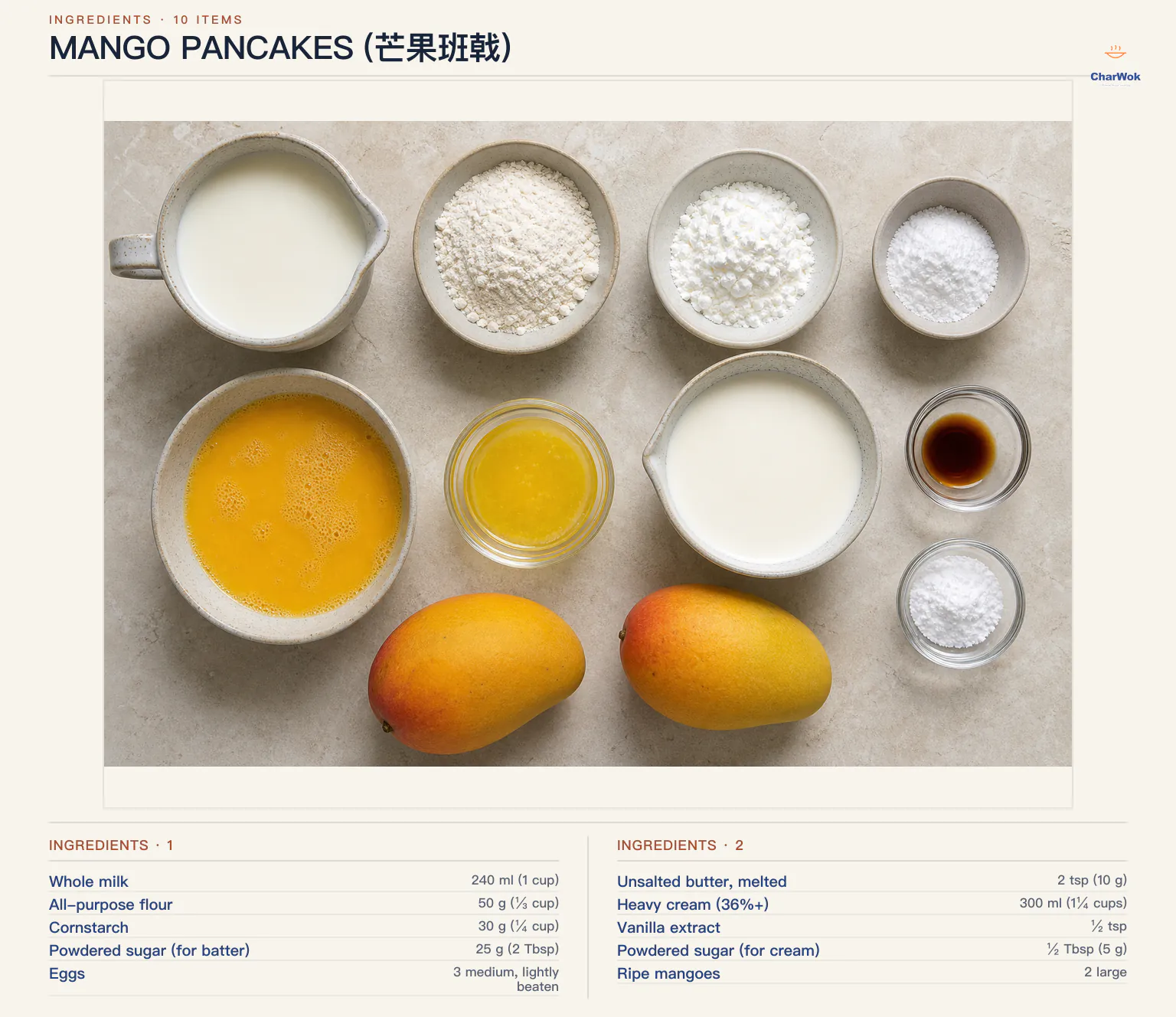
| Ingredient | Amount | Notes / substitute |
|---|---|---|
| Whole milk | 240 ml (1 cup) | Whole milk gives the best color and body; low-fat works but the crepe is thinner and less tender. |
| All-purpose flour | 50 g (⅓ cup) | US all-purpose (about 11% protein) is right. Do not use bread flour. |
| Cornstarch | 30 g (¼ cup) | Or custard powder (Bird's) for the classic yellow. Do not swap in cake flour. |
| Powdered sugar (for batter) | 25 g (2 Tbsp) | Powdered dissolves cleanly; granulated leaves grit. |
| Eggs | 3 medium, lightly beaten | About 150 g shelled. Large eggs (about 55 g each) work too; the batter just runs a touch thinner. |
| Unsalted butter, melted | 2 tsp (10 g) | For tenderness and a little richness. Neutral oil works in a pinch. |
| Heavy cream (36%+) | 300 ml (1¼ cups) | Must be at least 36% fat to whip firm and hold. Do not use half-and-half or light cream. |
| Vanilla extract | ½ tsp | Real extract, not imitation. Optional but recommended. |
| Powdered sugar (for cream) | ½ Tbsp (5 g) | Barely sweet is correct; the mango is the sugar. |
| Ripe mangoes | 2 large | Ataulfo / honey / champagne mangoes preferred. See below. |
Choose the mango first
The whole dessert rises or falls on the fruit. You want a mango that is intensely fragrant, barely yielding to thumb pressure, and almost fiber-free. My pick is the small Ataulfo (also sold as honey, Manila, or champagne mango): deep gold flesh, low fiber, complex sweetness. Two of them give you enough clean chunks for twelve pancakes with a little left over to snack on.
The big red-skinned Tommy Atkins mangoes common in US supermarkets are my last choice. They look the part but the flesh is fibrous, and those fibers end up poking through the crepe when you fold it. If Tommy Atkins is all you have, cut the flesh off the pit in two cheeks, score it, and slice the cubes off the skin so you leave most of the fibers behind. Then trim each cube of any obvious threads.
Ripeness matters more than variety. A rock-hard mango has no aroma and tastes like a carrot. A mushy one collapses into the cream. Aim for a mango that smells like a mango at arm's length and gives just slightly when you press the stem end.
How to make the batter (and why you strain it)
- Whisk the dry into the wet. Pour the 240 ml milk into a bowl. Sift in the 50 g flour, 30 g cornstarch (or custard powder), and 25 g powdered sugar. Whisk with a balloon whisk until smooth. Sifting matters here, because cornstarch and powdered sugar both clump, and a lump in the batter becomes a hole in the crepe.
- Add eggs and butter. Pour in the 3 beaten eggs and 2 tsp melted butter. Whisk only until combined. Over-whipping now just aerates the batter and makes crepes that blister instead of lying flat.
- Strain the batter. Pour it through a fine sieve into a pitcher with a spout. This is the step most home recipes skip and it is the reason shop crepes look flawless. The sieve catches unmixed flour, egg chalazae, and sugar grit. Press any lumps through with the back of a spoon. Let the batter rest 10 minutes while you find your pan; resting lets the flour hydrate and the foam settle, so the crepes cook up smooth.
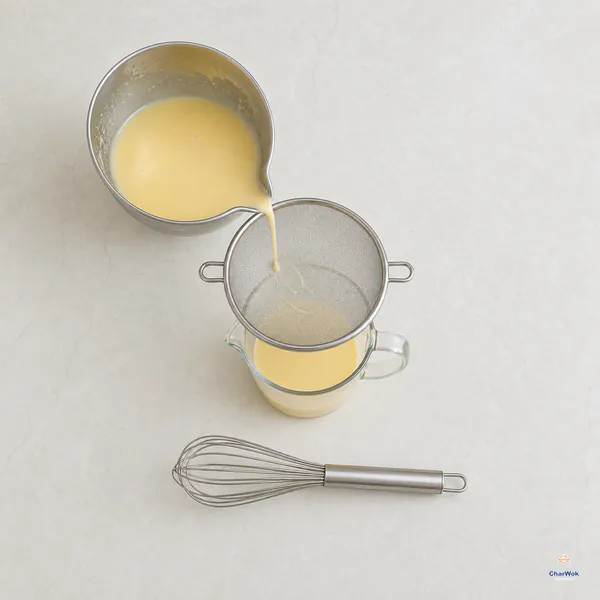
Strain the batter into a pouring jug to remove any remaining lumps, then let it rest for 10 minutes.
Cooking the crepes: low, slow, one side only
This is where most people, including past me, go wrong. You are not making jian bing or a scallion egg crepe. You are not browning anything. Heat a nonstick skillet about 20 cm (8 inches) over low heat. The pan should be hot enough that a drop of batter sets on contact but not so hot that it colors. Think the lowest setting that still sizzles faintly when batter hits it.
- Pour and swirl. Lift the pan off the heat. Pour in roughly 2 tablespoons of batter and immediately tilt and rotate the pan so the batter runs into a thin even disk about 12 cm (5 inches) across. You want it thin enough to see through at the edges, thick enough in the center that it does not tear. The first two are always ugly while you calibrate the pour. Eat them.
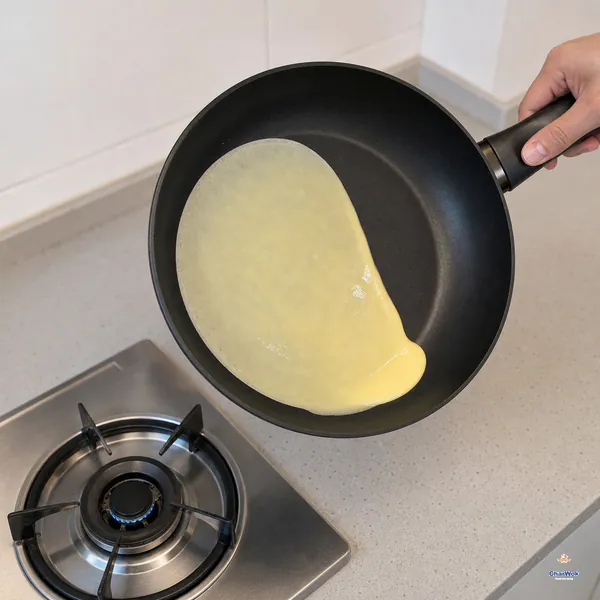
Lift the pan off the low heat, add roughly 2 tablespoons of batter, and swirl immediately into a thin 12 centimetre disk.
- Watch the surface, not the edges. Cook undisturbed. After about a minute you will see the surface go from glossy wet to matte, and tiny bubbles will rise and pop and leave little pinholes. That matte finish with pinholes is your signal. The underside should be a uniform pale gold with no brown spots.
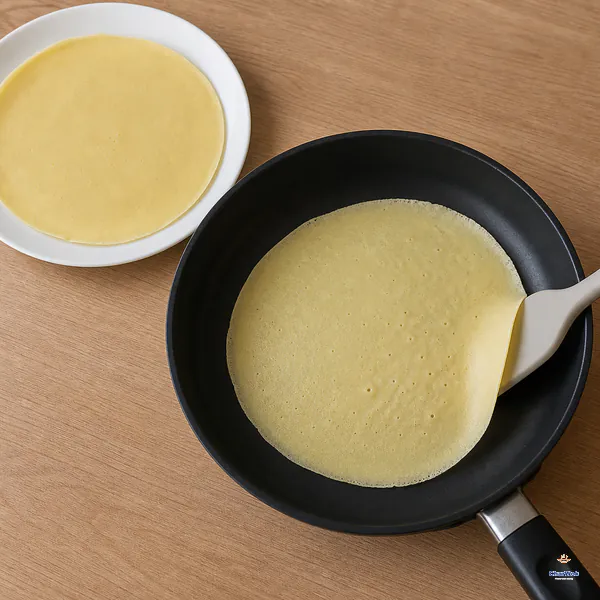
Cook for about 1 minute, until the surface is matte with small pinholes; remove it without flipping and place it smooth-side down.
- Flip it out, do not flip it over. The moment the top looks dry, slide a thin spatula under the crepe and lift it onto a plate. There is no second side. Cooking both sides dries the crepe out and makes it crack when you fold it. The cooked crepe should feel like soft, slightly tacky skin.
- Stack, smooth side down. Lay each finished crepe cooked (shiny) side down on the plate, so the raw-feeling top of one crepe does not stick to the cooked bottom of the next. Do not grease between them; they will not stick if you got the side right. Repeat until the batter is gone. You should get about twelve.
- Let them cool completely. Warm crepes melt the cream on contact. Spread the stack out on a clean plate or tray and leave it until they are at room temperature, about 15 minutes.
The cream, and the case for restraint
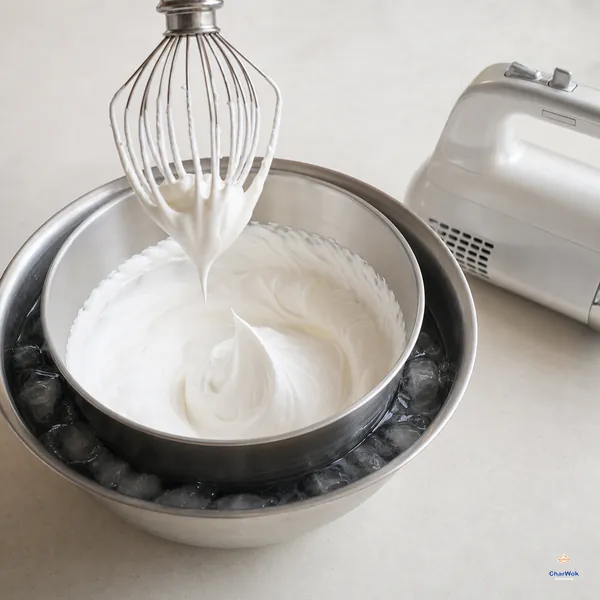
Keep the bowl cold and whip until the cream holds a firm, upright peak; stop before it turns grainy or separates.
While the crepes cool, whip the cream. Pour 300 ml cold heavy cream into a cold metal or glass bowl with ½ tsp vanilla and ½ Tbsp powdered sugar. Whip to stiff peaks: when you lift the whisk, the peak should stand straight up and not flop. Stop the instant you reach stiff peaks. Go past it and the cream turns grainy and eventually separates into butter and buttermilk, which has happened to me more than once when I got distracted by the crepes.
Note the sugar: half a tablespoon for a whole cup and a quarter of cream. That is deliberate. Hong Kong mango pancakes are not meant to taste like frosting. The cream is a cool, fatty counterweight to the mango; if you sweeten it like Western whipped cream you bury the fruit. If you have a sweet tooth, add another half tablespoon, but I would not go further.
Wrapping the pillows
- Lay it smooth side down. Place one cooled crepe on a cutting board with the shiny cooked side facing down and the slightly matte, raw-feeling side facing up. The smooth side becomes the outside of the pancake, which is what you want people to see.
- Build the mound. Spoon about 2 tablespoons of whipped cream into the center and spread it into a rough square a little smaller than your mango slice. Set a slab of mango, about 1.5 cm (½ inch) thick, on top of the cream. Press gently so the cream rises around the mango and will seal the folds.
- Fold like an envelope. Fold two opposite edges of the crepe in over the filling, then fold the remaining two edges over those to make a neat square parcel. The cream should squish together at the seams and hold them shut. Flip the parcel over so the seams are on the bottom and the smooth, unbroken face is up.
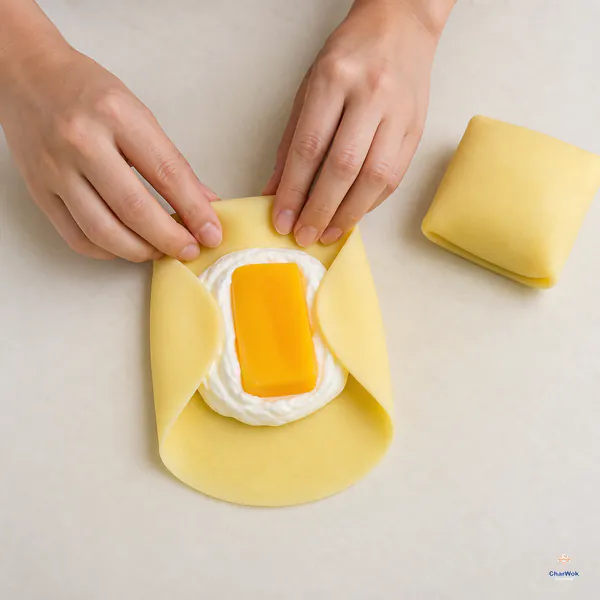
Top about 2 tablespoons of cream with one 1.5 centimetre mango slab, fold all four sides into a pillow, and turn it seam-side down.
- Repeat, then chill. As you finish each one, set it seam-down on a serving plate. When all twelve are wrapped, cover the plate loosely and refrigerate at least 30 minutes, ideally an hour. This does two things: the cream firms back up so the pancakes hold their shape when you cut them, and the crepe relaxes and stops trying to unfold.
It is worth saying plainly: a mango pancake is meant to be served cold and eaten the day it is made. The dessert-shop version sitting in the cold case works because it sells fast. At home, the clock is similar.
When things go wrong
| Problem | Why it happened | The fix |
|---|---|---|
| Crepes tear when you fold them | Overcooked, or cooked on both sides. Or batter too thin. | Cook one side only, pull them off the moment the top turns matte. Add 1 tsp flour to the next batch. |
| Crepes brown and crisp at the edges | Heat too high, or pan not nonstick. | Drop to the lowest heat that still sets the batter. A properly seasoned or Teflon pan needs no oil. |
| Crepes blister and lift off the pan in bubbles | Batter over-aerated, or poured into a too-hot pan. | Let batter rest 10 min after whisking to kill foam. Pour into a warm, not hot, pan. |
| Batter is full of lumps | Cornstarch or powdered sugar added without sifting. | Strain through a fine sieve. Always sift the dry into the wet, never the reverse. |
| Whipped cream is runny or weeping | Under-whipped, over-whipped, or cream too low in fat. | Use 36%+ cream, cold bowl, whip to stiff peaks and stop. If over-whipped, fold in 2 Tbsp fresh cold cream to smooth it. |
| Folded pancakes unwrap in the fridge | Not enough cream at the seams, or crepe still warm when folded. | Cool crepes fully. Press a little extra cream into each seam as you fold. |
| Mango fibers poke through the wrapper | Wrong mango variety, or untrimmed flesh. | Use Ataulfo, or score and slice the flesh off the skin to leave fibers behind. |
| Pancakes look soggy the next day | Cream and mango juice soaking into the crepe overnight. | Eat same day. Wrap each pancake individually in cling film if you must keep them. |
Variations worth making
The crepe-and-cream template is endlessly adaptable, and Hong Kong shops rotate through them seasonally. A few that genuinely work at home:
- Durian pancake. The original variation and the one purists argue is better than mango. Replace the mango with about 1 tsp of soft, ripe durian pulp per pancake. The cream tames the sulfur and lets the custardy fruit come through. Not for guests who have not consented.
- Strawberry or mixed berry. Hull and halve small sweet strawberries, or use a mix of raspberries and blueberries. Berries are less sweet than mango, so bump the cream sugar to 1 Tbsp.
- Banana and Nutella. A concession to children and to the fact that it is delicious. Thin spread of Nutella on the crepe, half a banana, then the cream.
- Passionfruit cream. Fold 1 Tbsp passionfruit pulp (seeds and all) into the whipped cream and skip the fruit chunk. Tart and tropical, closer in spirit to a mango sago than to the original.
What to serve alongside
Mango pancakes are rich and cold, so the rest of the table should lean light and warm. After a dim sum spread they are a natural closer, the way shops serve them. At home they pair well after something savory and brothy. A bowl of egg drop soup or a clean steamed dish like Cantonese steamed fish leaves room for the sweetness without competing with it.
For a fully Cantonese dessert table, you could put these next to ginger milk curd (warm, spicy, the opposite temperature and flavor profile) and a plate of almond cookies for crunch. The contrast of cold-creamy, warm-soft, and dry-crumbly is what makes a Cantonese dessert course feel complete rather than just sweet.
Storing and reheating
Do not reheat these. Heat melts the cream and turns the whole thing into a puddle. They keep, loosely covered, in the fridge for about 24 hours, but day-one texture is noticeably better than day-two. For best results, wrap each finished pancake individually in cling film (this is what shops do) and eat within a day.
You can make the crepes a day ahead. Stack them smooth-side-down with a sheet of parchment between each, wrap the stack tightly, and refrigerate. Bring them to room temperature before filling so they fold without cracking. The cream and mango should be done the day you serve.
The one thing to remember
If you forget everything else: cook the crepes on one side only, on low heat, until the top just turns matte. Everything else, the wrapping, the chilling, even the mango variety, is adjustable. That single decision is what separates a crepe that folds like silk from one that cracks down the middle while you stand there holding a spatula and a lot of mango juice. I learned it the hard way. You do not have to.
Frequently asked questions
Can I make the batter the night before?
Yes. Cover and refrigerate up to 24 hours. The flour fully hydrates and the crepes come out even smoother. Whisk gently before cooking; the cornstarch settles.
Why cook only one side of the crepe?
The second side never touches the pan, so it stays soft and slightly tacky. That tackiness is what lets the crepe fold around the filling without splitting. Cooking both sides dries the wrapper and makes it brittle.
Can I use a blender instead of a whisk?
You can, briefly. Blend only until combined, then strain. A blender whips in too much air if you run it long, and aerated batter makes blistered, holey crepes.
Is custard powder necessary for the yellow color?
No. Plain cornstarch gives a paler crepe, and the mango carries the yellow anyway. Custard powder just deepens it. Avoid liquid food coloring, which leaves a flat, artificial tint.
Can I make these dairy-free?
Yes, with compromises. Use coconut milk in the batter and whip the solid cream scooped from the top of a chilled full-fat coconut milk can, sweetened and vanilla-ed the same way. The flavor is different but good, and the technique is unchanged.